Independent comparisons. We may earn from shop links. More info

Electric or water underfloor heating thermostat

Updated: October 2026

You can hear water in the manifold cupboard, or you can see a thin mat under the tile adhesive, and you are not sure which wall stat belongs to which. An electric or water underfloor heating thermostat is not one product with two modes. A mat needs a contact that can carry the heating current, plus a floor probe. Pipes need a call to an actuator or a wiring centre, at actuator current, not at mat current. The eleven stored rows are on the [underfloor heating thermostat comparison](/hub/thermostats/underfloor-heating-thermostat). The checks that come before any brand name are on the [buying guide](/hub/thermostats/underfloor-heating-thermostat/sub/underfloor-heating-thermostat-buying-guide). This page only sorts the heat source. A qualifying purchase through our links can earn a commission at no extra cost to you.

You can hear water in the manifold cupboard, or you can see a thin mat under the tile adhesive, and you are not sure which wall stat belongs to which.

Our top picks

On this page

Mat or pipes

Look at what is already in the floor before you look at an app logo. An electric mat or a foil heater is a cable or a film bonded under the finish, fed from a wall controller, usually on its own circuit with a 30 mA RCD as Warmup specifies for its mats. You will not find a manifold, a circulating pump, or actuator heads on a brass bar. Warm-water underfloor heating is the opposite picture: pipes in the screed or in panels, a manifold with little motorised heads, and a boiler or heat pump connection. The wall stat in that house often does not switch the full heating load. It asks a wiring centre to open a valve. If you are replacing a failed controller and you never saw the install, the old unit’s manual is the cleanest clue. A rating plate that says 16 A and a floor sensor in conduit points at a mat. A cable that disappears towards a wiring centre, with several thin actuator leads, points at water. Guessing from the word underfloor on a new listing is how a Meross electric stat ends up in front of a manifold that never opens. A mat is a load. Pipes are a valve.

What an electric mat needs

The stat for a mat has to switch the current the mat draws, or it has to drive a contactor that switches that current. Warmup’s own FAQ says that once their electric heaters total more than 16 A, one thermostat can still be used if it controls a contactor. Sixteen amps at 230 V is about 3,680 W. That is the electric figure. It is not the figure for a manifold head. In this stored set a 16 A line is printed on the KETOTEK dial, the M6, the M9.716, the KTF0155A, and the KTF0163A. The GLOGLOW states 16 A and 3,600 W. The KTF0172A states 3,680 W and leaves amps unstated. Denash puts 16 A in the title only. The DEWIN wattage line says 3,600 W without an amp figure. The Meross MTS205 and MTS215 leave the heating load unstated. On the MTS205 the wattage field says 5 W, which is not the mat. Electric mats also need the floor probe in the control loop. Drayton’s Wiser note, for its own electric switch rather than for these ASINs, requires a floor sensor on the electric side. Heatmiser’s electric-floor guidance forbids air-only control. A stat that only watches the air can keep calling for heat after the tile is already hotter than the finish allows. The floor sensor page is where ohms and the 27 °C and 29 °C surface figures belong. Both Meross bullets say the product is for electric floor heating, not water-based. A high star line does not move them onto the pipe side.

What water pipes need

A water system wants a call, not a 16 A heating contact. The usual domestic head is a normally closed actuator on the manifold. The Underfloor Heating Company describes that head as the part that opens the loop. Actuators are sold as 230 V or 24 V, and those voltages are not interchangeable. Choosing and landing that voltage is electrician work. This page names the fork and stops before the terminals. Who can fit a thermostat in the UK covers who signs that work. The wiring centre behind those heads is a different current again. Heatmiser’s UH6-class centres are 230 V units whose actuator relays are about 3 A each, with a total load around 5 A, because they are switching actuators, a pump, and a boiler enable. Three amps is the right order of magnitude for a valve and the wrong order for an electric mat. Putting a mat’s live through a wiring-centre relay sized for actuators is how that relay fails. Putting a 16 A mat stat across a 24 V actuator coil is how the coil fails. You may still want a wall stat in the room, so the call follows the room rather than a cupboard dial. That stat has to speak the wiring centre’s language: a volt-free contact, a 230 V call, or whatever that centre’s diagram demands. None of the eleven listings here is a multi-zone wiring centre. Only one bullet even claims the actuator job.

Where these 11 listings sit

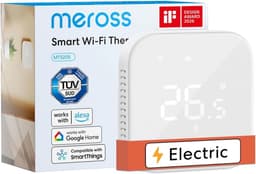
Electric, and explicit that water is out: the Meross MTS205 at £49.99 and the MTS215 at £50.99. Both need live and neutral. Neither states a heating-load current. They can be a sensible electric-mat choice when you accept that gap, which is the judgement on the best underfloor heating thermostat page. They are the wrong buy if the cupboard contains a manifold. Electric with 16 A stated: the KETOTEK dial at £14.99, the M6 at £24.99, the M9.716 at £25.99, the KTF0155A at £44.99, and the KTF0163A at £49.99. The GLOGLOW states 16 A and has no reviews. The Denash title says 16 A and a UK review says the unit does not connect to the internet. Those are electric-side listings with very different evidence. They are not water controllers because a wattage line is large. Water, inside this set, is one sentence. The KETOTEK M6 bullet says electric heating devices or an on/off valve actuator for water-based heating. It is still a 16 A programmable wall stat with a 3 m probe, rated 4.2 from 271 reviews, not a manifold controller and not a 24 V supply. If your actuator is 24 V, the M6 does not become 24 V because the bullet says water. If you have several loops, you still need the wiring centre the install already uses. A UK review on the KTF0163A says two of three units were on wet underfloor heating. Record that as a review. The listing heat source remains electric underfloor heating. A reviewer can wire a stat to a call terminal and be lucky. That does not add an actuator claim to the bullet.

Common questions

How do I tell a mat from water pipes before I buy?
A mat is a heater under the finish, fed at mains from a wall stat, usually with a floor probe in the adhesive or the screed. Water pipes end at a manifold with actuator heads and a link to a boiler or heat pump. If the old controller was marked 16 A and had a floor sensor, start from the electric side. If the cable run goes to a wiring centre, start from the water side. The listing title alone will not tell you.
Can a Meross electric stat run a water manifold?
The stored bullets say no. The MTS205 and the MTS215 are for electric floor heating, not water-based systems. They need live and neutral, and they do not state a heating current. A manifold needs an actuator call at the actuator’s voltage. In this set, that sentence appears on the M6, not on Meross.
Which listing in this set mentions a water actuator?
The KETOTEK M6, at £24.99. The bullet says electric heating devices or an on/off valve actuator. It is one wall stat with a weekly programme and a 16 A claim. It is not a multi-zone wiring centre, and it does not state 24 V. Every other row in the file is electric floor heating, and the two Meross rows say they are not for water.
Why is 16 A the electric figure and not the actuator figure?
Sixteen amps is the order of an electric mat contact, about 3,680 W at 230 V. Actuator heads and wiring-centre relays are far smaller. Heatmiser’s centre table is about 3 A per actuator relay and about 5 A total, because those relays switch valves, a pump, and a boiler enable. Using the mat figure on the valve side, or the valve figure on the mat side, mismatches the contact to the load.
Can one stat do both?
Not by a mode switch in this set. The M6 bullet is the only one that names both electric heating devices and an on/off water actuator. Even then it is still one contact, not a mat and a manifold at the same time. The Meross listings exclude water. If you have a mat in the bathroom and pipes downstairs, those are two controls, sized separately.
Do I need a wiring centre as well as a wall stat?
For several water loops, yes, you typically already have one, or you need one. The centre takes the room call and drives the actuators, the pump, and the boiler enable. None of these eleven amazon listings is that centre. A single-room mat does not need one. It needs a load-rated stat and a probe. Actuator voltage, 230 V or 24 V, is electrician work. If the voltage is unknown, stop before you order a coil to match a guess.

Related pages

Sources

Public UK sources for notifiable electrical work, floor-surface limits, and electric floor heating. Listings are the amazon.co.uk captures for these eleven ASINs on 15 October 2026, not a live reload. Prices on amazon.co.uk move.

  1. Approved Document P (retrieved 15 October 2026)
  2. GOV.UK competent person schemes (retrieved 15 October 2026)
  3. Bath and North East Somerset, electrical safety (retrieved 15 October 2026)
  4. IET Wiring Matters, section 753 (retrieved 15 October 2026)
  5. NHBC underfloor heating (retrieved 15 October 2026)
  6. Warmup Pro floor finishes (retrieved 15 October 2026)
  7. Drayton Wiser underfloor heating note (retrieved 15 October 2026)
  8. Heatmiser neoStat-e V2 (retrieved 15 October 2026)