Independent comparisons. We may earn from shop links. More info

Underfloor heating floor sensor

Updated: October 2026

The old controller is dead and the thin cable still disappears into the tile adhesive. You would like to keep that underfloor heating floor sensor, screw on a new stat from this amazon.co.uk set, and set a limit that will not cook a vinyl floor. Reuse is reasonable only when the resistance matches. The limit you then type is a surface temperature for the finish, not the top of a 90 °C menu. The eleven rows are on the [underfloor heating thermostat comparison](/hub/thermostats/underfloor-heating-thermostat). A qualifying purchase through our links can earn a commission at no extra cost to you.

The old controller is dead and the thin cable still disappears into the tile adhesive.

Our top picks

On this page

What the floor probe is for

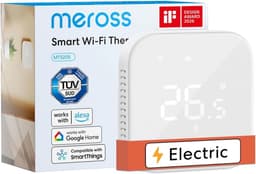
The probe is the stat’s view of the floor, not a second opinion on the room. An electric mat can keep heating after the air at the wall has reached the setpoint, because the tile or the timber is what stores the heat. Heatmiser’s Touch-N guidance, cited for electric floors, says air-only control must not run electric underfloor heating. Use the floor sensor alone, or use air and floor together so the air calls for heat and the floor sensor caps it. A water system is less brutal about this, because the water temperature is already limited at the manifold, but the surface cap still applies to the finish. Whether the floor is a mat or pipes is the electric or water fork. Air and floor are not the same reading. The MTS205 claims about ±0.5 °C and a range of 5 to 35 °C, and a non-UK review calls the built-in air sensor unreliable unless the external sensor is used. That is one review, not a calibration certificate. The KETOTEK dial uses the air sensor to pause at the setpoint and the floor probe as the high limit. The M6 and the M9.716 let you choose air, floor, or both. Choosing air on an electric mat because the probe wire looks awkward is the option those Heatmiser notes forbid. The cable in the box is not automatically the cable in the floor. If the old probe is in a conduit between the mat runs, you can pull a replacement later. If it was taped into the adhesive with no conduit, a dead probe is a floor-up repair, not a menu setting.

10 kΩ and the other values

Floor probes are usually NTC thermistors. The number that has to match is the resistance at 25 °C, not the length printed on the sleeve. Ten kilohms at 25 °C is the common UK value. It is not the only one. Shops and replacement notes also list 6.8 kΩ, 12 kΩ, 15 kΩ, and sometimes 33 kΩ. DEVIreg’s own display stat defaults to NTC 15 kΩ at 25 °C and can be set to other values, including 10 kΩ. Total Tiles sells a 10 kΩ probe and says it will not stand in for a DEVI 15 kΩ sensor. A stat that expects 10 kΩ will misread a 15 kΩ probe. The floor can run too hot or refuse to heat. Only one listing in this stored set prints that number. The KETOTEK KTF0163A includes a 2.5 m NTC 10 kΩ probe. Everything else is vaguer. The KETOTEK dial, the M6, and the M9.716 ship a 3 m probe and do not state ohms. The GLOGLOW and the DEWIN describe a cable of about 2.9 m. The DEWIN specification line also says 3 m, so even the length is not stable inside one file. The MTS205 includes one sensor and talks about air and floor sensors, with no ohms. The MTS215 calls the external sensor optional and still puts one sensor in the box. The Denash claims internal and external sensors and lists only the thermostat as included. A UK review of the KTF0172A replaced an Aube TH232, first on the old probe and later, after a retile, on a new 10 kΩ NTC. That is one install. It does not mean every Aube probe is 10 kΩ. A Swedish review of the DEWIN could not use the original probe because the impedance differed. Sensor wires are generally not polarity-sensitive when you are joining a matching probe. It does not help when the ohms differ. If you cannot identify the pair, stop. This page does not include a meter procedure on live terminals.

27 °C and 29 °C

The limit you type is a surface temperature, not the menu maximum, and not the room setpoint. NHBC’s underfloor-heating note, drawing on BS EN 1264-2, limits floor surface temperature to 29 °C, with lower maxima for some finishes. The note is written around water-based design. The surface cap is still the figure worth using when you are asking what comfortable means underfoot. Warmup’s professional finish guidance puts that 29 °C in occupied rooms at about a 9 °C rise over a 20 °C room. So 29 °C is the floor face, while the air at the stat might be near 20 °C. Setting the air setpoint to 29 °C is a different, hotter request. Timber, vinyl, and laminate makers often want 27 °C at the contact face. Quick-Step’s UK laminate FAQ states a maximum contact temperature of 27 °C. Tile and stone usually tolerate the higher comfort surface, still inside the 29 °C cap. IET Wiring Matters has used 35 °C as an example surface limit and 80 °C as an overheating cap to design out. Do not collapse 27, 29, 35, and 80 into one safe setpoint. The KETOTEK dial’s floor-limit field is 25 to 55 °C, and the listing also says the probe keeps the floor from exceeding 50 °C. Fifty degrees is inside that menu. It is not a timber target. The GLOGLOW prints 25 to 55 °C as well. The M6 and the M9.716 setpoint fields run from 5 to 90 °C. That range is not a target. If the finish maker says 27 °C, a floor limit at or below 27 °C is the setting, where the stat actually offers a numeric cap. Several rows only say high and low protection, or that wood will not overheat, with no degree figure. You cannot invent a 27 °C cap on a listing that does not print one. The buying guide is where you decide whether that missing number is acceptable before you order.

When the old probe has to go

If the resistance does not match, do not hope the floor will average it out. A 15 kΩ DEVI probe on a stat that expects 10 kΩ is a mismatch, not a small calibration offset. The M9.716 reviews mention an offset for trimming a probe that is already the right type. An offset is not a way to turn 15 kΩ into 10 kΩ. Fit the probe that the new stat is built for, which in this set is a named 10 kΩ part only on the KTF0163A, or use the probe that came in the box if you can get it into the floor. That second option depends on the conduit. A probe in a duct between the heater cables can be withdrawn and replaced. A probe buried with no duct cannot. Chasing it out is a floor repair. Trade guides place the sensor between runs, in conduit, for this reason. Call an electrician if you cannot identify the probe pair, if the RCD trips when the stat is powered, or if the probe is buried and dead. Also call one if the job has become a new circuit or work in a bathroom special location. This page does not tell you how to meter a live conductor. Once the probe matches and the limit matches the finish, the weekly times are a separate job on the how to set an underfloor heating thermostat page.

Common questions

Can I keep the probe under the tiles?
Yes, when it is the same resistance the new stat expects, and when it still reads. Length in the new box does not prove that. In this set only the KTF0163A prints NTC 10 kΩ. A DEWIN review could not reuse the original probe because the impedance differed. If the old cable is unlabelled, treat a straight swap as unproven.
What does 10 kΩ at 25 °C mean?
It is the probe’s resistance at 25 °C, the figure manufacturers use so a stat can turn ohms into temperature. NTC resistance falls as the floor warms. A 10 kΩ probe and a 15 kΩ probe are not interchangeable, even if both are 3 m long. Matching that 25 °C value is the check. A room-temperature guess on a meter is not a procedure this page will write out.
Which listings in this set actually print 10 kΩ?
The KETOTEK KTF0163A, on a 2.5 m probe in the box. The other KETOTEK probes are 3 m with no ohm value, or, on the KTF0155A, an empty included list. Meross, DEWIN, GLOGLOW, Denash, and the KTF0172A describe a sensor without printing 10 kΩ. A review that later fitted a 10 kΩ probe is not the same as a listing that states it.
What if the old probe was a DEVI 15 kΩ?
Do not assume the new stat can read it. DEVIreg defaults to 15 kΩ at 25 °C, and a shop 10 kΩ spare is sold specifically because it will not match that probe. None of these eleven listings say they accept 15 kΩ. Unless the new manual lists 15 kΩ as a selectable sensor, plan on the probe that came with the stat, or on a confirmed 10 kΩ part where the listing prints one.
Should an electric floor run on the air sensor only?
No. Heatmiser’s electric-floor note says air-only must not control electric underfloor heating. Use floor only, or air and floor together, so the mat cannot keep heating once the surface is hot. The M6 and M9.716 offer that choice. Leaving them on air because the probe wire is spare is the configuration to avoid.
Is 29 °C the room setpoint?
No. The 29 °C figure from BS EN 1264-2, as NHBC quotes it, is a floor surface limit. Warmup’s finish note treats it as about 9 °C above a 20 °C room. The air setpoint can sit near 20 °C while the floor face is the thing limited to 29 °C. Typing 29 into the room setpoint asks for a warmer room than that comfort example describes.
Why do wood floors cite 27 °C?
Makers of laminate, vinyl, and timber often cap the contact temperature at 27 °C, below the 29 °C general comfort surface. Quick-Step’s UK FAQ is one public example for its laminate. Follow the board you actually laid. A menu that runs to 90 °C, on the M6 and the M9.716, is the range, not the target. If the stat has no numeric floor limit, you cannot set 27 °C as a cap from the listing text alone.

Related pages

Sources

Public UK sources for notifiable electrical work, floor-surface limits, and electric floor heating. Listings are the amazon.co.uk captures for these eleven ASINs on 15 October 2026, not a live reload. Prices on amazon.co.uk move.

  1. Approved Document P (retrieved 15 October 2026)
  2. GOV.UK competent person schemes (retrieved 15 October 2026)
  3. Bath and North East Somerset, electrical safety (retrieved 15 October 2026)
  4. IET Wiring Matters, section 753 (retrieved 15 October 2026)
  5. NHBC underfloor heating (retrieved 15 October 2026)
  6. Warmup Pro floor finishes (retrieved 15 October 2026)
  7. Drayton Wiser underfloor heating note (retrieved 15 October 2026)
  8. Heatmiser neoStat-e V2 (retrieved 15 October 2026)