Independent comparisons. We may earn from shop links. More info

How to set an underfloor heating thermostat

Updated: October 2026

The stat is already on the wall, the mat or the pipes are in, and the menu is offering numbers you do not trust. This is how to set an underfloor heating thermostat for the week you actually live, and for a floor limit that matches the finish, without opening a terminal. Button names differ between KETOTEK, Meross, and the trade manuals, so the steps below are what the functions do, not a shared key sequence. The eleven listings are on the [underfloor heating thermostat comparison](/hub/thermostats/underfloor-heating-thermostat). A qualifying purchase through our links can earn a commission at no extra cost to you.

The stat is already on the wall, the mat or the pipes are in, and the menu is offering numbers you do not trust.

Our top picks

On this page

Dial or programme

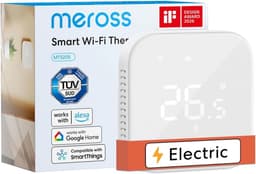
Three rows in this stored set have no weekly pattern at all. The DEWIN, the GLOGLOW, and the KETOTEK dial at £14.99 give you on, off, and a temperature. Reviews of that KETOTEK dial say it is the wrong unit if you wanted a timer. Their setpoint scales run from 5 to 40 °C. You can turn the dial down when you leave the house. You cannot store Monday separately from Saturday. If there is no weekly pattern, stop looking for one in a hidden menu. The wired programmers are the KETOTEK M6 and the M9.716. Both list 5+2, 6+1, and 7+0, plus a manual hold. A 5+2 pattern means one timetable for the five weekdays and a second timetable for the two weekend days. A 6+1 pattern keeps Saturday with the week and isolates Sunday. A 7+0, or 7-day, pattern lets each day differ. The KETOTEK Wi-Fi rows add up to six periods inside those patterns, and a holiday mode. The Meross MTS205 and MTS215 claim up to eight periods a day. Child lock is claimed on the programmers and the Wi-Fi rows, not on the three dials. Set times only on a unit that lists a pattern. Electric mats warm the surface more quickly than a thick screed with water pipes, so the afternoon period often needs to start earlier on a screed than on a mat. The listing will not print that lag for your floor. You learn it from the first week. Model choice stays on the best underfloor heating thermostat page.

Comfort, setback, and manual hold

A programme is a pair of temperatures, not a single on/off alarm clock. Trade manuals, including the Warmup Tempo guide, describe comfort periods and setback periods. Comfort is the surface and room you want while you are there. Setback is a lower hold so the floor is not stone cold at the next start, without paying for a full afternoon while the house is empty. On a six-period KETOTEK day you might use three comfort blocks and three setbacks. On a Meross day with eight periods you have more edges, which helps if someone is home at lunch and gone again. A manual hold, sometimes called a constant or a temporary override, freezes the setpoint until you release it or until the next period, depending on the menu. Use it when you are ill at home on a Wednesday and the weekday setback would otherwise drop the floor. Do not leave a hold on for a fortnight and then blame the programme. The M6 and M9.716 both list a manual mode beside the weekly patterns. Reviewers of the M6 say the paper manual makes the first programming session a slog. Change one period, check that the floor responds the next morning, and only then copy the pattern across the week. A hallway mat on the KETOTEK dial has no periods, so you set one number and accept that it holds all day. The same hallway on an M9.716 can hold a milder setpoint from 09:00 to 16:00 on weekdays and a higher one from 16:00 to 22:00. The 90 °C top of that menu is not either of those numbers.

Holiday and open-window pause

Holiday, where the listing claims it, parks the weekly pattern and holds a lower or frost setting for a stretch of time, then returns to the programme. The KETOTEK Wi-Fi rows include holiday mode. Trade manuals such as Nu-Heat’s neoAir and Cosytoes’ Curve describe the same idea: frost protection while you are away, then the normal week when you are back. These amazon listings do not print a maximum number of days. Do not assume a 30-day cap because another brand’s booklet has one. If you are away for a weekend only, a manual hold is often enough. One KTF0163A review said settings were still there after the unit was switched off for the summer. That is memory, not a holiday mode, and it is not promised on the dials. Frost protection and holiday mode is the wider note on leaving the heating low. Open-window pause is claimed on the Wi-Fi KETOTEK rows and on both Meross rows. It is not claimed on the dials, the M6, or the M9.716. Trade manuals describe a rapid drop in room temperature, then a pause of about 15 minutes so the mat is not replacing heat that is pouring out of a window. That 15-minute figure is a trade example. It is not printed on these amazon listings. A Meross review reports that the detection worked in practice. It does not publish the degrees of drop or the minutes of wait. If you ventilate for an hour, the pause may end while the window is still open. Shut the window, or use a manual hold, if you are airing the room for longer than a brief drop.

Common questions

How do I set a 5+2 schedule?
On a stat that lists 5+2, you enter one set of periods for Monday to Friday and a second set for Saturday and Sunday. Each period is a start time and a comfort or setback temperature, not a single daily on time. The M6, the M9.716, and the KETOTEK Wi-Fi rows offer that pattern. The three dials do not. Change one weekday, confirm the floor responds the next day, then copy it.
What is a manual hold for?
A manual hold keeps one temperature and ignores the weekly pattern until you cancel it or the next period takes over, depending on the menu. Use it for an odd day at home or a late evening. The M6 and M9.716 list a manual mode beside their weekly patterns. A hold left on for weeks is no longer a programme. It is a dial with extra buttons.
What does holiday mode do?
Where it is claimed, holiday mode parks the weekly pattern and holds a lower or frost setting, then returns to the programme. The KETOTEK Wi-Fi listings include it. They do not print how many days you can set. A weekend away can be a manual hold if you cannot find a holiday screen that matches the paper guide.
How does open-window pause decide a window is open?
The listings that claim it, the Wi-Fi KETOTEK rows and both Meross rows, describe a pause when the room temperature drops quickly. They do not print the size of the drop or the length of the pause. Other UK stats often pause for about 15 minutes, and that figure is a trade example, not a specification of these ASINs. A long airing can outlast the pause.
What temperature should I type in for a wood floor?
Use the floor-finish limit, commonly 27 °C contact temperature in maker guidance such as Quick-Step’s laminate FAQ, and keep the air setpoint at a normal room temperature. Do not type the top of a 90 °C menu. If the stat has no numeric floor limit, you cannot set 27 °C as a cap from this page’s listings.
The dial has no programme. What can I set?
On the DEWIN, the GLOGLOW, and the KETOTEK dial you set on or off and a temperature between 5 and 40 °C. The KETOTEK dial also has a floor-limit range of 25 to 55 °C. You cannot store weekdays, a holiday date, or an open-window pause, because those claims are absent. If you need times, you bought the wrong row.

Related pages

Sources

Public UK sources for notifiable electrical work, floor-surface limits, and electric floor heating. Listings are the amazon.co.uk captures for these eleven ASINs on 15 October 2026, not a live reload. Prices on amazon.co.uk move.

  1. Approved Document P (retrieved 15 October 2026)
  2. GOV.UK competent person schemes (retrieved 15 October 2026)
  3. Bath and North East Somerset, electrical safety (retrieved 15 October 2026)
  4. IET Wiring Matters, section 753 (retrieved 15 October 2026)
  5. NHBC underfloor heating (retrieved 15 October 2026)
  6. Warmup Pro floor finishes (retrieved 15 October 2026)
  7. Drayton Wiser underfloor heating note (retrieved 15 October 2026)
  8. Heatmiser neoStat-e V2 (retrieved 15 October 2026)