Gas safe thermostat installation: who can do the job
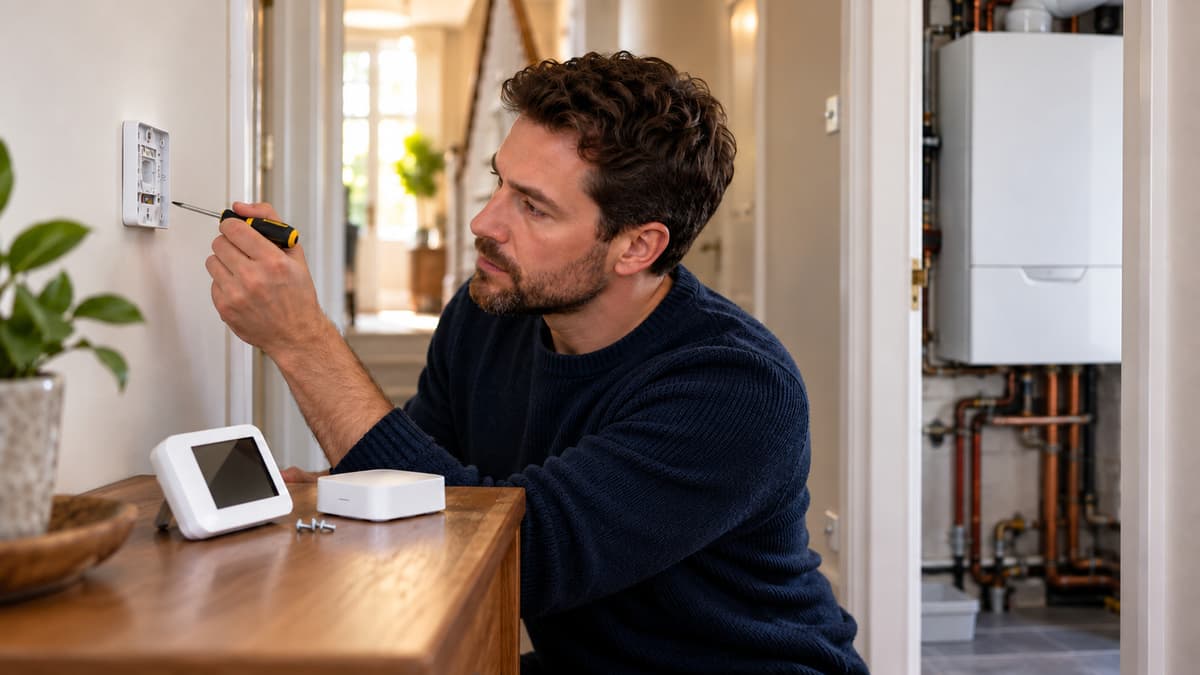
Gas safe thermostat installation splits a wall stat from the boiler. Employed domestic gas work needs Gas Safe. This Part P reading is the England text.
On this page

You have the new thermostat on the hall table and a screwdriver in your hand. The old one is a back box on the wall. The leaflet also shows a receiver, and that picture has the boiler panel off. A gas safe thermostat installation is those two pictures together. They are not the same job. One is electrical work at the wall unit. The other is work at the boiler. Calling every swap gas work stops a like-for-like change you might be competent to do. Calling none of it gas work is how a receiver gets fitted with the case open.
The split on this page comes from public UK sources. The Health and Safety Executive's domestic gas FAQ says anyone employed on domestic gas work must be Gas Safe registered, and it distinguishes wet work on pipes from work on the boiler. That FAQ does not name thermostats. Approved Document P, in the 2013 England text, describes notifiable electrical work as a new circuit, a consumer unit, or circuits in a special location. GOV.UK's page on when you do not need building-regulations approval says most repairs fall outside approval, and the exceptions include a replacement heating system. On the government professions page, the registered gas engineer is a UK profession and that scope includes Northern Ireland. The Part P text used here is England. The top-pick price is the stored amazon.co.uk figure in our Alexa thermostat comparison. We did not lab-test a thermostat or open a boiler. A qualifying purchase can earn a commission at no extra cost to you.
In short
The wall unit and the boiler receiver are different jobs. Anyone employed to do domestic gas work must be Gas Safe registered, and that profession's UK scope includes Northern Ireland. In England, the 2013 Approved Document P text treats a new circuit, a consumer unit, and circuits in a special location as notifiable, while a like-for-like wall swap remains electrical work that has to be safe under BS 7671.
The wall unit and the boiler are different jobs
The wall unit is the box you can already see. A like-for-like swap means the new stat uses the existing back box, the boiler panel stays on, and you are not adding a circuit. That is still electrical work. It has to be safe under BS 7671 when the heating comes back on. Isolate the mains before you take the stat off the wall, and only if you are competent to isolate that circuit and reinstate it. Turning the programmer to off, or pulling the batteries out of a wireless sensor, is not isolation. If you cannot find the right breaker, you stop. This page will not give you a wiring sequence, a cable colour, or a terminal name.
The boiler job starts when the next screw is on the boiler panel, or when the new kit needs a receiver among the boiler controls. Do not open the boiler to see whether the wires match. The HSE FAQ does not mention a thermostat, a receiver, or a back box. You cannot treat that gap as a ruling.
A wireless starter kit puts both pictures on one leaflet. Our top pick is the tado V3+ wireless starter kit, ASIN B08LP1LS5T, stored at £57.50 on the Alexa thermostat comparison. That row includes the sensor, the wireless receiver, and the Internet Bridge. The top pick is a shop judgement. It does not license anyone to fit the receiver, and it is not a Gas Safe card. If the leaflet shows the receiver at the boiler, the sensor in your hand is half the job. The Alexa thermostat comparison holds that row. The Alexa thermostat buying guide is for matching boiler type, wiring, and a hub before a panel opens.
A battery sensor still leaves the receiver
The round stat that takes batteries is often only the wall part. The receiver is the part the leaflet puts at the boiler. Hive's shop line, for anyone asking whether they can fit a Hive thermostat themselves, calls the fitting competent electrical work, or a job for a tradesperson. That line is retail copy. It is not the HSE test, and it does not allow the boiler panel off. If the receiver has to go at the boiler, who can wire a boiler receiver is the Gas Safe question for anyone employed to do that domestic gas work.
Gas Safe, and what the card is for
Gas Safe is the register for people employed to do domestic gas work. The HSE domestic FAQ says anyone employed on that work must be registered. The card covers that gas work. It is not a badge for every electrical job in the house, and a thermostat carton cannot issue it. The HSE page publishes a helpline, 0800 408 5500, for questions about who can do the work. Before a boiler panel comes off, ask which business is registered and ask to see the card. This website does not look a card up, does not see your flue, and does not sign a handover.
The FAQ's word is employed. This page will not add a householder exemption the extract does not contain. If you are paying someone to do the boiler end, that person is employed on the work, and the FAQ then requires Gas Safe registration. A landlord's handyman is under the same word when the landlord employs them for domestic gas work. The HSE landlords page is about who can do that work. Doing odd jobs around the house does not replace registration. Leave the panel on if you are the tenant. The same handyman can still change a wall stat on an existing back box when they are competent for that electrical work and the boiler stays shut. Those are two different tests.
Northern Ireland is inside the UK scope of the registered gas engineer on the government professions page. The register question is not England-only. The Part P text on this page does not travel with it. This page will not invent a separate registration body for Scotland or Wales. If someone is coming to the boiler, the card should be in view before they start, in any UK nation.
Part P in England, and where that text stops
Part P, in the 2013 England approved document used here, is an electrical building-regulation text. Readers searching for a part p thermostat replacement will not find that phrase mapped for them. The notifiable work it describes is a new circuit, a consumer unit, or circuits in a special location. A like-for-like room stat on an existing circuit, outside a special location, is not those three headings. That reading is not a certificate with your address on it. The work is still electrical, and it still has to be safe under BS 7671. Being outside building-regulations approval does not mean every householder is the right person for the back box.
GOV.UK's page on when you do not need approval says most repairs sit outside approval. The exceptions include a replacement heating system. A room thermostat swap is not a replacement heating system, and it is not a new boiler. When the boiler itself is replaced in the same visit, the job has changed. The person replacing the heating system is inside the exception that page already names. Buying a stat on amazon.co.uk does not turn that boiler change into a repair of a wall box. Competent person electrical work in England is the test for the wall stat you are considering. You isolate the correct circuit, you leave the connections safe under BS 7671, and you can explain what you did. If that is beyond you, you stop, including when the job is outside the three notifiable headings. This page will not list scheme logos, and a short course is not competence on its own. A tradesperson who does this work for a living is the ordinary answer when you are unsure.
This Part P reading is not the Scottish building standard. This page will not invent the electrical rule in Wales or Northern Ireland. A shopper in Glasgow can order the same stat and still be under a different electrical regime. Ask whoever does the electrical work which standard they are using. Gas Safe's UK scope, including Northern Ireland, answers who may be employed on domestic gas work. It does not make Approved Document P a UK-wide electrical code.
Electric underfloor heating and a bathroom back box
Electric underfloor heating has no gas valve in the mat. Gas Safe is the wrong register unless a boiler is also being opened that day. A new circuit for the mat is the first notifiable heading in the England document. Naming it a thermostat swap does not change the new circuit. Replacing only the stat on an underfloor circuit that already exists sits closer to the repair GOV.UK describes, and the work must still be safe under BS 7671. Isolate the supply if you are competent. Otherwise stop.
The comparison includes an electric underfloor thermostat, the KETOTEK model stored as ASIN B0833N4ZZ3 at £44.99. That amazon.co.uk figure can move. It is a different row from the tado wireless starter. You are choosing a control for a floor circuit, not a receiver for a gas boiler. The row does not say whether your circuit is existing, new, or in a bathroom. You need that answer before the back box comes off.
A bathroom is the special location people mean by zones. Approved Document P treats circuits in a special location as notifiable in this England text. This page will not redraw the zones. A back box above the tiles is not a clearance this page will grant. Zone distances belong in the document. If the thermostat, its cable, or its back box is in a bathroom, leave it unless you are competent to judge that work. A hallway stat, clear of the bath and of an open boiler panel, is the wall job this page will separate from the boiler. A bathroom stat stays in the special-location case.
A short stop list before you touch anything
Use these stops before a screwdriver touches a screw. Each line is a reason to pause, not a wiring step.
- If you smell gas, stop the fitting. Do not open the boiler to carry on. In Great Britain, call the National Gas Emergency Service on 0800 111 999. In Northern Ireland, use the emergency number published by the local gas network, and do not guess it from the Great Britain number.
- If the next step is the boiler panel, stop. Do not open the case to see whether the wires match. Anyone you employ for that domestic gas work must be Gas Safe registered. Ask for the card first. The HSE helpline for who can do gas work is 0800 408 5500. That helpline is not the smell-of-gas number.
- If you are not competent to isolate the mains at the wall stat, stop. A programmer set to off is not isolation. Batteries out of a sensor do not isolate the receiver.
- If you are adding a circuit, changing a consumer unit, or working on a circuit in a special location such as a bathroom, you are on the England notifiable list in the 2013 document. Do not file that work as a casual like-for-like swap.
- If you are a tenant, leave the boiler panel to a registered engineer the landlord is employing. Do not start that job to be helpful.
- When the hardware is already in, the circuits are safe, and the boiler was not yours to open, the app is a later job. The setup guide covers those steps after the hardware is fitted. It is not a fitting manual for the receiver.
Keep the engineer's business name with the boiler papers if they did the boiler end. If the kit is both a wall stat and a boiler job, do the wall only when you are competent for that electrical work, and leave the boiler to the registered person you are employing.
Common questions
Is changing the wall unit gas work?
When does the receiver make it gas work?
Do I need building-regulations approval in England?
What is a special location for a thermostat?
Can my landlord's handyman do the boiler end?
Is a new circuit for electric underfloor heating notifiable?
How do I check a gas engineer's card?
What do I do if I smell gas?

Peter F. is the editor for DIY & tools at productscompared.co.uk. Comparisons in this category are checked against amazon.co.uk listings, review evidence and public UK sources.
Related articles
Boiler Plus and smart heating controls in England
Boiler Plus applies when a gas boiler is replaced in an existing English home. It does not tell you to open the case.
When to replace a room thermostat
A sticking or drifting room stat is a reason to change the wall unit. Opening the boiler is a separate job.

OpenTherm or a simple on-off control
OpenTherm and a simple on-off link are boiler protocols. Match the kit before you buy, and leave the case closed.