Independent comparisons. We may earn from shop links. More info

Wired or wireless room thermostat

Updated: October 2026

You are choosing how the thermostat reaches the boiler, and a cheaper head is often a sensor with half the system missing. Wired or wireless room thermostat is a box-contents question. A wired stat is the switch on the cable. A wireless stat is a sensor plus a receiver, and an add-on head is not that receiver. The [room thermostat comparison](/hub/thermostats/room-thermostat) lists the four amazon.co.uk products. This page follows the path from the wall to the heat source. The Products Compared editorial team updated this on 16 October 2026 from the listings, tado’s UK shop, and BEAMA’s siting note. A qualifying purchase through our amazon.co.uk links can earn us a commission at no extra cost to you.

You are choosing how the thermostat reaches the boiler, and a cheaper head is often a sensor with half the system missing. Wired or wireless room thermostat is a box-contents question.

Our top picks

On this page

What wired and wireless actually are

Wired means the thermostat and the boiler already share a cable. The dial closes the call on those conductors. You cannot carry the sensor into the lounge unless you extend the cable. Wireless means the sensor talks by radio to a receiver wired at the boiler. The receiver is the switch. Without it, the sensor can show a temperature and still leave the boiler with nothing to obey. tado X uses the starter’s receiver as a Thread border router, and the attribute block also says Wi-Fi, so it is not a plain home Wi-Fi join. Both mechanical listings here are wired.

The two wired dials in this set

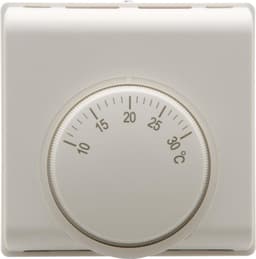
The ESI ESRTM (B00QGKSTD8) is about £13.99, with 4.4 from 1,139 ratings. The bullets say two-wire volt-free contacts and an easy-fit backplate. The included-components line has no receiver. Reviews describe swaps onto old Honeywell and Danfoss dials. An attribute line that says Wi-Fi conflicts with that mechanical object. The livager (B0FZ4Y89KP) is also wired, at about £15.99 with 3.8 from 19 ratings. It claims potential-free contacts, a two-wire cable, and a neon. One review found three wires. Another said the neon stayed off on a two-wire boiler cable, and a further buyer used a spare conductor from a three-wire stat to light it. Count the cores before you choose the livager for its lamp. Both dials stay where the cable ends.

Starter kit versus wired add-on

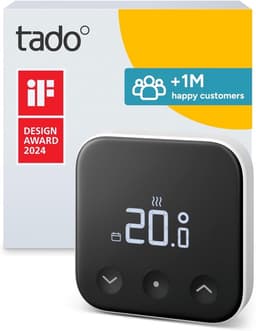
The tado Wireless Smart Thermostat X starter (B0D9QBPV51) is about £129.99, with 4.4 from 286 ratings. The box includes Wireless Receiver X, the sensor, a stand, and three AAA batteries. A bullet says no extra Bridge X is needed, because the receiver is the border router. The title still says with Bridge X. Trust the components line. You fit the receiver at the boiler and place the sensor in the room. The wired add-on (B0CWPG6G5W) is about £79.99, with six AAA batteries and no Bridge X. Matter and Thread need that bridge or another Thread border router. tado’s UK shop sells Wireless Receiver X alone at £119.99 and points new buyers to the starter. That is not an extra part for a starter that already includes the receiver.

Where the sensor can sit

BEAMA still wants a fixed stat at about 1.5 m, in free air, not above a radiator, in sun, a draught, or a corner. A wired ESI, livager, or tado head has to live at the cable. If that cable is in a poor spot, the wired choice locks the error in. The starter’s sensor can move to the room you care about. The receiver stays at the boiler, on the terminals the manual allows. These listings publish no metre figure for walls. HSE L56 leaves a consumer swap that does not open a gasway outside that part of the gas rules, and boiler replacement is Gas Safe work. Choose wired when a sound two-wire cable already ends in the right room. Choose the starter when the sensor must leave that cable and the receiver is in the box.

Common questions

What is the receiver for?
The receiver is the switch at the boiler. The wireless sensor tells it the room temperature, and the receiver opens or closes the heating call. Without it, a wireless sensor has nothing at the heat source to operate. The tado starter lists Wireless Receiver X and describes it as the border router. A separate receiver on tado’s UK shop at £119.99 shows it is its own product.
Does the tado wired add-on need anything else?
Yes, unless a Bridge X or another Thread border router is already in the house. The listing at about £79.99 includes the wired head and six AAA batteries. It excludes Bridge X. Reviews describe it as a second zone on an existing X system. For a first install, the starter is the listing that contains the receiver.
Does the tado starter include the receiver?
Yes. The included-components line lists Wireless Receiver X, the wireless temperature sensor, and three AAA batteries. A bullet says no extra hub or Bridge X is needed. The title’s with Bridge X wording conflicts with that bullet, so trust the components list. You do not also need the £119.99 shop receiver if this starter is what you are fitting.
Can I put the wireless sensor in another room?
Yes. That is the point of the sensor and stand. Place it at about 1.5 m in free air, in the room that should stop the boiler, off a radiator and out of sun. The receiver stays wired at the boiler. A wired ESI, livager, or tado add-on cannot move without new cable.
Who wires the receiver?
Someone who can identify the boiler terminals. A like-for-like consumer stat swap that does not open a gasway sits outside that part of HSE L56, and competence still applies. A new receiver is a wiring job on volt-free or OpenTherm terminals, and Part P covers mains work in England and Wales. Boiler replacement is Gas Safe work. If the core count does not match the new head, stop.

Related pages

Sources

Public UK sources for room controls, Boiler Plus in England, siting, and gas competence. Listings are the amazon.co.uk captures for these four ASINs, not a live reload on 17 October 2026. Prices on amazon.co.uk move.

  1. Approved Document L Volume 1 (retrieved 17 October 2026)
  2. Boiler Plus factsheet (retrieved 17 October 2026)
  3. Boiler Plus final policy (retrieved 17 October 2026)
  4. Boiler Plus clarification (retrieved 17 October 2026)
  5. BEAMA siting note (retrieved 17 October 2026)
  6. Energy Saving Trust heating controls (retrieved 17 October 2026)
  7. BEIS/BRE TPI evidence (retrieved 17 October 2026)
  8. HSE L56 (retrieved 17 October 2026)