Independent comparisons. We may earn from shop links. More info

Room thermostat and TRV

Updated: October 2026

You have thermostatic radiator valves on most radiators. A room thermostat and TRV do different jobs, and the boiler gets a clean off signal only if one room is left to the wall stat. You should leave knowing which device calls the boiler, which device throttles one radiator, and why the guidance says not to put a TRV in the thermostat’s room. Which stat to buy is on the [room thermostat comparison](/hub/thermostats/room-thermostat). The Products Compared editorial team updated this on 16 October 2026 from Approved Document L, BEAMA, and the CE30 guide, not from a lab test. A qualifying purchase through our amazon.co.uk links can earn us a commission at no extra cost to you.

You have thermostatic radiator valves on most radiators. A room thermostat and TRV do different jobs, and the boiler gets a clean off signal only if one room is left to the wall stat.

Our top picks

On this page

Two different switches

A room thermostat senses the air in one room or zone and tells the boiler, heat pump, or heating circuit to run or stop. When that air is warm enough, the call ends. That stop is boiler interlock. A TRV senses the air beside one radiator and closes that radiator’s valve. The other radiators, and the boiler, can keep going. You use both, in different rooms. The CE30 guide, hosted by BPEC, states the limit: TRVs alone do not provide boiler interlock. Something with the room thermostat’s job has to be able to turn the boiler off. If every radiator has a TRV and there is no wall stat, each valve can shut its own emitter while the boiler still runs. A room thermometer only displays a number. It does not close a contact at the boiler.

The pattern in Approved Document L

Approved Document L Volume 1 (2021, 2023 amendments) is England guidance. Paragraph 5.20 says that when a boiler is replaced, rooms should have thermostatic room controls. Paragraph 5.22 describes one pattern: a thermostat in a room the circuit serves, a TRV or equivalent on the emitters outside that room, and no TRV in the thermostat’s room. Paragraph 5.25 says boiler work should include boiler interlock. Paragraph 5.21 is the open-plan case. A single-storey open-plan dwelling whose living area is more than 70% of the floor area can be one zone. That 70% case still needs a room thermostat. A two-storey house is outside that sentence. Scotland, Wales, and Northern Ireland are not this document.

Why the thermostat room stays on a manual valve

The thermostat has to see air that other TRVs are not already throttling. Worcester Bosch’s answer, reported in Heating & Plumbing Monthly, describes a TRV on the hall radiator that left the boiler running. Keep a manual valve on the radiator in the thermostat’s room, and avoid a room with a fire. BEAMA says not to site the stat in a room fitted with radiator thermostats, and to put it at about 1.5 m in free air, not above a radiator. One room, often the hall, has the stat and a manual valve. The other heated radiators have TRVs. The thermostat room has to be able to get warm enough to satisfy the stat and switch the boiler off. Viessmann’s UK interlock page makes the combi version: interlock is usually the room thermostat, and that same room does not need a TRV.

What that means for these four products

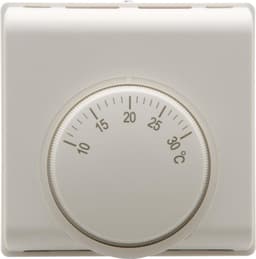
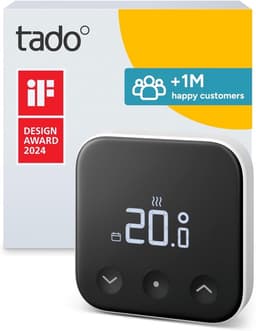
None of the four listings is a TRV. The ESI ESRTM and the livager are mechanical room thermostats. The tado wireless starter is a room sensor plus a receiver. The tado wired add-on is another room head. Fitting one does not valve a bedroom radiator, and fitting TRVs does not replace it. A review of the wired add-on that mentions a second underfloor zone is describing a second call, not a TRV on every panel radiator. Smart radiator valves still throttle one radiator each. If they close the radiator in the thermostat room, the stat loses the air temperature it needs. A consumer swap that does not open a gasway sits outside that part of HSE L56. Draining radiators or replacing a boiler does not. If the only cable is in a room you want on TRVs, make that room the reference room or move the stat.

Common questions

Do I need both a room thermostat and TRVs?
Yes, for the pattern in Approved Document L paragraph 5.22. The room thermostat provides the off signal. TRVs set the other rooms. CE30 states that TRVs alone do not provide boiler interlock. A stat without TRVs heats every radiator on that circuit together. The useful arrangement is both, in different rooms.
Can I fit a TRV in the same room as the stat?
No. Paragraph 5.22 says there should be no TRV in the room that contains the thermostat. BEAMA says not to site the stat in a room that already has radiator thermostats. A TRV there can shut the radiator before the stat is satisfied, so the boiler runs on, which is the hall-radiator fault Worcester Bosch described. Leave a manual valve in the thermostat room.
Which room should have the thermostat?
A room the circuit serves, often the hall or landing, where the sensor reads air that is not above a radiator or next to a fire. Worcester’s answer warns against a TRV on the hall radiator and against a room with a fire. BEAMA wants about 1.5 m and free air. The other heated rooms get the TRVs. If comfort matters in the living room, a wireless sensor can live there, and that room is then the one without a TRV.
What about an open-plan flat?
Paragraph 5.21 allows a single zone where the home is single-storey open-plan and the living area is more than 70% of the floor area. You still need a thermostat for that zone. You do not put TRVs on every emitter in that open space and delete the stat. A two-storey house is outside the exception.
Do smart radiator valves change the rule?
No. They still throttle individual radiators. They do not replace the room thermostat’s interlock. If a smart valve closes the radiator in the same room as the wall stat or the wireless sensor, you recreate the problem in paragraph 5.22. A second tado zone is another thermostat call, not a valve on every radiator.

Related pages

Sources

Public UK sources for room controls, Boiler Plus in England, siting, and gas competence. Listings are the amazon.co.uk captures for these four ASINs, not a live reload on 17 October 2026. Prices on amazon.co.uk move.

  1. Approved Document L Volume 1 (retrieved 17 October 2026)
  2. Boiler Plus factsheet (retrieved 17 October 2026)
  3. Boiler Plus final policy (retrieved 17 October 2026)
  4. Boiler Plus clarification (retrieved 17 October 2026)
  5. BEAMA siting note (retrieved 17 October 2026)
  6. Energy Saving Trust heating controls (retrieved 17 October 2026)
  7. BEIS/BRE TPI evidence (retrieved 17 October 2026)
  8. HSE L56 (retrieved 17 October 2026)