Independent comparisons. We may earn from shop links. More info

How to set a room thermostat

Updated: October 2026

The house feels cold, so the dial goes to the end of the scale, or it stays on one number all night. If the thermostat is already on the wall, how to set a room thermostat is a setpoint question. Product choice stays on the [room thermostat comparison](/hub/thermostats/room-thermostat). The Products Compared editorial team updated this on 16 October 2026 from Energy Saving Trust, the DECC factsheet, and BEAMA, not from a lab test. A qualifying purchase through our amazon.co.uk links can earn us a commission at no extra cost to you.

The house feels cold, so the dial goes to the end of the scale, or it stays on one number all night. If the thermostat is already on the wall, how to set a room thermostat is a setpoint question.

Our top picks

On this page

What the dial actually does

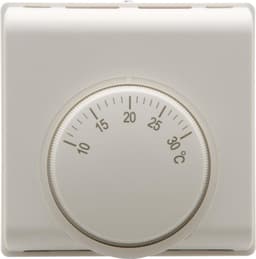
A room thermostat is a stop for one room or zone. It calls the heating while the air at the sensor is below your setpoint, and it ends that call when the air reaches it. Turning the ESI ESRTM or the livager from 20°C to 30°C does not make the radiators hotter in the next ten minutes. You have only moved the temperature at which the call ends. The DECC factsheet says turning the room thermostat up does not heat the house faster. The livager listing states 10°C to 30°C and an audible click as the knob passes the current temperature. That click is the switch point. A programmer decides the hours. The stat decides the temperature inside those hours.

A temperature to start from

Energy Saving Trust and the DECC factsheet both put a usual setting between 18°C and 21°C. Start inside that band and adjust by feel over a day or two. If you are comfortable at 20°C, that is the number. If someone needs it warmer for health reasons, follow that need.

Night, away, and frost

A setback is a lower temperature while you are in bed or out, with the heating still able to call. The DECC factsheet says not to leave the stat high while you are out, and to use a programmer for the hours. Powering Homes treats about 16°C as an example floor, with occupied rooms at least 18°C. That 16°C figure is their example, not a rule for every home. Frost protection is a low floor for an empty building, not a comfort target. ESI’s programmable ESRTP4RF shows a frost symbol at 5°C. Neither the ESRTM nor the livager documents that symbol. On those dials you set a low number by hand, and the livager scale only runs from 10°C to 30°C.

Where you put it

BEAMA’s siting note puts a room thermostat at about 1.5 m, in free air. Keep it off a radiator, out of direct sun, out of a draught, out of a corner, and out of a room that already has thermostatic radiator valves. Above a radiator the sensor sees a plume and shuts the boiler while the sofa is still cold. Sun does the same on a bright afternoon. A draught or a corner pulls the reading the other way, so the boiler runs on. The tado starter’s sensor can move. The ESI, the livager, and the wired tado head stay on the cable, so a cable over a radiator still reads the plume.

When the number on the dial is a lie

ESI ESRTM reviews report the scale several degrees out. One buyer reseated the knob. If the dial says 21°C and a thermometer at the same height says 18°C, believe the room, then treat the dial as a relative mark. The livager’s stated range is 10°C to 30°C. On tado X the schedule lives in the app. AI Assist on the starter is £3.99 a month or £29.99 a year, so a timed programme is not the same as every automatic feature. If the setpoint is sensible, the programmer is on, and the radiators stay cold, stop turning the knob up and call an installer.

Common questions

What temperature should the room thermostat be?
Start between 18°C and 21°C, the band Energy Saving Trust and the DECC factsheet both use. Pick the lowest temperature that still feels comfortable where the stat sits, then leave it for a day. EST’s one-degree example, 22°C down to 21°C, is about £120 a year in Great Britain and about £80 in Northern Ireland on EST’s figures. It is not a test of a particular listing.
Does turning it to 30°C heat the house faster?
No. The thermostat is a stop, not an accelerator. At 30°C you have told it to keep calling until the air at the sensor reaches 30°C, so the boiler runs on. The DECC factsheet states that turning the stat up does not heat the house faster. The livager scale stops at 30°C.
What should I do at night?
Use a setback rather than leaving the daytime number on, and rather than switching the system fully off on a cold night. The DECC factsheet says not to leave the stat high while you are out, and to use a programmer for the hours. Powering Homes uses about 16°C as an example floor, with occupied rooms at least 18°C. If the dial has no night programme, the programmer changes the hours.
What is a frost setting?
A frost setting is a low floor against freezing, not a comfort target. ESI’s programmable ESRTP4RF shows 5°C on its frost symbol. Historic England uses 7°C for a frost thermostat in a historic building. The ESRTM and the livager in this set do not document that symbol. The livager listing only runs from 10°C to 30°C, so a 5°C figure from another model may sit below that scale.
When is a cold house an installer problem?
When the setpoint is already in the 18°C to 21°C band, the programmer is in an on period, and a radiator in the thermostat’s room stays cold. Flat batteries, a missing receiver, or a boiler fault are not fixed by turning the knob to 30°C. If you are only unsure of the number, start at 20°C for a day. If you are unsure of the wiring, stop.

Related pages

Sources

Public UK sources for room controls, Boiler Plus in England, siting, and gas competence. Listings are the amazon.co.uk captures for these four ASINs, not a live reload on 17 October 2026. Prices on amazon.co.uk move.

  1. Approved Document L Volume 1 (retrieved 17 October 2026)
  2. Boiler Plus factsheet (retrieved 17 October 2026)
  3. Boiler Plus final policy (retrieved 17 October 2026)
  4. Boiler Plus clarification (retrieved 17 October 2026)
  5. BEAMA siting note (retrieved 17 October 2026)
  6. Energy Saving Trust heating controls (retrieved 17 October 2026)
  7. BEIS/BRE TPI evidence (retrieved 17 October 2026)
  8. HSE L56 (retrieved 17 October 2026)