Independent comparisons. We may earn from shop links. More info

Tower extension lead vs power strip

Updated: 24 October 2026

You have one UK socket and a tangle of plugs, and the results offer a vertical tower or a flat bar. This tower extension lead vs power strip page is that fork. Both end in one BS 1363 plug, so neither raises the 13 A limit. The difference is where the sockets sit: up on a desk you can see, or flat behind a sofa or a television. The towers we can name are the twelve on the [socket tower comparison](/hub/sockets-and-extension-leads/socket-tower). This page does not invent a bar model. Products Compared did not lab-test either shape. A qualifying purchase can earn a commission at no extra cost to you.

You have one UK socket and a tangle of plugs, and the results offer a vertical tower or a flat bar. This tower extension lead vs power strip page is that fork.

Our top picks

On this page

Same fuse, different footprint

A tower and a flat strip both draw through one fused plug. Electrical Safety First applies the same rules to multi-way leads: one lead per socket, and a load inside the rating, usually 13 A. Eight sockets on a column and six on a bar are different footprints with that same fuse. A 3,250 W title is the 13 A budget in watts at about 250 V. It is not a bonus for the taller box. Choose a tower when floor space is scarce and you can see the column. Choose a flat bar when the lead must lie behind furniture. Scottish Fire and Rescue and London Fire Brigade still prefer a fused lead to a plug-in cube, and they do not treat either shape as unlimited. Plug, current and length, before you fall for a silhouette, are on the tower extension lead buying guide.

Choose a tower for a desk or a small floor patch

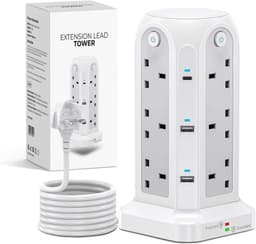
A tower suits a desktop or a small patch of floor, with outlets facing outwards rather than upwards under a shelf. In this set, Type G eight-socket towers include the HAFINO night-light model at a captured £20.62 with a 1.8 m lead, and the Addtam at £17.99, also 1.8 m. Type G 12-socket towers are Wolf Power at £22.98 with 2 m, and the toomke 12-way at £23.99 with 3 m. Twelve holes help when a laptop brick blocks its neighbour. They do not give you twelve times 13 A. Wolf Power buyers say awkward plugs waste the next socket. On the toomke 12-way, adaptors above the earth pin do the same. TESSAN will not stand upright with oversized plugs. hotimy has a report of a tower that topples however the plugs are arranged. The Sun makes a similar point about a light tower from another brand, which is not in this set. A tower needs a hard base and plugs that do not lever it over.

Choose a flat bar behind furniture

Choose a flat bar when the lead must sit behind a sofa, under a worktop, or along the skirting behind a wall-mounted television. A tower’s height is wasted there, and a tip is easy to miss. This folder does not stage a bar, so there is no strip to crown. The hub’s 6-way extension lead comparison is where those listings live. Use it for length and switched sockets on a bar. A tower review is not a review of those bars. A bar is still one 13 A plug. Hiding it makes heat harder to notice, so leave an air gap and keep the flex out from under a rug. The Fire Protection Association’s workplace note says not to cover a block, not to hang one from its cable, and to keep the lead only as long as the run. If the tidy route is inside the wall, stop. Do not assume a tower will screw to the skirting. SE UKASE says mountable and describes a base with non-slip pads, which is a foot on the floor. Once you have chosen a column, the top pick and the best value are on best tower extension lead.

A cube is not the compromise

A plug-in cube looks like a middle path: more sockets, no cable, no choice. London Fire Brigade asks for a fused in-line lead rather than a block adaptor. Scottish Fire and Rescue prefers a multi-way bar, still within 13 A. Several plugs can ease a cube out of the wall. A tower or a bar keeps that weight off the socket pins, with one plug fully home. The cube is still one device in one wall socket, and so is the tower. Adding a cube to the back of a tower is daisy-chaining, which Electrical Safety First tells you not to do. If the room needs this every day because there are too few sockets, a registered electrician is the durable fix. Heat and the point where you unplug are on how to use a tower extension lead. Use a tower when you can see it and you are short of floor space. Use a flat bar when the lead has to lie behind furniture. Use neither as a kettle hub.

Common questions

When is a tower the better shape?
When the desk or a small floor patch is the scarce space, and you can see the column. An eight-socket Type G tower such as the Addtam or the HAFINO night-light model holds a modest set of plugs. A 12-socket Type G tower such as Wolf Power or the toomke 3 m model gives more faces when bricks block each other. The fuse stays 13 A, and the base has to resist tipping when a cable pulls sideways.
When is a flat bar the better shape?
When the lead must sit behind a sofa, under a worktop, or behind a wall-mounted television. A tower’s height gets in the way, and you may not see a lean. Use the hub’s extension lead or 6-way extension lead comparisons for that shape. The bar remains one fused plug. Leave it uncovered so a hot smell or a scorch mark is visible.
Does a tower give me more power than a bar?
No. Both draw through one 13 A plug. A 3,250 W title restates that rating. Twelve sockets on Wolf Power and six on a bar are different ways to park plugs. London Fire Brigade still wants a kettle, a toaster or a microwave in the wall socket rather than shared on either lead. More holes are not more current.
Is a cube adaptor a third option?
It is a third object, and the fire services quoted here prefer a fused lead. London Fire Brigade wants an in-line lead rather than a block adaptor. Scottish Fire and Rescue prefers a multi-way bar and still caps the load at 13 A. A cube can ease out of the socket under the weight of plugs. It does not split the difference between a tower and a bar.
Will a tower fit behind a wall-mounted TV?
A flat bar usually fits that gap better. A tower needs headroom and a base that stays put when cables pull. If you cannot see the column, you will not see it lean. Keep the flex out of the wall cavity. A hidden mains lead is a job for a fixed socket, whichever plastic shape you preferred in the search results.
What if my plugs are large laptop bricks?
Expect a wasted neighbour. Wolf Power reviews say awkward plugs occupy the next socket, and the toomke 12-way has the same note about adaptors above the earth pin. Extra faces on a 12-socket tower absorb some of that waste. They do not shrink the brick. A flat bar with wide spacing can do the same job with a lower profile, if that bar’s listing actually states the spacing.
Can I fix a tower to the skirting like a bar?
Do not assume a bracket. The staged bullets do not give you a checked skirting fixing. SE UKASE describes non-slip pads on a base, which is a freestanding foot. If the lead has to be flat and fixed, choose a bar that states how it mounts, and keep the load inside one 13 A plug.

Related pages

Sources

Sources taken from the research digest. Shelf prices, stars and review counts are the amazon.co.uk figures in the stored listings. This page did not run a lab test.

  1. Electrical Safety First — extension leads, cable reels and block adaptors (retrieved 22.10.2026)
  2. Electrical Safety First — overloading sockets (retrieved 22.10.2026)
  3. Electrical Safety First — plugs and fuses (retrieved 22.10.2026)
  4. Electrical Equipment (Safety) Regulations 2016, regulation 35 (retrieved 22.10.2026)
  5. BEAMA — extension lead safety check-list (retrieved 22.10.2026)
  6. IET — Surge protective devices (retrieved 22.10.2026)
  7. Kent Fire and Rescue Service — electricity safety (retrieved 22.10.2026)
  8. London Fire Brigade — cables, fuses and leads (retrieved 22.10.2026)