Independent comparisons. We may earn from shop links. More info

Tower extension lead USB-C

Updated: 24 October 2026

You want the phone bricks in a drawer, and you hope the USB-C port will charge the laptop too. On these twelve towers the USB claims are mostly under 20 W. That will top up a phone. It will not replace a 45 W or 65 W laptop charger. This tower extension lead USB-C page follows the captured figures, then shared current, then switches that leave the ports on. Mains overload stays on [how to use a tower extension lead](/hub/sockets-and-extension-leads/socket-tower/sub/socket-tower-how-to-use). Plug checks stay on the [tower extension lead buying guide](/hub/sockets-and-extension-leads/socket-tower/sub/socket-tower-buying-guide). The listings are on the [socket tower comparison](/hub/sockets-and-extension-leads/socket-tower). Products Compared did not meter these ports. A qualifying purchase can earn a commission at no extra cost to you.

You want the phone bricks in a drawer, and you hope the USB-C port will charge the laptop too. On these twelve towers the USB claims are mostly under 20 W. That will top up a phone.

Our top picks

On this page

What these USB ports are rated to do

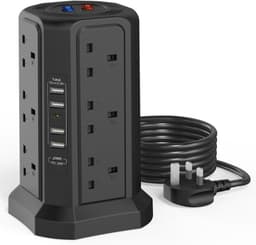
Read the watts or amps, and treat fast charge as a slogan until a number sits beside it. SE UKASE offers two USB-A ports and one USB-C at 2.4 A total. Sameriver lists four ports at 17 W and 3.4 A. Addtam lists USB-A up to 2.4 A and USB-C up to 3 A, with no combined watt total. HAFINO B0BMZTKS5P claims 18 W on one USB-C port. The night-light HAFINO, B0B8J3D97J, says up to 2.4 A per port and 5 A shared. toomke’s 12-way states USB-C at 5 V / 3 A, USB-A at 5 V / 2.4 A, and a total of 3.8 A or 19 W. Kemelo states USB-C at 5 V / 3.1 A. hotimy caps four USB-C ports and two USB-A ports at 3.6 A or 18 W. A phone lives in that band. At 5 V, 2.4 A is about 12 W and 3 A is about 15 W. A laptop that wants 45 W to 65 W from USB-C still uses its own charger in a mains socket on the tower. The ports sit on the same 13 A plug as the mains sockets.

Shared current, not a charger each

A 2.4 A bullet is often a ceiling, not a promise that every port delivers 2.4 A together. The clearest shared line in this set is the HAFINO night-light tower: 2.4 A per port and 5 A shared. Five amps at 5 V is 25 W for the group, while one port stays around 12 W. SE UKASE is the other way round: 2.4 A total across three ports, so two phones split a small budget. toomke’s 12-way prints per-port volts and a 19 W total. Use the total when several cables are in. A toomke eight-way review cites about 15 W on USB-C and 12 W on USB-A. Wolf Power reviews say the USB is not fast charging, although the bullet says smart charging. The HAFINO 12-way has a buyer who found USB slower than the 18 W claim. Addtam, Kemelo and KLINTOS draw the same kind of comment. The mains ranking of the top pick and the best value is on best tower extension lead.

Switches often leave USB on

A side switch usually cuts mains faces and leaves the USB rail awake. toomke’s bullet on B0CVXNS84B says the four switches govern the AC outlets while leaving the USB ports unaffected. A HAFINO night-light review says the USB sockets, the green LED and the touch light stay active, and one buyer covered the green light in a bedroom. Kemelo reviewers say the USB ports are not on the four switches. BEAMA’s note on BS 1363 makes the same distinction: a socket switch is not there to switch off built-in electronics other than an indicator. If you want every port dead, unplug at the wall. Switching the faces off can silence a monitor and leave a phone charging, with a lamp still lit. That suits a desk where the phones should stay alive. It is a poor match for a dark room. TESSAN’s single top switch is described as controlling the whole tower. Do not copy that onto a four-switch column unless the listing says so.

A 65 W port is a different product

HAFINO B0FJQFZ8S3 advertises 65 W USB-C on amazon.co.uk, and that ASIN is not staged here. A high-watt UGREEN cube is a cube, not this tower. Do not paste 65 W onto B0B8J3D97J or B0BMZTKS5P. The night-light figure is 2.4 A per port and 5 A shared. The 12-way HAFINO’s USB-C claim is 18 W. The letters USB-C do not mean Power Delivery, and they do not mean the wattage of another listing from the same brand. If the laptop is why you are shopping, buy the charger it expects and put that brick in a mains socket. Use the tower’s USB ports for a phone, earbuds and a watch. A future row in this comparison can carry 45 W or 65 W only if that figure is printed on the port you will use, including what happens when the other USB ports are busy. These twelve do not print that.

Common questions

Will the USB-C port charge my laptop?
Only in a limited way, and not as a 45 W or 65 W stand-in. The staged USB-C claims top out around 15 W to 18 W on a port, or a shared total around 19 W to 25 W. That may trickle a sleeping laptop. It will not match a proper charger. Use the laptop’s own brick in a mains socket on the tower, and use the USB-C port for a phone or a small tablet.
Is 2.4 A per port or shared?
Read the sentence, because the listings differ. The HAFINO night-light tower says 2.4 A per port and 5 A shared, so the group is capped. SE UKASE says 2.4 A total across three ports. toomke’s 12-way prints per-port figures and a 19 W total. When the listing says neither shared nor total, treat a lone 2.4 A figure as a ceiling. Do not multiply it by the number of holes.
Do the side switches turn the USB ports off?
Often they do not. toomke B0CVXNS84B says the switches control AC outlets and leave USB unaffected. A HAFINO night-light review says the USB ports, the green light and the touch light stay on. Kemelo reviewers say the USB ports sit off the switches. Unplug at the wall if the USB rail has to be dead. A bedroom that must be dark is a reason to skip a tower whose light stays available.
Is USB power part of the 13 A limit?
Yes. The ports are fed from the same plug as the mains sockets. A 19 W USB total is a small slice of a 13 A budget, roughly 3,000 W, so phones are not what overload a desk. They still count. A kettle on the same tower is the load that uses the fuse, which is why the how-to page keeps kettles in the wall socket.
Why do reviews say charging is slower than the title?
The title says fast, and the bullet says something like 12 W to 19 W, or a buyer describes a result in that range. Wolf Power, Addtam, the HAFINO 12-way, Kemelo, KLINTOS and the toomke eight-way all attract that comment. A phone that can take a higher rate falls back to the port. Several phones at once fall back again when the current is shared across the group.
When should I keep the phone’s own charger?
Keep it when you want a full-speed charge, when the tower’s USB total is already busy, or when you have not yet checked that the plug is BS 1363. A 2.4 A port is a reasonable overnight top-up. It is a weak match for a phone you need full in half an hour, and it is the wrong tool for a laptop. The original charger can sit in a mains socket on the same tower.
Where is the 65 W tower, if not in this list?
On a different amazon.co.uk listing. HAFINO B0FJQFZ8S3 is an example of a 65 W USB-C claim, and it is not one of these twelve. The HAFINO towers staged here are the 18 W USB-C model and the night-light model at 2.4 A per port with 5 A shared. Matching the brand does not move the watts across.

Related pages

Sources

Sources taken from the research digest. Shelf prices, stars and review counts are the amazon.co.uk figures in the stored listings. This page did not run a lab test.

  1. Electrical Safety First — extension leads, cable reels and block adaptors (retrieved 22.10.2026)
  2. Electrical Safety First — overloading sockets (retrieved 22.10.2026)
  3. Electrical Safety First — plugs and fuses (retrieved 22.10.2026)
  4. Electrical Equipment (Safety) Regulations 2016, regulation 35 (retrieved 22.10.2026)
  5. BEAMA — extension lead safety check-list (retrieved 22.10.2026)
  6. IET — Surge protective devices (retrieved 22.10.2026)
  7. Kent Fire and Rescue Service — electricity safety (retrieved 22.10.2026)
  8. London Fire Brigade — cables, fuses and leads (retrieved 22.10.2026)