Independent comparisons. We may earn from shop links. More info

UK to Europe plug adapter: pins, earth, exceptions

Updated: 23 October 2026

A UK to Europe plug adapter is a pin change, not a voltage change, for a typical hotel in France, Spain, Germany or Portugal. Both sides of the Channel are about 230 V at 50 Hz. The question is Type C without an earth, Type E or F with an earth, or Type J, K or L. The listings are in the [plug adapter comparison](/hub/sockets-and-extension-leads/plug-adapter). Peter F. used the October 2026 listings and Electrical Safety First. A qualifying purchase can earn a commission at no extra cost to you. How the pins seat is on the [how to use a travel adapter](/hub/sockets-and-extension-leads/plug-adapter/sub/plug-adapter-how-to-use) page.

A UK to Europe plug adapter is a pin change, not a voltage change, for a typical hotel in France, Spain, Germany or Portugal. Both sides of the Channel are about 230 V at 50 Hz.

Our top picks

On this page

Voltage is not the problem

Electrical Safety First treats Europe and the UK as the same nominal voltage. A 220–240 V hairdryer is fine in Berlin if the pins fit and the earth is there when the dryer needs one. You do not pack a converter for that plate. A US dryer, or a switch left on 120 V, is not European because the hotel is in Spain. If there is no 230 V line, stop. That case is the travel adapter vs voltage converter page. Ireland, Malta and Cyprus use Type G, so a British three-pin needs no adaptor there.

Type C, E and F

Type C is the unearthed Europlug, for Class II kit such as many phone chargers. Type F, the Schuko pattern in Germany, Spain, Portugal, Greece and the Netherlands, earths with clips. Type E, common in France, Belgium and Poland, earths with a pin in the socket. A useful adaptor accepts both. A two-pin sliver can enter a Schuko socket and leave the earth open. Electrical Safety First limits that to Class II. A UK three-core hairdryer should see Type E or F. A dedicated E/F adaptor is not in this display, so no model name is borrowed from another shop.

Italy, Switzerland, Denmark, and the Type G islands

Italy often uses Type L, in 10 A and 16 A. Type C may run Class II kit and still leave a Class I dryer without an earth. Switzerland is Type J. Denmark is Type K. A standard C/E/F adaptor is not enough in those three. Ireland, Malta and Cyprus need nothing. For Rome plus a Swiss train, pack the exception or confirm the universal names J, K or L. Europe on the box is not that promise.

What this comparison's universals actually cover

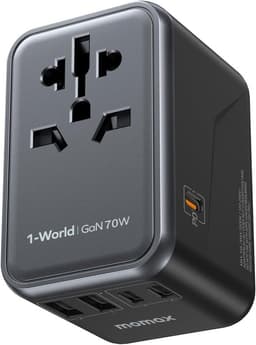
The TESSAN at £19.99 lists Types C, A, G and I. That is an unearthed Europlug, not a named Type E or F earth. One UK review missed sockets in Poland. The BigFish at £13.99 names Type E, and a bullet also says Type C. The fuse is absent from the spec. The MOMAX UA8A names Type C among A, B, G and I. The UA36A has a review that says it will not feed Class I kit, despite 4.7 from 12 reviews. The inbound adaptor, the cube and the 1 A shaver do not grow Paris pins. Who should skip which universal is on the best travel adapter page.

Common questions

Do I need a converter for Spain or France?
No, not for a normal 220–240 V or 100–240 V appliance. Spain and France use about 230 V at 50 Hz, the same nominal supply as the UK. Electrical Safety First treats that as an adaptor trip. You change the pin shape. You still read the plate, because a US-only 120 V dryer will not become European just because the hotel is in Barcelona.
Is Type C enough, or do I need an earthed E or F adaptor?
Type C is enough for double-insulated Class II kit, such as many phone chargers. It is not enough when the appliance needs an earth. Type E, common in France, and Type F, common in Germany and Spain, provide that earth in different shapes. A UK three-core hairdryer should see an earthed adaptor. A two-pin sliver that happens to fit a Schuko socket does not earth it.
What about Italy, Switzerland or Denmark?
They are the usual exceptions to a C/E/F adaptor. Italy is widely Type L, Switzerland Type J, and Denmark Type K. A Type C plug may run small Class II chargers in some of those sockets and still leave a dryer without an earth. If the itinerary includes those countries and a Class I tool, pack the matching adaptor or leave the tool at home. Europe on a box does not cover all three.
Do I need an adaptor in Ireland or Malta?
No. Ireland, Malta and Cyprus use Type G, the same plug as the UK, at the same nominal voltage. A British three-pin goes straight into the wall. Northern Ireland is the same. You need a UK to Europe adaptor when you continue to a Type C, E or F country, not for a weekend in Dublin or Valletta.
Will a universal in this table work in Germany?
It can, for Type C loads, if the brick lists Type C and the pins seat fully. The TESSAN and both MOMAX units name Type C. Germany's earthed sockets are Type F. Do not assume a C-only pin set earths a Class I dryer. The BigFish table names Type E, the French earth pin, rather than German earth clips, so read the pins on the unit. One Poland review on the TESSAN is a fit warning, not a ban on German sockets.
Can I use a UK hairdryer in Europe through an adaptor?
Yes, if the plate includes 230 V and the adaptor gives the earth the dryer needs. You do not add a converter for France or Spain, and you do not use a 1 A shaver adaptor. If the dryer is Class I, Type C alone is the wrong pin. If the plate is 120 V only, an adaptor will not run it. Use the hotel dryer instead of forcing the plug.

Related pages

Sources

Sources taken from the research digest. Listings were scored in October 2026. This page did not run a lab test.

  1. Electrical Safety First, travel advice (retrieved 22.10.2026)
  2. Electrical Safety First, travel adaptors (retrieved 22.10.2026)
  3. Electrical Safety First, dangerous online adaptors (retrieved 22.10.2026)
  4. Plugs and Sockets etc. (Safety) Regulations 1994 (retrieved 22.10.2026)
  5. BSI, BS 8546 scope (retrieved 22.10.2026)
  6. BSI, BS 1363-5 scope (retrieved 22.10.2026)
  7. OPSS recall 2201-0320 (retrieved 22.10.2026)
  8. OPSS report 2601-0166 (January 2026) (retrieved 22.10.2026)