Independent comparisons. We may earn from shop links. More info

How to use a travel adapter: plate, pins, then fuse

Updated: 23 October 2026

How to use a travel adapter starts with the rating plate, not the slider. If the plate already includes the wall voltage, set one pin family fully out, plug the appliance in, then the wall, and stop if the body is more than warm. The [plug adapter comparison](/hub/sockets-and-extension-leads/plug-adapter) is the product table. This page assumes you already own a brick. Peter F. used October 2026 amazon.co.uk notes and Electrical Safety First's travel advice. No heat test was run. A qualifying purchase can earn a commission at no extra cost to you. If the plate misses the voltage, read the [travel adapter vs voltage converter](/hub/sockets-and-extension-leads/plug-adapter/sub/plug-adapter-vs-voltage-converter) page first.

How to use a travel adapter starts with the rating plate, not the slider.

Our top picks

On this page

Read the plate before you pack

Find volts, not watts. A charger marked 100–240 V, 50/60 Hz, needs pins and not a converter. A hairdryer marked 220–240 V only is for the UK and most of Europe, not for 110–120 V. A MOMAX UA8A review records a US hair dryer that did not run. Electrical Safety First treats mainland Europe as the same nominal 230 V and 50 Hz as Britain. Some cruise cabins are not on the shore voltage, so the plate still beats the brochure. If the plate is missing, do not guess from the plug shape. France and Spain are on the UK to Europe plug adapter page. If you are still choosing, use the travel adapter buying guide.

Set the pins and seat them fully

Select one pin set. On the BigFish, a set that is not fully out will not connect. On the TESSAN the slider is smooth, and the body can sit loosely. One UK review missed sockets in Poland. Do not file the pins. If the socket is loose, cracked or warm, use another one. If a MOMAX slider sticks, or UK and EU pins lock together, retire the brick. Plug the appliance into the adaptor first, then the adaptor into the wall. Masterplug's sheet for a different model, the TAVUK, which is not one of our eight, gives that order and says it is not a converter. Copy the order. Unplug the wall first. Do not daisy-chain a cube.

Fuse, heat and when to stop

Stay under the amp mark. The TESSAN spare is a 10 A fuse, not a 13 A cartridge from a kitchen drawer. The shaver adaptor is 1 A and 240 W. The cubes claim a shared 13 A. Unplug, then fit a BS 1362 cartridge of the same rating. Do not bridge a blown fuse with foil. The BigFish listing does not name a fuse, so read the body. Slight warmth can be normal. Heat, a smell, or marked plastic means stop. One BigFish review describes a melted cable in the AC well. A scorched home socket needs an electrician. Never back-feed a generator through an adaptor.

A shaver two-pin is a different well

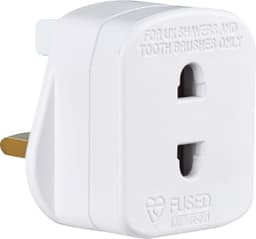
A UK toothbrush often has a BS 4573 two-pin, not a Type C Europlug. Spacing differs, so a travel well can refuse it. Forcing it cracks the charger. At home, the Masterplug SHADC-MP is the 1 A, 240 W, BS 1363-3 body, about £2.29. Abroad, use the hotel shaver socket and keep the universal for the phone. If the plate, the pins, the fuse or the temperature disagree, unplug it.

Common questions

How do I know if I only need an adaptor?
Read the appliance plate and compare it with the socket you are about to use. If the printed range includes that voltage, you need the right pin shape and you do not need a converter. A line such as 100–240 V covers the UK and the United States. A line that says 220–240 V only covers the UK and most of Europe. If the plate is missing, do not guess from the plug shape.
In which order do I plug in?
Fit the appliance into the adaptor first, with the adaptor still out of the wall. Then push the adaptor fully into the socket. When you finish, remove the adaptor from the wall before you separate the appliance. That keeps a live front socket off the bedside table. Do not connect a second adaptor or a cube in between.
How do I change a BS 1362 fuse?
Unplug the adaptor. Open the fuse holder the way that model allows, and fit a BS 1362 cartridge of the same amp rating printed on the body. The TESSAN spare matches its 10 A claim, not a 13 A kitchen fuse. If the rating is unmarked or the holder is damaged, stop using the adaptor. Do not bridge a blown fuse with foil.
Why will my toothbrush not go in?
A UK toothbrush charger is usually a BS 4573 bathroom plug, not a Type C Europlug. The pin spacing is different, so a travel well can refuse it even when European plugs fit. Forcing it risks the charger. At home, a 1 A shaver adaptor such as the Masterplug SHADC-MP is the body made for that plug. Abroad, use the hotel shaver socket if there is one.
What do I do if the body is hot?
Unplug it from the wall and let it cool somewhere that is not a bed or a carpet. Slight warmth after a phone charge can be normal. Heat that softens plastic, a burning smell, or a mark on a cable means the adaptor is finished. One BigFish review describes a melted cable in the AC well. Do not plug it back in to see if the heat was a one-off.
When do I stop and call a professional?
Call a registered electrician if a household socket is scorched, cracked, or keeps blowing a fuse on an appliance that is otherwise sound. Call one if a foreign flex needs rewiring, or a conversion plug needs fitting and the instructions are not enough. Bathroom isolating-transformer work is the same stop. Do not back-feed a generator through any adaptor in this category.

Related pages

Sources

Sources taken from the research digest. Listings were scored in October 2026. This page did not run a lab test.

  1. Electrical Safety First, travel advice (retrieved 22.10.2026)
  2. Electrical Safety First, travel adaptors (retrieved 22.10.2026)
  3. Electrical Safety First, dangerous online adaptors (retrieved 22.10.2026)
  4. Plugs and Sockets etc. (Safety) Regulations 1994 (retrieved 22.10.2026)
  5. BSI, BS 8546 scope (retrieved 22.10.2026)
  6. BSI, BS 1363-5 scope (retrieved 22.10.2026)
  7. OPSS recall 2201-0320 (retrieved 22.10.2026)
  8. OPSS report 2601-0166 (January 2026) (retrieved 22.10.2026)