Independent comparisons. We may earn from shop links. More info

Travel adapter vs voltage converter: read the plate

Updated: 23 October 2026

The travel adapter vs voltage converter decision is one question: does the rating plate already include the voltage at the socket? If it does, you change the pin shape. If it does not, none of these eight listings will fix that. The [plug adapter comparison](/hub/sockets-and-extension-leads/plug-adapter) is a table of pin changers, cubes and a shaver body. Peter F. used Electrical Safety First's travel advice, the BS 8546 scope, and the October 2026 listings. No converter was tested. A qualifying purchase can earn a commission at no extra cost to you. The pin sequence is on the [how to use a travel adapter](/hub/sockets-and-extension-leads/plug-adapter/sub/plug-adapter-how-to-use) page.

The travel adapter vs voltage converter decision is one question: does the rating plate already include the voltage at the socket? If it does, you change the pin shape.

Our top picks

On this page

Shape is not voltage

An adaptor changes which pins meet which holes. A converter changes the voltage the appliance sees. Electrical Safety First's test is the plate. A line such as 100–240 V was built for both. You still need the right plug. BS 8546 includes USB and excludes voltage conversion. A 70 W GaN figure is a USB budget, not a transformer for a dryer. A BS 1363-5 conversion plug is a fused British plug for an appliance that stays in a UK house. It does not change voltage either. If the plate is missing, do not infer volts from a two-pin shape.

Europe is the easy no

France, Spain, Germany and Portugal use about 230 V at 50 Hz, like Britain. A 220–240 V hair tool is still the right voltage in Paris if the adaptor earths a Class I dryer, and if you are not in Italy, Switzerland or Denmark with the wrong pins. That map is the UK to Europe plug adapter page. Do not buy a converter to be safe for a standard EU trip. A 120 V-only dryer stays wrong in Rome. We are not listing a converter for it.

North America and single-voltage hair tools

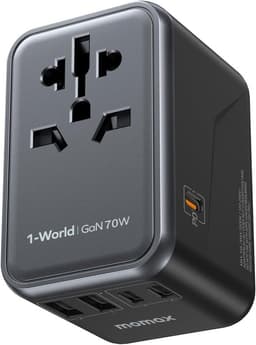
The United States and Canada are about 120 V at 60 Hz. Much of Japan is 100 V. A plate marked only 220–240 V does not include those numbers. An adaptor mates the plug and then feeds the element the wrong voltage. A MOMAX UA8A review records a US hair dryer that did not run. The listing had already said it is not a converter. With no 110–120 V line and no voltage switch, leave the straightener at home or use a converter rated above the load. A laptop charger marked 100–240 V needs pins only. The TESSAN watt lines are a ceiling for kit already in range, not a fix for a 230 V-only dryer.

What this table cannot do

The TESSAN, the BigFish and both MOMAX bricks are not converters. The Double Dragon world-to-UK unit claims BS 8546, which does not convert. The cube and the Masterplug three-way only split a British socket. The shaver body is 240 W at UK voltage. A claimed 21 W or 70 W charges USB devices. It does not step mains. If the destination voltage is on the plate, use the fuse and earth checks on the travel adapter buying guide. If it is not, leave the tool at home. Shape is the adaptor. Volts are the converter.

Common questions

What is the difference in one sentence?
A travel adapter changes the pin shape so a plug can meet a socket. A voltage converter changes the voltage the appliance receives. If the rating plate already includes the socket's voltage, you need the adaptor only. If it does not, the pins may still connect and the appliance still sees the wrong voltage. USB watts on a travel brick are not a converter.
Do I need a converter in France?
Usually no. France uses about 230 V at 50 Hz, like the UK. A 220–240 V or 100–240 V appliance needs a pin adaptor, not a converter. You still match earth and pin type, including Italy, Switzerland and Denmark if the route includes them. A 120 V-only appliance bought in the US stays the exception. A French hotel does not correct that plate.
Do I need a converter in the United States?
You need a converter, or a different appliance, when the plate says 220–240 V only. A UK hair tool in that group will not run properly through an adaptor on a 120 V socket. One MOMAX UA8A review describes a US hair dryer that did not run. If the plate says 100–240 V, you need the adaptor only. If you are unsure, leave the tool at home.
My laptop brick says 100–240 V. Is an adaptor enough?
Yes. That range covers UK 230 V and US 120 V, and a 50/60 Hz line covers frequency as well. You change the plug shape, or you use a detachable mains lead with the right plug. You do not add a converter. You also do not need a 70 W travel brick unless you want to drop the laptop's own charger and rely on USB-C, which is a separate feature.
My straightener says 220–240 V. Now what?
For Europe, an earthed pin adaptor is the right tool if the plate includes 230 V. For the United States, Canada, or a 100 V region of Japan, do not rely on an adaptor. Leave the straightener at home, buy a dual-voltage one and read its plate, or use a converter rated above its watts. This folder does not list that converter, so we will not invent a price or a model for it.
Can a 70 W GaN travel brick replace a converter?
No. The 70 W claim on the MOMAX UA8A and UA36A is USB power for phones, tablets and some laptops. It is not a mains conversion. The listings say the bricks are not converters and limit you to dual-voltage appliances. A UK dryer marked 220–240 V only is outside that limit in America, however good the USB ports are. Read the plate, not the watt badge on the brick.

Related pages

Sources

Sources taken from the research digest. Listings were scored in October 2026. This page did not run a lab test.

  1. Electrical Safety First, travel advice (retrieved 22.10.2026)
  2. Electrical Safety First, travel adaptors (retrieved 22.10.2026)
  3. Electrical Safety First, dangerous online adaptors (retrieved 22.10.2026)
  4. Plugs and Sockets etc. (Safety) Regulations 1994 (retrieved 22.10.2026)
  5. BSI, BS 8546 scope (retrieved 22.10.2026)
  6. BSI, BS 1363-5 scope (retrieved 22.10.2026)
  7. OPSS recall 2201-0320 (retrieved 22.10.2026)
  8. OPSS report 2601-0166 (January 2026) (retrieved 22.10.2026)