Independent comparisons. We may earn from shop links. More info

How to use a USB-C extension lead without overload

Updated: 23 October 2026

The USB-C ports on a new lead feel like a second supply. They are not. They sit inside the same 13 A plug, or inside the 10 A figure on the one tower whose table prints 10 A. This is how to use a USB-C extension lead you already own: add the mains loads, keep one lead in one wall socket, and unplug anything too hot to touch. The examples are the twelve listings on the [extension lead with USB-C comparison](/hub/sockets-and-extension-leads/extension-lead-with-usb-c). We used those amazon.co.uk pages from 19 October 2026 and did not lab-test the leads. A qualifying purchase can earn a commission at no extra cost to you.

The USB-C ports on a new lead feel like a second supply. They are not. They sit inside the same 13 A plug, or inside the 10 A figure on the one tower whose table prints 10 A.

Our top picks

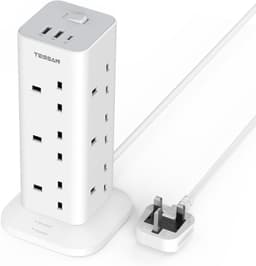
TESSAN TESSAN 12-way tower

Best overall

TESSAN TESSAN 12-way tower
9.4/10about £26.99
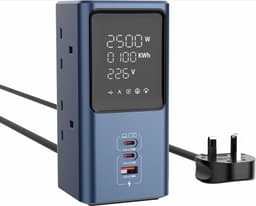
MINGWU MINGWU 45 W tower

Rank 2

MINGWU MINGWU 45 W tower
9.2/10about £29.99
HANYCONY HANYCONY switched 4-way

Best value

HANYCONY HANYCONY switched 4-way
9.0/10about £15.99
On this page

One plug, one rating

Start with the number on the lead, not the number of holes. Electrical Safety First rates an ordinary extension at 13 A. You use one lead per wall socket. Daisy-chaining does not create a new 13 A allowance. Thirteen times 230 V is 2,990 W, and 13 times 250 V is 3,250 W. MINGWU’s table says 10 A and 2,500 W, so read that before you load the tower, even though USB-C1 states 45 W. JSVER’s 3.4 A cell is the USB bank, not the whole lead. If you are still choosing, the order of checks is the USB-C extension lead buying guide.

What can share the lead

A lamp, a router, a monitor and two phones are an ordinary desk load if the total stays inside the amp rating. A kettle is a different class. Electrical Safety First puts a kettle up to about 3,000 W. London Fire Brigade says a kettle, a toaster and a microwave should not share an extension. Moving the phones onto USB-C does not make room for the kettle. POWSAF’s review file includes a unit that smoked after a washing machine. That is one report, and it is enough to keep the machine on the wall socket. AUNNO’s 1,800 J and the TESSAN 12-way’s 900 J are joules, not extra amps.
TESSAN TESSAN 12-way tower

Testsieger

TESSAN TESSAN 12-way tower
9.4/10about £26.99

When the USB block is the warning

Stop when the housing, the plug or the USB block is too hot to touch, or when you smell plastic, hear crackling, or see scorch marks. Unplug at the wall. Each of these is one report, not a lab rate. An AUNNO review calls the USB section dangerously hot. A ROOTOMA unit was too hot to handle after two days. A TESSAN 12-way overheated after two days. A POWSAF smoked on a washing machine. Electrical Safety First has warned that some low-cost USB supplies inside 13 A accessories separate the USB side from the 230 V side poorly. That is a reason to stop, not a finding that a named ASIN here failed that investigation. If you are replacing the lead, the best USB-C extension lead page says which listing matches a phone and which states 45 W.

When a new lead is the wrong fix

Buy another lead when this one is damaged, too hot, or the wrong wattage. A socket that is warm, discoloured or buzzing needs a registered electrician, not another strip. A breaker that trips again after you have removed the kettle is the same stop. A BS 1363 plug does not turn a block into a ring circuit. If you are still deciding whether the port is 5 V, use the USB-C Power Delivery extension lead page.

Common questions

Do the USB-C ports add amps on top of 13 A?
No. The USB bank is inside the same plug. A 17 W JSVER bank or a 45 W MINGWU port does not sit on top of 3,250 W. MINGWU’s table says 10 A and 2,500 W. JSVER’s 3.4 A cell is the USB total, not a second rating beside the 13 A cut-out in the bullets.
Can the lead run a kettle if the phones use USB-C?
No. A kettle is up to about 3,000 W on Electrical Safety First’s figures, which is almost a whole 13 A lead. Phone charging is often around 20 W. Moving the phones to USB-C does not free a kettle, a toaster and a microwave. London Fire Brigade says those three should not share one extension.
What do I do if the USB block is hot?
Unplug at the wall. Too hot to touch, a smell, crackling or scorch marks are stop signs. AUNNO, ROOTOMA, the TESSAN 12-way and POWSAF each have a heat or smoke report in the review notes. Each is one report, not a measured failure rate. Do not leave that lead on overnight to see if it settles.
Is daisy-chaining acceptable for an extra half metre?
No. Electrical Safety First says one lead per wall socket. A second lead plugged into the first does not add a safe half metre. It adds contacts and cable to the same fuse. If 1.5 m or 2 m does not reach, move the appliance or have a socket fitted.
Should I keep charging overnight on a lead that has already run warm?
No. A lead that has already been too hot to touch, or that has smoked, sparked or scorched, stays unplugged. Overnight charging is how a warm USB block gets ignored. Replace the lead, or use the wall socket, after the high load is gone.
When is this a job for an electrician rather than a new lead?
Call a registered electrician when the wall socket is warm, buzzing or discoloured, when a breaker trips again after you have reduced the load, or when the lead stands in for permanent wiring. A new strip does not repair fixed wiring. A damaged cable on the lead itself means you stop using that lead as well.

Related pages

Sources

Sources taken from the research digest. Listings were scored on 19 October 2026. This page did not run a lab test.

  1. USB-IF — USB Type-C system overview (retrieved 19.10.2026)
  2. USB-IF — USB Power Delivery (retrieved 19.10.2026)
  3. BSI — BS 1363-2:2023 changes (retrieved 19.10.2026)
  4. Electrical Safety First — Extension leads (retrieved 19.10.2026)
  5. Electrical Safety First — Appliance ratings (retrieved 19.10.2026)
  6. London Fire Brigade — Cables, fuses and leads (retrieved 19.10.2026)
  7. Legislation.gov.uk — Plugs and Sockets Regulations 1994 (retrieved 19.10.2026)
  8. Tech Advisor — USB-C PD chargers (retrieved 19.10.2026)