Independent comparisons. We may earn from shop links. More info

USB-C Power Delivery extension lead: 15, 18 or 45 W

Updated: 23 October 2026

A USB-C hole on an extension lead looks like the charger that came with the phone. On most of the twelve listings in the [extension lead with USB-C comparison](/hub/sockets-and-extension-leads/extension-lead-with-usb-c) it is a 5 V socket with a reversible plug. A USB-C Power Delivery extension lead, strictly, is one whose own page states Power Delivery and a wattage. Here that wattage appears three times: 15 W, 18 W and 45 W. We read the amazon.co.uk listings on 19 October 2026 and the USB-IF ladder. We did not lab-test the ports. A qualifying purchase can earn a commission at no extra cost to you. This page only sorts the power.

A USB-C hole on an extension lead looks like the charger that came with the phone.

Our top picks

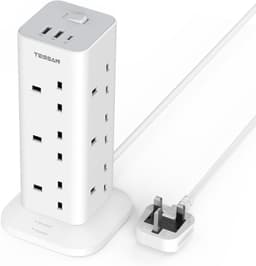
TESSAN TESSAN 12-way tower

Best overall

TESSAN TESSAN 12-way tower
9.4/10about £26.99
PARTH PARTH 18 W cube

Alternative

PARTH PARTH 18 W cube
9.2/10about £13.99
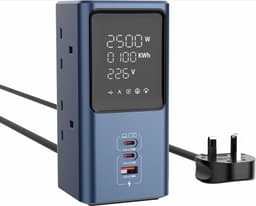
MINGWU MINGWU 45 W tower

Rank 3

MINGWU MINGWU 45 W tower
9.2/10about £29.99
On this page

USB-C without a wattage is 5 V

USB-IF’s ladder starts at 5 V. A simple Type-C supply at 5 V and up to 3 A is 15 W, without the handshake that raises the voltage. Five times 3.4 A is 17 W. Those products are still 5 V. POWSAF shares 5 V / 3.4 A, and one review says the USB-C port does not have Power Delivery. JSVER prints 17 W across four ports, so 3 A is not free on every port at once. HANYCONY shares 3.1 A. ROOTOMA’s bullets say up to 12 W a port and do not say Power Delivery. One review mentions PD 20 W. That sentence belongs to the reviewer. The shared-bank check is on the USB-C extension lead buying guide.

15 W and 18 W are phone figures here

The TESSAN 12-way prints USB-C at 15 W maximum, on a 12-socket tower at £26.99. Fifteen watts is 5 V times 3 A. The page does not print 9 V or 20 V. Twelve sockets and 900 J do not change that. PARTH’s cube is £13.99, and the seller says PD 18 W. The same listing also says 5 V / 3 A with a total of 18 W. Five times three is 15, not 18. Both lines stay. Who should buy which of the three is on the best USB-C extension lead page.
TESSAN TESSAN 12-way tower

Testsieger

TESSAN TESSAN 12-way tower
9.4/10about £26.99

45 W is the only higher figure in this folder

MINGWU states up to 45 W on USB-C1, with PD and PPS, at £29.99. PPS is not a second, higher wattage. The second USB-C port has no wattage printed. Tech Advisor’s charger guide uses about 30–45 W for a small laptop and about 65 W for a mid-size one, as charger guidance. The table says 10 A and 2,500 W. There are 14 reviews. If the laptop brick says 65 W, this port does not state that number. How you load the 10 A plug is on the how to use a USB-C extension lead page.

What these ports will not do

On both Addtam listings the USB-C ports are up to 3 A, and the page says they do not support devices that need 14–22 V, including named MacBooks. The two-socket lead has 12,963 reviews. That count does not remove the sentence. Nothing here states 65 W or 100 W. PARTH does not become a laptop lead because 18 W sits beside a 5 V line. MINGWU does not become every laptop’s charger because 45 W is the highest figure in the folder.

Common questions

Does every USB-C port negotiate voltage?
No. USB-IF’s ladder starts at 5 V. Negotiation above that is Power Delivery, and it has to be stated. Most ports here are printed as 5 V and an amp limit. Only the TESSAN 12-way, PARTH and MINGWU name a wattage, and only MINGWU states a figure above the 15 W ceiling, at 45 W on USB-C1.
What is 5 V / 3 A in watts?
Fifteen watts. Five times three is 15, still at 5 V. Five volts at 2.4 A is 12 W, and 5 V at 3.4 A is 17 W. JSVER’s 17 W is a shared total, not 17 W from each USB-C port. A 3 A mark on one port does not mean 3 A is free on every port at once.
Is 15 W on the TESSAN tower laptop PD?
No. The TESSAN 12-way states USB-C at 15 W maximum, which matches 5 V at 3 A, and USB-A at 12 W maximum. The page does not print 9 V or 20 V. Twelve sockets and 900 J do not raise the port. It is a phone ceiling on a tower.
Why does PARTH say 18 W and 5 V / 3 A?
Because the listing prints both. PD 18 W is the seller’s claim, and “5 V / 3 A, total 18 W” is also on the page. Five times three is 15 W, so the lines disagree. Keep both. Do not call the cube a laptop charger on the strength of the higher number.
Is 45 W a small-laptop figure?
It can be, if the laptop maker’s charger is in that band. Tech Advisor uses about 30–45 W for a small laptop and about 65 W for a mid-size one, as charger guidance. MINGWU states 45 W on USB-C1 only, on a 10 A / 2,500 W table, with 14 reviews. It does not state 65 W.
What does PPS mean on the MINGWU listing?
The listing names PPS beside PD and GaN on the port that states up to 45 W. It is part of that 45 W claim, not an extra wattage. The second USB-C port still has no printed watts. One review calls the watt display consistently inaccurate.
Why does Addtam mention 14–22 V?
Those are voltages above 5 V that many laptops expect from Power Delivery. Both Addtam listings say the USB-C ports do not support devices that need 14–22 V, including named MacBooks, while offering up to 3 A. The port can feed a 5 V phone. It is not offering the laptop range the sentence excludes.

Related pages

Sources

Sources taken from the research digest. Listings were scored on 19 October 2026. This page did not run a lab test.

  1. USB-IF — USB Type-C system overview (retrieved 19.10.2026)
  2. USB-IF — USB Power Delivery (retrieved 19.10.2026)
  3. BSI — BS 1363-2:2023 changes (retrieved 19.10.2026)
  4. Electrical Safety First — Extension leads (retrieved 19.10.2026)
  5. Electrical Safety First — Appliance ratings (retrieved 19.10.2026)
  6. London Fire Brigade — Cables, fuses and leads (retrieved 19.10.2026)
  7. Legislation.gov.uk — Plugs and Sockets Regulations 1994 (retrieved 19.10.2026)
  8. Tech Advisor — USB-C PD chargers (retrieved 19.10.2026)