Independent comparisons. We may earn from shop links. More info

USB-C extension lead buying guide: plug, then watts

Updated: 23 October 2026

You have a phone cable in one hand and a UK three-pin plug in the other, and the listing only says USB-C. That logo does not say whether the port stays at 5 V or states a wattage, or whether those watts are shared. This USB-C extension lead buying guide is the order of checks for the twelve amazon.co.uk listings on the [extension lead with USB-C comparison](/hub/sockets-and-extension-leads/extension-lead-with-usb-c). Shelf prices on 19 October 2026 run from £9.99 to £29.99. We did not lab-test any lead, and a qualifying purchase can earn a commission at no extra cost to you. Read the plug and the amp rating before the USB line.

You have a phone cable in one hand and a UK three-pin plug in the other, and the listing only says USB-C. That logo does not say whether the port stays at 5 V or states a wattage, or whether those watts are shared.

Our top picks

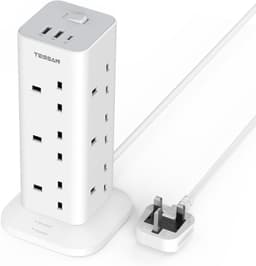
TESSAN TESSAN 12-way tower

Best overall

TESSAN TESSAN 12-way tower
9.4/10about £26.99
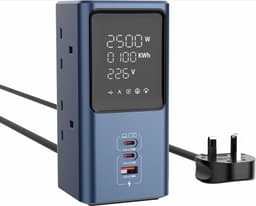
MINGWU MINGWU 45 W tower

Rank 2

MINGWU MINGWU 45 W tower
9.2/10about £29.99
HANYCONY HANYCONY switched 4-way

Best value

HANYCONY HANYCONY switched 4-way
9.0/10about £15.99
On this page

Start with the plug and the amp rating

A UK extension lead is still a 230 V lead with a BS 1363 plug and a BS 1362 fuse. USB-C does not replace that fuse. Electrical Safety First treats an ordinary lead as 13 A: one lead in one wall socket. Thirteen amps at 230 V is 2,990 W, and 13 A at 250 V is 3,250 W. That second figure is the same current with a 250 V label. MINGWU’s table prints 10 A and 2,500 W. AUNNO prints 12.8 A beside 3,250 W. JSVER’s amperage cell prints 3.4 A, the USB total, beside a 13 A cut-out. Plan around the lower figure.

Read USB-C as watts or as 5 V

USB-IF’s ladder starts at 5 V. Five volts at 3 A is 15 W, still at 5 V. Above 15 W, Power Delivery raises the voltage. Only three listings name a wattage: the TESSAN 12-way at 15 W, PARTH at 18 W, and MINGWU at 45 W on USB-C1. The voltage steps are on the USB-C Power Delivery extension lead page. The shared bank is the trap. HANYCONY’s four USB ports share 3.1 A. JSVER prints 17 W across four ports. Addtam says the USB-C ports do not support devices that need 14–22 V. Four holes are not four chargers.
TESSAN TESSAN 12-way tower

Testsieger

TESSAN TESSAN 12-way tower
9.4/10about £26.99

Then count sockets, length and switches

A tower does not add amps. The TESSAN 12-way gives twelve sockets and a stated 15 W port. MINGWU gives four sockets and the only 45 W port. Stated lengths run from 1.5 m on ROOTOMA to 2 m on both TESSAN towers. MINGWU’s table leaves length blank. HANYCONY gives a switch per socket. Switches do not raise the amp rating. How to load one lead is on the how to use a USB-C extension lead page.

What this set can and cannot promise

You can expect a phone charge at 5 V from most of these ports, inside the shared total. PARTH prints PD 18 W and also 5 V / 3 A. Five times three is 15, so keep both lines. MINGWU states 45 W on USB-C1 only, on 14 reviews and a 10 A table. Nothing here states 65 W. AUNNO prints 1,800 J and the TESSAN 12-way prints 900 J. Those joules do not change the fuse. Who should take which lead is on the best USB-C extension lead page.

Common questions

What should I read before the USB-C logo?
Read the plug and the amp rating first. A UK lead needs a three-pin plug and a BS 1362 fuse, and Electrical Safety First rates an ordinary lead at 13 A. In this folder MINGWU’s table says 10 A and 2,500 W, AUNNO prints 12.8 A beside 3,250 W, and JSVER’s amperage cell says 3.4 A beside a 13 A cut-out. The USB-C logo comes after those figures, because the charging bank sits inside the same plug.
Is 3 A the same as fast charging?
No. Five volts at 3 A is 15 W, still at 5 V. USB-IF treats Power Delivery as the step that raises voltage above that. Addtam’s listings say the USB-C ports do not support devices that need 14–22 V. A phone can take a 5 V top-up. A laptop that expects 9 V, 15 V or 20 V will not get it from a port the listing keeps at 5 V.
Why do some tables say Type B or Type C on a UK lead?
The plug-type cell is wrong on several rows. POWSAF and Addtam’s two-socket lead print Type C. The TESSAN 12-way, Addtam’s six-socket lead and AUNNO print Type B. The titles describe a UK lead. Treat the cell as a catalogue error and check the plug you receive. Do not treat a UKCA bullet as the mark on that plug.
Is 3,250 W more current than 2,990 W?
No. Thirteen amps at 230 V is 2,990 W, and 13 A at 250 V is 3,250 W. It is one current with two labels. USB watts are inside that ceiling, not on top of it. MINGWU’s 2,500 W line is a different, lower rating, because the table says 10 A.
When is 18 W enough, and when do I need the 45 W listing?
Eighteen watts is a phone-class claim, and on PARTH it sits next to a 5 V / 3 A line that only adds up to 15 W. Forty-five watts is the only higher figure here, on MINGWU’s USB-C1. Tech Advisor’s charger guide uses about 30–45 W for a small laptop, as charger guidance, not as a test of this tower. If the maker asks for 65 W, that lead is not in these twelve.
Does a surge figure change the amp rating?
No. A printed joule rating, 900 J on the TESSAN 12-way or 1,800 J on AUNNO, is not a higher fuse. Several other listings name surge or overload and print no joules. You still add the appliance watts and stay inside 13 A, or inside 10 A on the MINGWU table.

Related pages

Sources

Sources taken from the research digest. Listings were scored on 19 October 2026. This page did not run a lab test.

  1. USB-IF — USB Type-C system overview (retrieved 19.10.2026)
  2. USB-IF — USB Power Delivery (retrieved 19.10.2026)
  3. BSI — BS 1363-2:2023 changes (retrieved 19.10.2026)
  4. Electrical Safety First — Extension leads (retrieved 19.10.2026)
  5. Electrical Safety First — Appliance ratings (retrieved 19.10.2026)
  6. London Fire Brigade — Cables, fuses and leads (retrieved 19.10.2026)
  7. Legislation.gov.uk — Plugs and Sockets Regulations 1994 (retrieved 19.10.2026)
  8. Tech Advisor — USB-C PD chargers (retrieved 19.10.2026)