Independent comparisons. We may earn from shop links. More info

Best USB-C extension lead for phones or a 45 W port

Updated: 23 October 2026

None of the 65 W cubes in amazon.co.uk search results is in this folder. The twelve listings on the [extension lead with USB-C comparison](/hub/sockets-and-extension-leads/extension-lead-with-usb-c) mostly keep the USB-C port at 5 V, and only three name a wattage: 15 W, 18 W and 45 W. The best USB-C extension lead from this set depends on the job. A phone happy at 5 V, a phone whose page should print a wattage, and a small laptop that can live with a stated 45 W are three different buys. We read the pages on 19 October 2026 and did not lab-test them. A qualifying purchase can earn a commission at no extra cost to you.

None of the 65 W cubes in amazon.co.uk search results is in this folder.

Our top picks

PARTH PARTH 18 W cube

Best overall

PARTH PARTH 18 W cube
9.2/10about £13.99
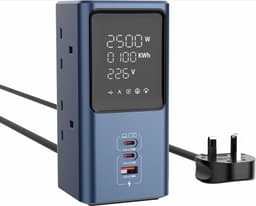
MINGWU MINGWU 45 W tower

Rank 2

MINGWU MINGWU 45 W tower
9.2/10about £29.99
HANYCONY HANYCONY switched 4-way

Best value

HANYCONY HANYCONY switched 4-way
9.0/10about £15.99
On this page

For phones that are happy at 5 V

HANYCONY’s four-socket strip is the best value when phones only need 5 V and you want a switch you can see. It is £15.99, with 4.5 from 1,378 reviews, two USB-C and two USB-A ports sharing 3.1 A, and a 1.8 m lead. No Power Delivery wattage is printed. POWSAF is cheaper at £9.99 and shares 5 V / 3.4 A. Skip it as the default: the plug cell says Type C on a UK title, and a buyer reports smoke after a washing machine. ROOTOMA caps each port at 12 W and the bank at 24 W. The checks that put the plug ahead of the logo are on the USB-C extension lead buying guide.

If the phone should negotiate above 5 V

PARTH’s cube is the listing that prints a phone-class wattage. It is £13.99, 4.6 from 67 reviews, with one USB-C port on a 2 m lead. The seller says PD 18 W and also 5 V / 3 A with a total of 18 W. Five times three is 15, so the lines disagree. Electrical Safety First puts a typical phone charger around 20 W. This cube does not state a laptop figure. The surge cell prints 3,250 W, the mains rating, not joules. Choose PARTH when you want PD 18 W on the page and can accept the conflicting 5 V line. The voltage ladder is on the USB-C Power Delivery extension lead page.
PARTH PARTH 18 W cube

Testsieger

PARTH PARTH 18 W cube
9.2/10about £13.99

If a small laptop must charge from the lead

MINGWU is the top pick when the laptop maker’s figure is about 45 W and you can accept a thin review file. It is £29.99, 4.6 from 14 reviews. USB-C1 is stated at up to 45 W with PD and PPS. The second USB-C port has no printed wattage. Tech Advisor’s charger guide uses about 30–45 W for a small laptop. That is charger guidance, not a test of this tower. Nothing here states 65 W. The mains cell says 10 A and 2,500 W. Cable length is blank; one review says 2 m. Match 45 W to the laptop’s own charger before you retire that brick. Where the tower sits is on the USB-C extension tower or strip page.

Leave these for a different job

Both Addtam listings say the USB-C ports do not support devices that need 14–22 V, including named MacBooks. The two-socket block has 12,963 reviews and the six-socket block has 5,189. The counts do not cancel the exclusion. The TESSAN 12-way states USB-C at 15 W maximum, on a £26.99 tower with twelve sockets and 900 J. If the laptop maker asks for 65 W or more, stop inside this folder.

Common questions

Which of these is for phones only?
HANYCONY at £15.99, with two USB-C ports inside a 3.1 A bank and a switch per socket. POWSAF is cheaper and should not be the default, because a review describes smoke on a washing machine and the USB-C port is not stated as Power Delivery. ROOTOMA’s 12 W ports are also a phone bank, with a heat report in the same file. None of those three states a wattage above 5 V.
Which one states enough watts for a small laptop?
MINGWU states 45 W on USB-C1, with PD and PPS, at £29.99. Tech Advisor’s guide puts a small laptop around 30–45 W. The table also says 10 A and 2,500 W, the second USB-C wattage is blank, and there are 14 reviews. If your laptop’s own charger is 65 W, this port does not state that figure.
Why not the cheapest?
POWSAF is £9.99 and has 792 reviews at 4.5. The USB bank is 5 V / 3.4 A, one review says the USB-C port is not Power Delivery, and a washing-machine report describes smoke at the front. Price is the last check, after the plug, the amps and the USB line.
Is the 15 W TESSAN tower a laptop charger with more sockets?
No. The TESSAN 12-way states 15 W maximum on USB-C, which is 5 V at 3 A, across three USB ports. Twelve sockets and 900 J do not raise that port. It suits a television stand that also charges phones. It does not replace a laptop brick.
Should I skip a lead whose own listing excludes 14–22 V?
Yes, if the device is one of those laptops. Both Addtam pages say the USB-C ports do not support devices that need 14–22 V, including named MacBooks. The six-socket version has 5,189 reviews. The exclusion is still printed. Keep the laptop on its own charger.
What if I need 65 W?
This folder does not contain a 65 W lead. MINGWU stops at a stated 45 W on one port. PARTH’s 18 W line conflicts with 5 V / 3 A. The TESSAN 12-way stops at 15 W. A 65 W result elsewhere on amazon.co.uk is outside this comparison, and it still has to sit inside one 13 A plug.

Related pages

Sources

Sources taken from the research digest. Listings were scored on 19 October 2026. This page did not run a lab test.

  1. USB-IF — USB Type-C system overview (retrieved 19.10.2026)
  2. USB-IF — USB Power Delivery (retrieved 19.10.2026)
  3. BSI — BS 1363-2:2023 changes (retrieved 19.10.2026)
  4. Electrical Safety First — Extension leads (retrieved 19.10.2026)
  5. Electrical Safety First — Appliance ratings (retrieved 19.10.2026)
  6. London Fire Brigade — Cables, fuses and leads (retrieved 19.10.2026)
  7. Legislation.gov.uk — Plugs and Sockets Regulations 1994 (retrieved 19.10.2026)
  8. Tech Advisor — USB-C PD chargers (retrieved 19.10.2026)