Independent comparisons. We may earn from shop links. More info

Adapter plug with switch vs extension lead: which one

Updated: 22 October 2026

You have one wall socket and two jobs. Sometimes every plug already reaches it and you only need more outlets. Sometimes the lamp is two metres away and only a lead will do. A switched adapter plug and a fused extension lead both draw from one 13 A outlet. Neither raises the ceiling. This page is that fork. The [adapter plug with switch comparison](/hub/sockets-and-extension-leads/adapter-plug-with-switch) holds the blocks. Load sums are on [how to use an adapter plug with switch](/hub/sockets-and-extension-leads/adapter-plug-with-switch/sub/adapter-plug-with-switch-how-to-use). There was no lab test.

You have one wall socket and two jobs. Sometimes every plug already reaches it and you only need more outlets. Sometimes the lamp is two metres away and only a lead will do.

Our top picks

On this page

Two tools, one socket

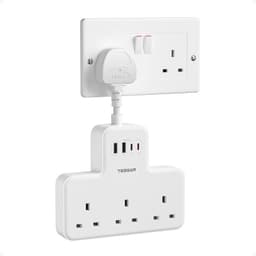
A no-lead block and a trailing strip use the same path: one set of wall contacts, one fuse, and one 13 A budget for everything that is on. Daisy-chaining breaks Electrical Safety First’s one-device-per-socket guidance. Blocks win when clearance at the wall is the only problem. Leads win when equipment cables cannot reach. Fire services often prefer a fused bar on a short lead to a cube, because of weight and historic unfused cubes. Which? adds that a correctly used fused block is not automatically unsafe. The risk they emphasise is mass pulling the adaptor out. TESSAN B092M738G8 blurs the line with a short lead and USB, but its switch field is blank, so it is a hybrid, not the pure switched block.

Use the adaptor when the plugs already reach

Choose a switched wall adaptor when the lamp, router, television and chargers already reach the socket and you want individual off switches without a cable across the carpet. Side outlets, a T-shape under the plate, or a four-gang neon plate are the same idea: more Type G outlets at the point of supply. The failure mode is mechanical. A lead trips people when it crosses the room. A heavy block levers on the wall contacts. Which? names plug weight pulling adaptors out, which is why spacer screws and rotating plugs show up in these reviews. If per-outlet off at the wall is the goal, stay with a block, and keep loads low-power as the adapter plug with switch buying guide describes. LENCENT and Status 3WAISB110 are no-lead blocks here. TESSAN is not that case.

Use a fused bar lead when you need reach

Choose a fused extension lead when the appliance flex stops short of the wall. Scottish Fire and Rescue Service and Greater Manchester Fire and Rescue Service steer households toward a fused multi-way bar rather than a cube, largely because of weight on the socket. London Fire Brigade still says not to share a kettle-class load even on a lead. Keep the lead short, where it will not be stepped on, and do not hide it under a carpet. Scottish guidance treats a covered cable as a heat and damage risk. Unwind a cable reel fully before you load it. A four-gang block does not replace a four-gang lead if the metres are what you need. Joules still count only when printed. Spike claims are separate from overload on surge protection on an adapter plug with switch.

Do not plug one into the other

Stacking a block on a lead puts two bodies and extra wobble on one wall outlet, and it hides a fuse. If you need reach, buy one lead or move the furniture. If you need outlets at the wall, buy one block that fits the twin plate. TESSAN’s short lead is still one adaptor, not permission to add another cube. The bullets do not state the length in metres. Rotating four-gangs solve orientation. They do not add cable. When you need both reach and many outlets as permanent furniture, a registered electrician fits another wall socket.

Common questions

Is a block adaptor or an extension lead safer?
Neither is safer by category alone. A fused, correctly loaded block with good contact pressure can be fine. Fire services worry about unfused cubes and about weight pulling blocks out of the wall. Leads add trip and damage risks, especially under a carpet. Match the tool to the job and keep one 13 A path. Do not stack a block on a lead.
When is no flex the better choice?
When every appliance already reaches the wall socket and you want switches without a cable route across the room. A switched block adds Type G outlets at the point of supply. Side sockets or a T-shape can leave the neighbouring half of a twin plate usable. The limit is still one 13 A total, and a heavy body can lever out of a shallow socket if it is not seated.
When do I need the lead instead?
When equipment cables cannot reach the outlet and you will route a short fused lead on purpose, not stretch an appliance flex taut. Keep it where it will not be stepped on, and do not cover it. Scottish Fire and Rescue Service treats a covered cable as a heat and damage risk. A kettle-class load still belongs in the wall socket on its own, even on a lead.
Can I plug the block into the lead?
No. Use one extension device per socket. Electrical Safety First’s guidance is one device, not a chain. Stacking hides the fuse you need to inspect and puts extra mass on the wall contacts. If you need reach, buy one lead. If you need outlets at the wall, buy one block. Do not join the two.
Does a four-way block replace a four-gang extension?
Only if reach is not required. A block adds outlets at the wall. A lead adds metres. Pro-Elec PL10031 gives four switched outlets on a plate, with 13 A, 230 V and 3,120 W stated, and no trailing flex. That does not help a lamp two metres from the socket. Pay for the lead when the cable length is the thing you need.
What about a short lead, like the TESSAN?
TESSAN B092M738G8 is a clearance and USB compromise in this set, not an individually switched block. The switch field is blank. The short lead lets the body sit clear of a neighbouring twin, with USB-C PD 20 W and a stated 13 A fuse, at about £19.99. It is still one adaptor. It is not permission to add another cube on the end, and the listing does not state the lead length in metres.
Should I ask for another wall socket instead?
Yes, if either tool would be permanent furniture, or if the wall outlet shows heat, cracks or scorch marks. Fixed sockets are an electrician’s job, not an adaptor upgrade. A block and a lead both remain one 13 A path. Cable reels are a temporary reach tool with an unwind rule, not a substitute for another wall outlet.

Related pages

Sources

Sources taken from the research digest. Listings were scored on 19 October 2026. This page did not run a lab test.

  1. Plugs and Sockets etc. (Safety) Regulations 1994 (retrieved 19.10.2026)
  2. Electrical Equipment (Safety) Regulations 2016, regulation 35 (retrieved 19.10.2026)
  3. BSI, BS 1363-3:2023 (retrieved 19.10.2026)
  4. Electrical Safety First, block adaptors and leads (retrieved 19.10.2026)
  5. Electrical Safety First, appliance ratings (retrieved 19.10.2026)
  6. London Fire Brigade, cables, fuses and leads (retrieved 19.10.2026)
  7. Scottish Fire and Rescue Service, electrical safety (retrieved 19.10.2026)
  8. Which?, overloading sockets (retrieved 19.10.2026)