Belt sander vs orbital sander: which to buy first
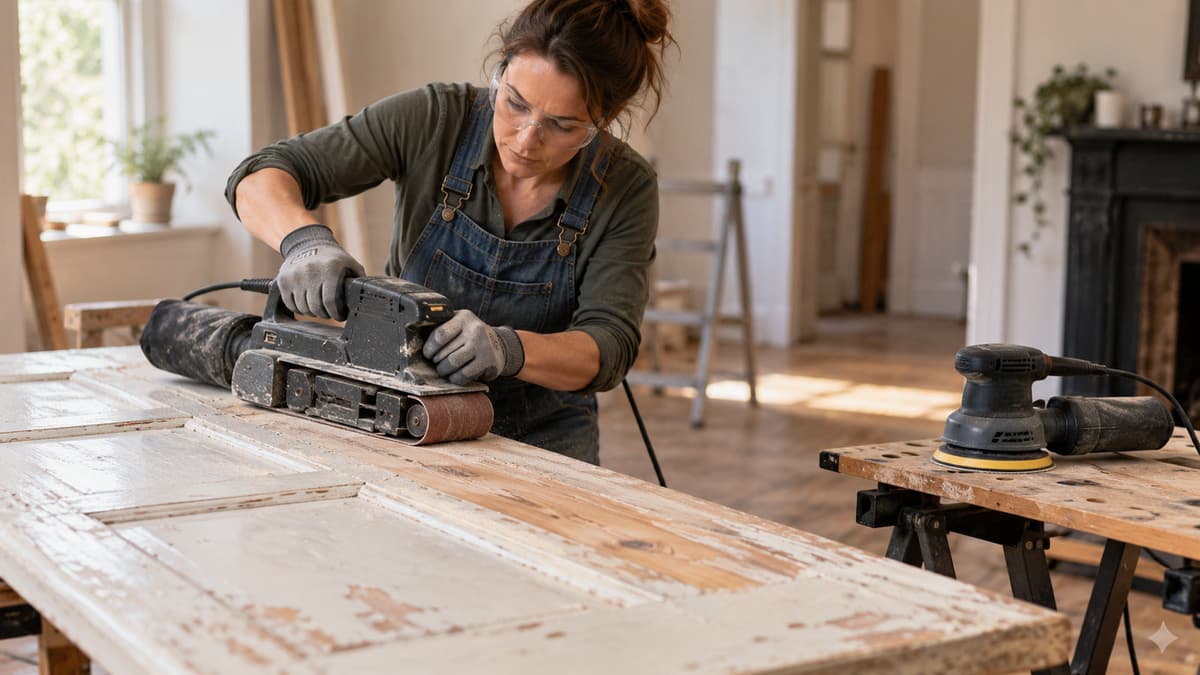
A belt sander strips paint and thickness on flat wood. A random orbital finishes. Buy the orbital first unless the job is removal, and hire a drum for a floor.
On this page

The door is off its hinges, the paint is still on it, and the tabletop has to take varnish by the weekend. Belt sander vs orbital sander is the split between them. A belt takes paint and thickness off flat wood quickly and leaves straight tracks. A random orbital is the first sander when the surface has to be finish-ready. A whole room of floorboards is a third answer: hire a drum, and leave both handhelds on the shelf.
This page is from Peter F., editor for DIY & tools at productscompared.co.uk. Prices and review counts come from amazon.co.uk listings stored for our belt and orbital comparisons on 15 and 16 October 2026. Dust limits come from the Health and Safety Executive, and the plug and mask notes from Electrical Safety First. We did not laboratory-test the tools. A qualifying purchase through our links can earn a commission at no extra cost to you.
In short
Buy a corded random orbital as your first sander unless you must remove paint or thickness from flat stock. A belt does that removal quickly, leaves tracks a random orbit is built to avoid, and digs a hollow if you pause. A floor you need flat is a hire drum.
What each sander is for
A belt sander runs a loop of abrasive over a flat platen. The handheld for a door takes a belt about 76 × 533 mm, also sold as 75 × 533 mm. In our amazon.co.uk set those corded tools weigh about 3 to 4.5 kg and draw about 720 to 1010 W.
Paint, varnish and rough timber come off fast because the belt moves whenever the motor runs. Homebuilding puts that removal on doors and panels, and treats the orbital as the general first tool. Pause, or tip the front roller, and the belt digs a groove you will fill later.
A random orbital uses a round pad that spins and orbits together. In UK shops that is what an orbital sander means, and the usual first tool is corded with a 125 mm pad. The scratches are meant to disappear under the next grit. Fine discs glaze on thick paint, and the pad stalls if you bear down while the motor still revs. Orbit diameter is not on these listings.
A search for belt sander swirl marks mixes up the two patterns. A belt leaves straight tracks. An orbital leaves circles when you linger or lift the pad while it is cutting. ManoMano's split is the one to remember: a belt for rough timber, an orbital for the finish, a floor drum for a floor.
When the belt is the second tool
Buy the belt when flat stock must lose paint or thickness and you can afford to thin it: a painted door, scaffold boards, oak with mill marks, a table under a thick film. If you already own an orbital, that removal is the only reason to add a belt.
The deepest record in our belt sander comparison is the Einhell TC-BS 8038, our top pick, an 800 W, 230 V handheld at £48.94 with 4.3 from 2,509 reviews. Reviewers use it on doors, banisters, oak and boards. Coarse belts wear out within minutes on old paint. The box holds one P80 belt, so a refill belongs in the first order. The listing does not state the length. One UK reviewer says 75 × 533 mm fits. A 76 × 457 mm belt will not run on a 533 mm machine.
The same reviews are the limit. The tool pulls hard enough for two hands. Leave the tracking and the belt walks, catches the front roller, and in several reports cuts the plastic surround until it jams. There is no speed dial. Keep the tool moving with the grain and let its weight cut. The buying guide separates handheld, power file and bench machine before you treat the word belt as one product.
When the orbital is enough
The orbital is enough when the wood is already flat. Keying a sound coat, easing a light scratch, and working up the grits before varnish are that work. A belt on a thin film cuts into the timber and prints tracks a clear finish shows. It cannot stand in once you are on varnish.
On 15 October 2026 most corded 125 mm tools in our orbital set sat at about £24 to £37. The Bosch PEX 220 A was £48.49, with 4.5 from 4,335 ratings, no variable-speed dial on the bullets, and three sheets in the box. No model has an unconditional top pick: dust boxes come loose, pads stall, or a voltage line conflicts with UK 230 V mains. Those limits sit on the orbital sander comparison.
A fine 125 mm disc will not strip a thick painted door. Press until the pad stalls and you heat the wood with a spinning motor and a stopped abrasive. If a coarse disc still leaves the paint, you wanted a belt.
Paint, spindles and a floor
Belt sander for paint stripping fits modern paint on flat wood you mean to bare. A door you can take off, and boards under a thick film, are belt work and then orbital work. Keying a sound coat is orbital work alone.
Stop if the paint may contain lead, a real risk in pre-1980s buildings. The Health and Safety Executive says not to dry-sand that paint and not to use a blow lamp. A belt makes more dust, faster, and an orbital is still dry. Leave sound paint, use wet methods with extraction, or hand it to someone equipped for it.
Spindles, tight stair corners and welds need a narrow belt. A 76 mm platen will not sit on a turning. In our set the BLACK+DECKER KA900E is the file for that shape: 350 W, a 13 mm belt, 4.5 from 95 reviews, £47.94. One UK reviewer gives the belt as 13 × 451 mm. With no tracking knob the band can fly off.
A floor makes both handhelds the wrong buy. ManoMano still points a floor at a drum. A belt on your knees dishes every pause, and the bag is the wrong dust control for a room. An orbital can blend one patched board after the drum. The floor guide is that limit.
Dust from either sander
Both tools put wood dust in the air you breathe. The Health and Safety Executive uses a belt sander as a high-dust example. Workplace limits are 3 mg/m³ for hardwood and 5 mg/m³ for softwood, as eight-hour averages. Mixed dust uses 3 mg/m³ for all of it. At work, control sits with the employer under COSHH. At home a belt on a hardwood door produces that dust in minutes.
A cloth bag or a small box is not the control in sheet WD7, which wants an M-class or H-class extractor and a hose on the port. Belt reviews say the bag misses a lot. Orbital reviews say the box falls off unless a vacuum fits. Fit the hose before you start, and leave the pile on the bench rather than brushing it into the air.
Electrical Safety First adds the domestic half: a BS 1363 plug, unplug before a belt or disc change, wear a mask, and empty wood dust before metal, because sparks and dust are a fire risk. A travel adaptor is not that plug, including on a listing marked 220 V. Tracking, and waiting until the belt stops, is in the how to use guide.
Which one to buy
The best first sander for most people in the UK is a corded random orbital, with a 125 mm pad, a BS 1363 plug and a dust port a hose will fit. A table, a cupboard door or a sound coat is that job. Judge the pad, the speed, the plug and how many reviews sit behind the stars.
Buy the belt when flat stock must lose paint or thickness, and keep the orbital for the last grits. In our set the top pick for that handheld job is the Einhell TC-BS 8038. Skip it if you wanted a speed dial or a finish straight off the belt. Hire the drum for a room of boards. One orbital, used with a hose and a mask, still finishes more first weekends than a belt bought because it looked faster.
Common questions
Which should I buy first, a belt sander or an orbital sander?
Can a belt sander replace an orbital for varnish?
Will a belt sander dish a tabletop?
Which is better for stripping paint, a belt or an orbital?
Which sander is better for spindles?
Is a detail sander a third option?
Do a belt sander and an orbital both need dust extraction?
When should I hire a floor sander instead?

Peter F. is the editor for DIY & tools at productscompared.co.uk. Comparisons in this category are checked against amazon.co.uk listings, review evidence and public UK sources.
Related articles
When a belt sander is the wrong tool
Veneer, a finished top and a whole staircase are the jobs a belt digs, dishes or overheats.

Hire a floor sander or buy a handheld
A cheap handheld and a one-day drum hire are different tools, with different dust, for a floor.

Wood dust when you sand
Hardwood and softwood dust have workplace limits, and a cloth bag is not an M-class extractor.