When not to use a belt sander: jobs that will gouge
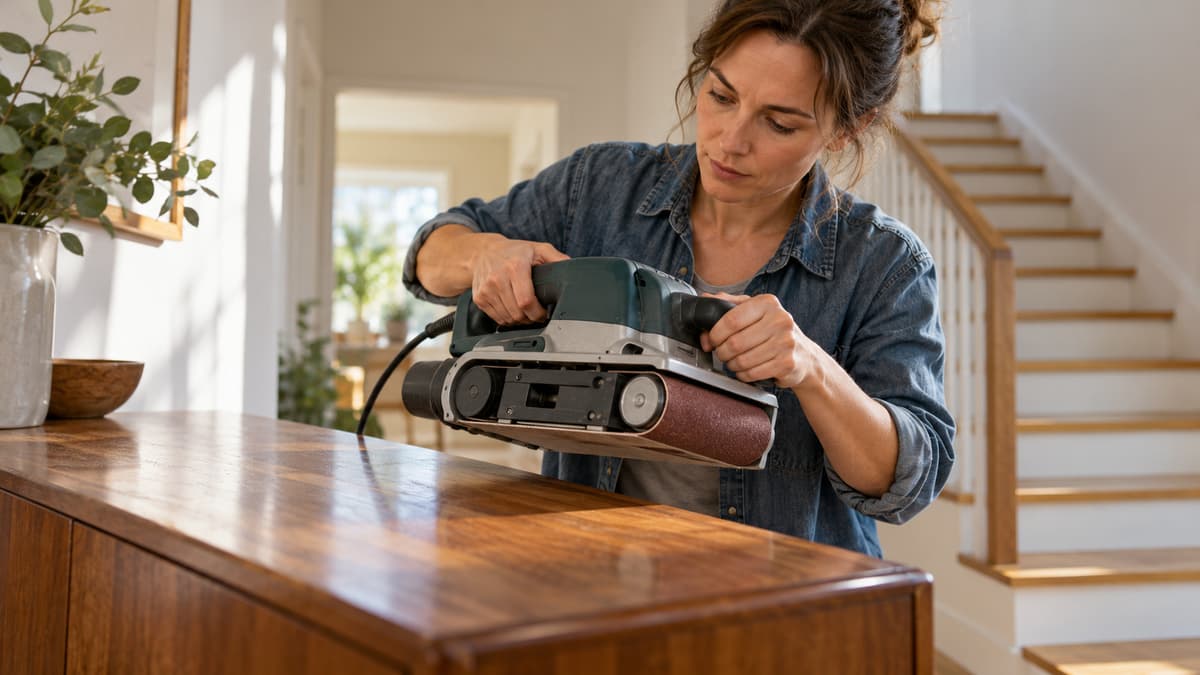
A belt sander gouges veneer, dishes a floor and can smoke if you lean on it. See when an orbital sander, a narrow file or a hire drum is the safer tool.
On this page

The sideboard is veneered, the staircase has a run of treads, and the belt sander on the bench is the heaviest sander you own. That weight is doing the cutting. A corded handheld in the belt sander comparison sits around 3 to 4.5 kg, with a belt about 76 mm wide, and it is built to strip paint and level solid timber. When not to use a belt sander is when that same machine meets a thin face, a coat you must not cut through, or a floor you need flat across a whole room.
This page is by Peter F., editor for DIY & tools at productscompared.co.uk. Prices and star ratings come from the amazon.co.uk listings in that comparison, captured on 16 October 2026. The dust point follows Health and Safety Executive guidance, and the unplug rule follows Electrical Safety First. We did not lab-test these tools. A qualifying purchase through our links can earn a commission at no extra cost to you.
In short
When not to use a belt sander is when the work is thin, already finished, or wider than you can keep flat. Veneer, a last coat and a whole floor need a lighter sander or a hire drum. Smoke, a damaged plug, or a belt that has already cut the housing means you stop and unplug.
When not to use a belt sander on a thin face
The belt only cuts where the plate presses it. On the GALAX PRO listing that plate is 75 by 170 mm, while motors in this set run from 720 W to 1010 W. Tip the tool onto the front roller, or let it sit, and it cuts a hollow in seconds. That warning is on the how to use a belt sander page.
On solid oak you can sand the groove out. On veneer the timber is a skin, and the groove is the core showing through. Homebuilding treats a belt sander as too aggressive for ordinary flat work, and the orbital as the usual tool.
The Einhell TC-BS 8038, our top pick, is £48.94 with 4.3 from 2,509 reviews. It is 800 W and 3.5 kg, with no speed dial and one P80 belt in the box. Reviewers say it runs away unless you keep both hands on it, and stored notes include a pine box that melted when the user pushed. A coarse belt you cannot slow down is a poor match for a face you must keep. A speed dial, where a listing has one, only slows the cut. It does not make that belt safe on a skin you cannot replace.
Old paint on solid timber is still a belt job, and a film between coats is where you change tool. MDF fails for the dust as well as the groove. HSE treats MDF dust as wood dust, and its construction guidance uses a belt sander as an example of very high dust even in a short burst. The workplace figures are 3 mg/m³ for hardwood and 5 mg/m³ for softwood. They bind employers, not a Saturday at home, and a cloth bag is not an M-class extractor, so use a mask and a random orbital when the sheet has to stay flat.
When the floor or the stairs need another machine
Reviewers in this set do sand boards with a handheld. GALAX PRO owners describe floorboards, and Einhell owners describe hours on scaffold boards. A patch, a deck or a hallway finished in an afternoon on P80 and then P120 can look acceptable once it is sealed. A living room often does not, because each pause of the front roller is a hollow and raking light shows it.
ManoMano's UK note prefers a floor sander for floors and treats a belt as rough stock. Hire a drum and an edger when the room has to be flat, which the belt sander for floorboards page sets out. Handhelds here cost about £45 to £64. The Bucktool at £159.99 weighs 13 kg and cannot sand a floor, and a cloth bag is not the control for a room of boards. One stained board does not need a drum.
A staircase sits closer to the floor than to a door strip. A 76 mm belt dishes a tread and rounds a spindle, because the grit is wider than the wood. The BLACK+DECKER KA900E is a 13 mm file, 350 W, at £47.94 with 4.5 from 95 reviews, and owners use it on treads and corners if they do not lean on it. It has no tracking adjuster. A flight you need level from wall to wall is a joiner or a hire drum.
A hung door fails faster still. The nose dips off the stile and the door swings, so take it off onto trestles, or leave it. A benchtop sander never reaches a leaf that is still in the frame.
Stop signs on the tool itself
Smoke, a burning smell or sparks at the motor end the session. Electrical Safety First's advice on sanders is to stop and unplug, and to let the housing cool rather than finish the pass. One stored DEKO review describes smoke within five minutes.
One stored review of the KATSU, the £44.99 900 W handheld, describes the belt flying off, the bearing seat breaking and the plastic melting in about ten minutes. The KATSU shows 4.3 from 40 ratings and only nine stored texts, so that melt is one report, not every KATSU. You still stop the tool that is hot in your hands. A second stored text on the same listing says the lock failed on first use.
A damaged plug is the same stop. These machines are 230 V and need a BS 1363 plug, so a cracked body, a burnt pin or a travel adaptor means it stays unplugged. The check before you buy is on the belt sander buying guide. There is no careful way to finish the door on a plug that is already damaged.
The housing is the stop you meet on an ordinary job. Tracking complaints run through the Einhell, the KA88, the GALAX PRO and the KATSU, and on the Einhell a walking belt can cut the surround until it jams. Once the case is grooved, new belts shred, and some owners report that jam after about six months. Track a fresh belt in the air, as the how-to page describes. If the case is already cut, the Consumer Rights Act 2015 short-term right to reject, generally 30 days, is the route for a new tool, and past that window you still stop.
What to use instead
For veneer, a de-nib between coats and a top you must not dish, use a random orbital sander. Those listings are on the orbital sander comparison. A belt leaves a straight scratch, and a pause is more likely to dig a trench. Thick paint on a solid door is still a belt job if you keep the plate flat. Change tools before the last coats.
For a corner, a spindle, a nosing or a weld, use the 13 mm file. The KA900E is the listing whose reviews describe that work. A 10 mm cordless belt, such as the JOJOCY sold without a battery, is a detail tool and a poor stand-in for a 76 mm handheld on a door. A triangular detail sander covers mouldings. None of them levels a tread from side to side, so a flight that has to be flat goes to a joiner or a hire drum.
For a whole floor, hire the drum and an edger and take the grit packs at the same time. For a few boards or a deck, keep the handheld moving and treat the cloth bag as a convenience. Connect a vacuum where the port allows, wear a mask, and empty the bag before metal, because a spark in fine wood dust is a fire risk. If the tool has already smoked, or the housing is already grooved, the substitute is another machine or a return to the seller.
Common questions
Can I use a belt sander on veneer?
Can a belt sander level a whole floor?
What should I do if the belt sander smokes?
Is a belt sander safe on MDF?
Can I sand a door that is still hung?
Is a power file better than a belt sander for corners?
Should I stop if the belt has cut the housing?
When should I hire a floor sander instead?

Peter F. is the editor for DIY & tools at productscompared.co.uk. Comparisons in this category are checked against amazon.co.uk listings, review evidence and public UK sources.
Related articles
Belt sander or random orbital sander
A belt strips paint fast and leaves tracks. An orbital is the flatter finish on doors, tops and coats you must not cut through.

Hire a floor sander or buy a handheld
A £50 handheld and a drum hire answer different floors. A whole room shows dips a patch never will.

Why the sanding belt keeps coming off
Tracking, belt direction and a housing that is already cut. Stop once the plastic is grooved.