Independent comparisons. We may earn from shop links. More info

Router table vs handheld router

Updated: 21 October 2026

You already own a plunge router, and the next job is a run of skirting or a few narrow mouldings in a UK garage. Choosing a router table vs handheld router means deciding whether inverting that router is worth the bench or the floor. A handheld router stays the better tool when the sheet is larger than the table top, or when you need to watch the cutter start and stop. Prices for the tables captured on amazon.co.uk on 19 October 2026 are on the [router table comparison](/hub/routers/router-table), and none of those tables includes a router. Peter F. checked the listings, with no lab test. A qualifying purchase can earn a commission at no extra cost to you.

You already own a plunge router, and the next job is a run of skirting or a few narrow mouldings in a UK garage.

Our top picks

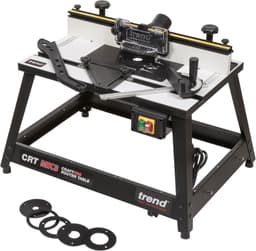
Trend Trend CRT/MK3

Best overall

Trend Trend CRT/MK3
9.0/10about £258.55
Charnwood Charnwood W012

Best value

Charnwood Charnwood W012
8.0/10about £88.50
Trend Trend WRT

Rank 3

Trend Trend WRT
8.6/10about £349.44
On this page

What changes when the router is inverted

With the router under the top, the cutter sticks up through an insert plate and you push the wood past it, in the same spirit as a small spindle moulder. Both hands press the piece against the fence, and a featherboard can hold a strip that would wobble under a handheld base. A repeat bead or rebate then lines up from one length to the next without you resetting a guide on every piece. The cost is access. A bit change means reaching under the table or lifting the router out, and dust falls toward the motor. Trend includes a no-volt switch on the CRT/MK3 so the motor does not restart after a power cut; on a smaller hobby table that switch is often extra. Inversion earns its keep when the fence, rather than your arms, does the alignment.

Stay handheld for these tasks

Large sheets stay put and the router moves across them. A kitchen worktop, a full door, or a sheet of plywood will not sit happily on a top of about 430 by 400 mm, and even an 804 by 604 mm standing table leaves you fighting the overhang. You can see the cutter and the pencil line, which matters for a stopped groove, a hinge recess, or lettering that must start and stop in the middle of the panel. Handheld work is also what you use when the piece cannot come to the shed. Trimming laminate on a fitted worktop, or easing an edge already fixed to the wall, needs the tool in your hands. The limit shows up on narrow stock: a 20 mm strip of architrave chatters or kicks if the base has nothing solid to sit on. That is when a table starts to make sense, not a reason to drop the handheld router for every other job.
Trend Trend CRT/MK3

Testsieger

Trend Trend CRT/MK3
9.0/10about £258.55

Move to a table for these tasks

Narrow stock, repeat mouldings, and larger cutters are the jobs that justify the footprint. A run of picture-frame stock or skirting beads is quicker once the fence is set and each length is fed from right to left, with the cutter turning anti-clockwise as you look down on the table. Thin offcuts sit flat, and a push stick keeps your fingers clear of the bit. A one-off round-over on a wide shelf does not need that setup. Cutter size is published guidance, not a lab score. Wonkee Donkee treats bits over about 44 mm in diameter as safer on a table than swung by hand, because that mass of cutter wants a fixed machine. It does not mean every table can take a panel raiser. Charnwood rates the W012 for cutters around 35 mm, so a large panel-raising bit can still be the wrong cutter on a hobby plate.

Benchtop versus free-standing in this comparison

The Charnwood W012 is the small hobby bench: about 430 by 400 mm, about 8 kg, for 1/4 inch routers, with an NVR that is optional rather than in the box. It sits on a shed bench if the router fits in about 260 mm under the top and the face plate is within about 190 mm. The insert is not pre-drilled. A taller router needs risers, and the cutter limit stays around 35 mm. The Trend CRT/MK3 is the middle bench. Trend states a 610 by 405 by 26 mm top, a height of 410 mm, and 13.6 kg, on 240 V with a no-volt release, and it still stands on a bench. A half-inch Trend router is the usual match, and UK buyers also cite the DeWalt DWE625. Ignore the amazon.co.uk line that lists this table at 1 kg; it does not match Trend's 13.6 kg. The Trend WRT is the free-standing end of this set, at 27.5 kg with a stated top of 804 by 604 mm. You walk up to it, and a small shed may not have that floor space. Who should skip each listing is on best router tables.

A simple decision path

If the router is a 1/4 inch model, the base is under about 190 mm, and you only ease a few edges a year, stay handheld. Add a W012 only when narrow strips or a repeated small moulding are the real jobs, and accept a cutter ceiling around 35 mm. Voltage, plate fit, and the switch belong in the router table buying guide. If you already run a 1/2 inch Trend or DeWalt and you want a 240 V bench table with an NVR, the CRT/MK3 matches, provided you can spare roughly 610 by 405 mm of bench. If you want standing height and can leave 27.5 kg on the floor under an 804 by 604 mm top, the WRT is the format built that way. Occasional DIY does not automatically earn either machine. One router can do both when the base fits the plate and you can lift it out. Mounting and feed are in how to use a router table. Keep the handheld router for large panels. Buy the table when repeat cuts, narrow stock, or a cutter you should not swing by hand justify the space.

Common questions

Should I buy a router table or use my router handheld?
Use the handheld router for large panels, for cuts where you must see the bit start and stop, and for timber that cannot come to the bench. Buy a table when you repeat mouldings, support thin stock, or use a cutter that is awkward in your hands. If those jobs are rare, the space costs more than it saves.
When is handheld routing still better?
Handheld routing is better for sheets and doors that overhang these tops, from about 430 by 400 mm on the W012 up to 804 by 604 mm on the WRT. It is also better for template work and for grooves in the middle of a panel, where you need to watch the bit. An edge already fixed to the wall cannot move to a table.
Do I need a floor-standing table or is benchtop enough?
A benchtop table is enough when the stock is short and you can spare the bench. The W012, at about 8 kg, and the CRT/MK3, at 13.6 kg with a no-volt switch, are both bench formats. Choose the floor-standing WRT when you want standing height and can leave 27.5 kg on the floor.
How much space does a router table need?
The W012 needs about 430 by 400 mm of bench and weighs about 8 kg. The CRT/MK3 needs a 610 by 405 mm top at a stated height of 410 mm and weighs 13.6 kg, so allow for the bench under it. The WRT needs floor space for an 804 by 604 mm top and 27.5 kg. Leave room to feed timber in from the right and out to the left.
Can I use large panel-raising bits handheld?
Guidance treats bits over about 44 mm in diameter as safer on a table than in a handheld router, because a cutter that size is hard to control in mid-air. That does not make every table suitable. The W012 is rated around 35 mm, so a large panel raiser can still be too big for a hobby plate. Match the bit to the stated limit.
Is a table worth it for occasional DIY?
For a few edges a year, a table is usually not worth the bench or floor it occupies. It earns its place when you repeat the same moulding, or when narrow stock keeps tipping under a handheld base. A 1/4 inch garage router points at staying handheld, or at a small bench table if those awkward jobs are real.
Can one router serve both handheld and table work?
Yes, if the face plate and body fit, and you can take the router out for handheld jobs. On the W012 that means a face plate within about 190 mm and about 260 mm under the top, and the plate is not pre-drilled. Trend plates suit many Trend routers. These tables do not include a router.

Related pages

Sources

Public UK sources from the research digest, used for this page in October 2026. Prices, stars and review counts are from the five amazon.co.uk listings captured on 19 October 2026. HSE dust limits and PUWER apply at work. They are not a certificate for a domestic table.

  1. HSE, Wood dust (retrieved 19 October 2026)
  2. HSE, WD5 Routers (retrieved 19 October 2026)
  3. legislation.gov.uk, PUWER 1998 (retrieved 19 October 2026)
  4. Trend, CRT/MK3 240 V (retrieved 19 October 2026)
  5. Trend, The fixed router (retrieved 19 October 2026)
  6. Charnwood, W012 bench top router table (retrieved 19 October 2026)
  7. Wealden, Safe use of a router (retrieved 19 October 2026)
  8. Electrical Safety First, Travel advice (retrieved 19 October 2026)