Independent comparisons. We may earn from shop links. More info

Router table dust extraction and safety

Updated: 21 October 2026

You have inverted a router under a bench in a UK garage, and pale dust is climbing the fence instead of entering the hose. Router table dust extraction decides whether you breathe that cloud. A port only offers the hose a connection. It does not prove airflow, filter class, or that the cutter stays off after a power cut. Peter F. used the five amazon.co.uk listings in the [router table comparison](/hub/routers/router-table), captured on 19 October 2026, and HSE guidance. There was no dust or noise lab test. A qualifying purchase can earn a commission at no extra cost to you.

You have inverted a router under a bench in a UK garage, and pale dust is climbing the fence instead of entering the hose. Router table dust extraction decides whether you breathe that cloud.

Our top picks

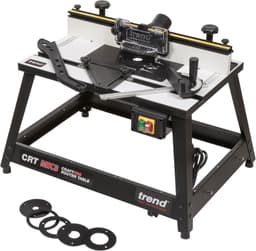
Trend Trend CRT/MK3

Best overall

Trend Trend CRT/MK3
9.0/10about £258.55
Charnwood Charnwood W012

Best value

Charnwood Charnwood W012
8.0/10about £88.50
Trend Trend WRT

Rank 3

Trend Trend WRT
8.6/10about £349.44
On this page

Why a router table throws fine dust

The cutter stands up through the plate and you slide the timber past it, with the motor under the top. HSE sheet WD5 says routers produce large quantities of dust and that a fixed head should be enclosed and extracted. A consumer fence mouth still leaves a gap around the bit. HSE links wood dust with asthma and a cancer risk, so brushing the bench later is a weak substitute. On an oak architrave the vacuum can be audible while a ribbon still runs the fence. The hose only takes dust that has already reached the port. We did not measure these five listings, so the ribbon is an example rather than a ranking. A Trend router manual says sound may exceed 85 dB(A), and that figure is the router rather than these tables. Wear hearing protection on a long session.

Dust ports on these five tables

Trend states a 57 mm outlet on the CRT/MK3 and the floor-standing WRT. Charnwood states 40 mm on the W012. The captured BOXURN BX-RT150 and SKIL SRT1039 listings give no diameter. A 57 mm port needs a hose that seats, because a rattling reducer leaks at the joint. You can hear the vacuum while dust still leaves the fence. The W012 does the same on 40 mm when an oval hose whistles. Neither outlet turns a household vacuum into a COSHH record. At home, a sealed domestic vacuum helps until the filter cakes and the open mouth wins. At work, WD5 asks for Class M or Class H extraction, which is another purchase entirely. A weekend bench and a workplace table split there.
Trend Trend CRT/MK3

Testsieger

Trend Trend CRT/MK3
9.0/10about £258.55

Workplace rules and a home garage

PUWER 1998 covers equipment used at work, not a private garage by default. Employ people, or rout as part of the job, and the duties sit with the employer. Keep a hose and skip dry sweeping in a hobby shed anyway. WD5 then asks for an enclosed cutter, Class M or Class H extraction, and an airflow indicator. The exhaust needs a thorough examination and test at least every 14 months. A shop vacuum on a 57 mm port is not a Class M certificate. HSE's hardwood limit is 3 mg/m³ over eight hours, and the softwood limit is 5 mg/m³. Mixed dust that includes hardwood uses 3 mg/m³, and those limits bind employers. For many machining jobs a respirator of assigned protection factor 20 backs up a hose that misses the cloud. It does not replace extraction.

No-volt release and switch habits

Extraction and restart are different risks. A no-volt release opens when power fails, so the cutter stays still until you reset it. Trend supplies that switch on the CRT/MK3 and the WRT. The W012 does not, and the Charnwood W026 is an optional extra. A home garage is outside an automatic PUWER duty, yet the switch still matters. Wealden's safe-use notes leave the trigger untaped. Tape, a mid-cut power loss, and a reset consumer unit spin the bit up under your hand. The no-volt switch prevents that only if it controls the supply. Some routers have anti-restart and switch themselves off when a table feed returns. Leave that behaviour in place and read the router manual before you pair the switches. Hand feed and the push stick are covered in how to use a router table.

Voltage, guards, and hearing

The SKIL SRT1039 is listed at 120 V, and UK mains are nominally 230 V with a BS 1363 plug. A UK plug or pin adaptor does not change the voltage. Electrical Safety First rejects a travel adaptor for a non-dual-voltage tool, and a 110 V site transformer is not a documented match here. If the listing and your socket disagree, choose a 240 V table, which the router table buying guide treats as a buying decision. Guard the cutter with the fence, a close-fitting insert ring, and a push stick or finger board. BOXURN's saw and jigsaw line is catalogue text, so mount neither in the plate. If a cutter grabs or a plate cracks, stop and call a competent person. Who should pause on 120 V, and who each table suits, is on our best router tables page.

Common questions

Does a dust port on the table mean I am COSHH compliant?
No. The port only accepts a hose. At work, WD5 expects enclosed Class M or Class H extraction, an airflow indicator, and a thorough examination at least every 14 months. A 40 mm or 57 mm spigot is not that system. At home the duty does not apply automatically, though a sealed hose is still worth fitting.
What hose size fits a Trend router table port?
Trend states 57 mm on the CRT/MK3 and the WRT. A hose of that size, seated without a leak, is the match. A smaller domestic hose needs a reducer that seals, or dust escapes at the joint. Charnwood states 40 mm for the W012. BOXURN and SKIL state no diameter in the listings we used.
Do I need a no-volt release switch at home?
Not under an automatic PUWER duty in a private garage. Add one if a power cut could restart the bit under your hands. Trend includes it on the CRT/MK3 and the WRT, while the W012 needs the separate W026. Leave the trigger untaped. If the router has anti-restart, follow that manual.
What is Class M extraction?
Class M is the medium-hazard class WD5 names, with Class H, for routers at work. It means extraction of that class plus an airflow indicator, not a household vacuum with a wood nozzle. Filling the bin does not create a Class M certificate. At work, clean settled dust with a Class M vacuum rather than a brush.
How often must extraction be examined at work?
WD5 asks for a thorough examination and test at least every 14 months on work equipment. That period is for workplace local exhaust, not for tipping out a garage vacuum. The airflow indicator covers the days between tests. A competent person should hold the schedule when routing is part of the job.
What are the UK wood dust exposure limits?
HSE sets hardwood dust at 3 mg/m³ and softwood dust at 5 mg/m³, as eight-hour averages. Mixed dust that includes hardwood uses 3 mg/m³. The limits bind employers. Dry sweeping puts settled dust back into the air those figures are meant to limit.
Is a 120 V router table safe on UK mains?
The SKIL SRT1039 states 120 V, against nominal UK mains of 230 V. A BS 1363 plug or pin adaptor does not convert voltage. Electrical Safety First treats a travel adaptor as the wrong tool for a non-dual-voltage appliance. A 110 V site transformer is not a documented match. Leave the plug alone and buy a 240 V table.

Related pages

Sources

Public UK sources from the research digest, used for this page in October 2026. Prices, stars and review counts are from the five amazon.co.uk listings captured on 19 October 2026. HSE dust limits and PUWER apply at work. They are not a certificate for a domestic table.

  1. HSE, Wood dust (retrieved 19 October 2026)
  2. HSE, WD5 Routers (retrieved 19 October 2026)
  3. legislation.gov.uk, PUWER 1998 (retrieved 19 October 2026)
  4. Trend, CRT/MK3 240 V (retrieved 19 October 2026)
  5. Trend, The fixed router (retrieved 19 October 2026)
  6. Charnwood, W012 bench top router table (retrieved 19 October 2026)
  7. Wealden, Safe use of a router (retrieved 19 October 2026)
  8. Electrical Safety First, Travel advice (retrieved 19 October 2026)