How often to check pipe insulation: an autumn check

Check visible pipe lagging once in early autumn, and again after a leak. Split foam shows before a thaw, and a fitted trace-heating cable needs a yearly test.
On this page
You lagged the loft pipes the year you moved in, and the foam has sat there since. The first hard night is a poor time to find a split along the slit, or a bare bend on the condensate where it leaves the wall. How often to check pipe insulation comes down to a short calendar: one walk in early autumn, another look if a joint has leaked, and a separate test if a trace-heating cable is already on the pipe.
Peter F. edits DIY & tools at productscompared.co.uk. This page uses public UK guidance and the amazon.co.uk listings in the pipe trace heating set, and there was no cold-room test. A qualifying purchase through our links can earn a commission at no extra cost to you.
In short
Once a year, in early autumn, is enough for a house you live in, if you look at the pipes you can reach. You are looking for split foam, a sleeve that has slipped, and a fitting left bare. Test a trace-heating cable once a year if one is fitted. A house empty in a cold week needs someone who can reach the stop tap. That visit is separate from any weekly round an insurer describes for an empty commercial site.
Inspect pipe lagging in autumn
Early autumn, once a year, is the right interval for a house you sleep in. Protector Insurance tells householders to check visible pipe and tank lagging then, including outside taps and condensate pipes. Wessex Water puts the job before temperatures fall. WaterSafe says you lag before cold weather and you know the stop tap.
RSA's escape-of-water guidance also says inspect lagging before winter and test trace heating yearly. That note is written for commercial property. Use it as insurer guidance for sites, and keep a lived-in house to one walk of the pipes you can see.
September or early October suits much of England and Wales. Higher ground and much of Scotland can turn sooner, so follow the forecast you have. A look in November still helps. A look during a thaw only shows which pipe already froze.
Walk the airing cupboard, the pipes under the sink, a garage on an outside wall, the loft if the boards will take your weight, and the condensate outside. Check a cold-water cistern jacket only if a tank is still in the roof. Start at the stop tap and confirm it turns, then put it back.
A Gas Safe registered engineer covers the boiler and the flue at the annual service. You leave the case closed.
What a failed lag looks like
A failed sleeve shows at the slit. The foam is split so it can open over the pipe, and that slit is where it tears. On a vertical pipe the sleeve often slides down and leaves the top bare. Tape lets go at elbows, and valves and tees stay bare because they were the fiddly part when the straight lengths went on.
The Energy Saving Trust heat-pump toolkit treats pipework insulation as part of an annual service, because foam gaps open as the material settles. That line is about heat-pump pipework and sits with the installer's visit on that system. The same settling shows on a gas-fired system lagged several years ago. If you can see metal, or you can slide a finger between foam and pipe, that spot will do little on a night below freezing.
Wet foam is finished. A weep soaks the sleeve, and the sleeve stays compressed after it dries. Stop the leak, let the pipe dry, and fit a new piece. Tape on the old foam leaves a damp slit.
Match the new sleeve to the outside diameter. Domestic copper pipe on heating and hot water is commonly 15 mm or 22 mm, and a sleeve for the larger size rattles on the smaller pipe. A plastic condensate is a different material, covered in our PVC pipe comparison, and the bend still needs a cover. Outside, Protector includes the garden tap. Cracked foam there means a bare tap, and a loft offcut is often the wrong bore once it is in the wet.
Condensate insulation and a yearly test
The condensate freezes after a careful loft job because it is a small plastic discharge that often runs outside. A bare bend at the wall can block it, and the boiler locks out even though the radiators were warm the day before. TM Hughes, a heating contractor, says check condensate insulation in autumn. Treat that as a reminder from a firm that does the work, not as a British Standard. Follow the pipe from the boiler to the outside, and stop where the foam stops short of a bend, a clip, or the wall.
If a cable is already fitted, test it on the same walk. A cable under a split sleeve heats the open air. RSA's commercial guidance says test trace heating annually, and that yearly interval is the one to use at home. Follow the maker's instructions, confirm the sleeve covers the heated length, and leave the cable uncut. If it is on a fused spur and you are unsure how to isolate it, ask an electrician.
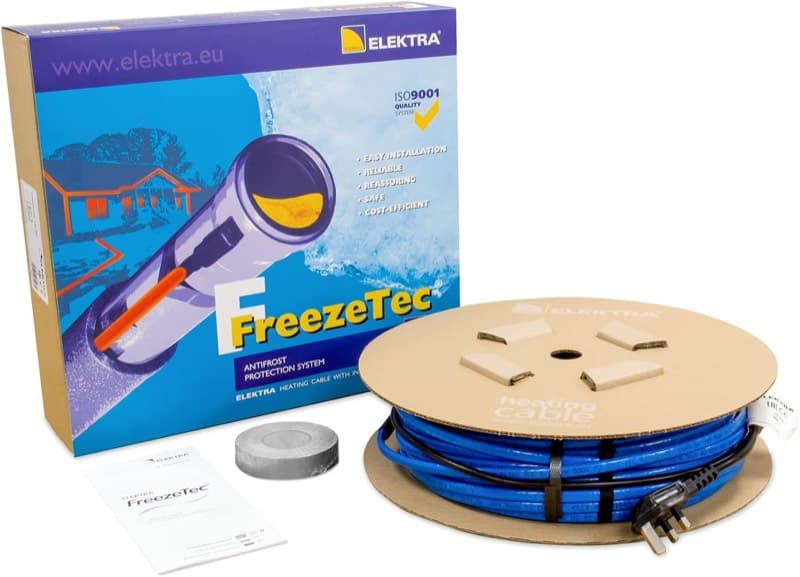
Buy a cable when the lagging is complete and a short external condensate still freezes. In our pipe trace heating comparison the top pick for that short discharge is the Elektra FreezeTec 3 m kit, ASIN B00HQEX4DS, at £57.49 on amazon.co.uk. The listing states 12 W/m, 36 W and 230 V, with a built-in thermostat, and the title names a freezing condensate pipe. Switch points and a BS 1363 plug are not in the capture.
The 4.5 from 48 reviews is shared with the 5 m kit at £66.49, stated at 12 W/m and 60 W. One 2017 report says a unit drew no current in an ice bucket at about minus 3°C. That is the listing record, not a test we ran.
About three metres suits the 3 m kit. Nearer five metres suits the longer one. Clip the cable, then lag over it.
An empty house in a cold week
A house empty for a fortnight in January needs a person who can get in, not a weekly inspection round. RSA says increase visits if a commercial property is empty in a cold spell. Take the warning, and leave that site routine with commercial customers. Your person needs to know which way the stop tap turns. WaterSafe treats that knowledge as part of protecting a house against frozen pipes.
Tell them whether the heating is on a frost setting, and that a frozen condensate can shut the boiler down. Ask them to look at the places you named, to turn the water off if something is wet, and to call you. Keep them off an unboarded loft.
If the house will be empty all winter, do the lagging walk before you leave. A full drain-down of a cylinder and any loft feed is a plumber's job. Opening a downstairs tap does not empty those pipes.
Close the gap before another cable
Split foam is a sleeve repair until the pipe is covered again. Cut out the damaged length, meet sound foam at both ends, and cover the fitting the old piece missed. Tape holds the slit shut. A 15 mm copper pipe needs a 15 mm sleeve, so measure before you order.
Repair the sleeve before you price a cable. The usual case for a cable is the external condensate. A heating pipe in a warm airing cupboard rarely needs one. A loft pipe needs new foam on this walk, and a cable only if that roof will freeze the water while the house is empty. Neither kit above repairs a split sleeve on a different pipe.
After a leak, bin the soaked foam once the joint is dry. Wet foam does not recover its thickness. Put next autumn back on the calendar, because new foam still settles and tape still lets go. Leave dry, screwed boxing closed, and open a panel only if you see staining.
Common questions
Is once a year enough?
Which month should I look?
What am I looking for?
Do I open every boxing-in?
How often is trace heating tested?
What if the house is empty in January?
Does a boiler service include the loft lagging?
What do I do if the foam is split?

Peter F. is the editor for DIY & tools at productscompared.co.uk. Comparisons in this category are checked against amazon.co.uk listings, review evidence and public UK sources.
Related articles

Lag pipes before a cold snap
What to cover on loft, garage and outside-wall pipes before the temperature drops, including fittings the foam often misses.

When a condensate pipe needs trace heating
When lagging is enough on a boiler condensate pipe, and when a short external run still freezes without a cable.

Joining copper pipe without solder
How to make a sound joint on a weeping copper run without a flame, once you have found the leak under the lagging.