Lag pipes before winter: match the pipe, then the cold

Lag pipes before winter in a loft, garage, or on an outside wall. Match the bore, cover valves and bends, and do not treat one foam thickness as the rule.
On this page

The forecast can still say 8°C while the loft is already the coldest part of the house. A 15 mm feed above the quilt, a rising main in an unheated garage, or a pipe on an outside wall sits near the outdoor air long before the kitchen feels cold. You lag pipes before winter while the foam will still close on a dry pipe and you can reach the valve.
Foam slows heat leaving the water. It does not heat a pipe that has already frozen, and it does not replace a heated cable on a boiler condensate that discharges outside.
In short
Lag pipes in unheated spaces before the first frost, not during it. Match the sleeve to the pipe, tape the seam, and cover fittings as well as straight lengths. One thickness does not serve both frost protection and cutting heat loss, and lagging does not add heat to an external condensate pipe.
Lag pipes before winter, not during the freeze
Wessex Water tells customers to lag before autumn, and it names outdoors, garages, lofts, and basements. The chance of a freeze rises once the air is below 0°C. A mild week in October or November is the working window. Waiting for a named cold snap puts you in the loft when the pipe is already near the temperature that splits it.
Energy Saving Trust says to turn the heating off and let hot pipes cool before you handle them. Flow and return beside a cylinder, and the pipes on a combi in a garage cupboard, can still burn a hand and soften cheap foam. Do not drain a vented system just to slide a sleeve on.
The miss is to lag only what you can reach from the hatch and to leave the run under the eaves. Foam does not make joists safe. If you cannot put your weight on a board, stop.
If a pipe has already frozen, do not force foam over a bulge or pour boiling water along a joint. Thaw slowly from the warm side of the house, open a tap so meltwater can escape, and lag only once you know the pipe has not burst.
Pipe insulation in the loft, garage, and outside tap
Wessex Water and Severn Trent both name lofts, garages, and outside taps as the pipes that freeze first. A basement and a void on an outside wall belong on the same list. A pipe in an internal stud wall, with rooms on both sides, is rarely first. An outside-wall chase is different: the plaster feels ordinary and the copper sits against cold masonry.
Severn Trent's free lagging is a size check, not a shopping list. Those lengths are for 15 mm pipe and are 2 m long. Many loft cold feeds are 15 mm copper. 22 mm is common on hot feeds and on some rising mains. Measure the outside before you buy a sleeve. The copper pipe comparison is for a replacement length, not a substitute for that measurement.
WaterSafe says not to put loft insulation under a cold-water tank. The quilt goes around the tank and across the floor beyond it, so the base can still take warmth from the ceiling below. Lag the pipes that leave the tank, including a warning pipe in the cold part of the loft. Glass fibre pushed underneath isolates the tank from the only heat it had.
Lag the pipe that rises to an outside tap, and the tap body if it stays full through winter. Where an indoor valve isolates that tap, shut it, open the tap, and drain the outdoor leg before a cold spell. A hose left screwed on holds water that freezes and can split the tap.
Thickness is not one number
Match the pipe diameter before you leave the aisle. A sleeve sold for 15 mm should close on 15 mm copper without an air gap, and a 22 mm sleeve should do the same on 22 mm. Severn Trent says to tape the seam. If the split gapes, the thickness on the packet is not the thickness on the pipe.
Energy Saving Trust says to use the thickest insulation that will still fit, and to seal the ends. That pulls against a matched bore when the pipe sits in a notch or against a joist. Do not crush the sleeve flat and call it lagged. Clear the obstruction, or tape a shorter thick piece to the next one.
Frost protection and heat-loss insulation are different tables. Installer Online, discussing BS 5422:2009 and the water regulations, gives an example frost line of 25 mm on 15 mm copper and 19 mm on 22 mm copper, and a different figure for saving heat. Treat those millimetres as that article's reading of the standard, not as a copied table and not as one legal thickness for every house. Thick foam with an open end at a tee behaves like a short coat.
Fittings, not just straight pipe
Straight foam is the quick part. The cold spot is usually the brass: an elbow on a wall plate, a gate valve under a tank, or a tee where the kitchen feed leaves the loft. Brass sheds heat faster than the lagged copper either side, so a bare fitting is a bridge however tidy the straight runs look.
Cut the sleeve up to the fitting, then cover the fitting. Preformed insulated elbows exist for common 15 mm and 22 mm bends. If you only have straight foam, mitre two pieces around the bend and tape every cut face, not only the long seam. Leave the stopcock handle free to turn. Boxing a valve in so you cannot isolate the house is a worse failure than a sleeve that stops short of the spindle.
Six elbows and two valves can take as long as three metres of straight pipe. If a valve will not take a sleeve and still turn, lag up to the body, keep the handle clear, and do not call the fitting covered.
What lagging does not fix
Foam slows heat loss. It does not put heat back. A still pipe in a loft at minus five will eventually match the air around it. Lagging buys time through a cold night. It will not mend a pipe that split last winter. A sleeve over a pinhole only moves the drip into the foam.
If you replace a split length, match the size on the copper pipe comparison before you buy foam for the new piece. The top pick is the PlumbUniverse 15 mm copper pipe, 1 m, at about £9.49, with 4.4 from 164 reviews. Use it for a short water or closed-heating repair after you check the stick for dents. The wall is printed as 1 with no unit, BS EN 1057 is not named, and a gas line in the bullets is not a reason to fit gas yourself.
A boiler condensate is easy to confuse with a cold feed. It often leaves the building, and insulation on that external pipe is its own specification. Foam copied from the loft, or foam treated as a heated cable, is how a boiler locks out while the kitchen taps still run. The decision is in when a condensate pipe needs trace heating. The kits are in the pipe trace heating comparison.
A short condensate kit is not loft lagging
The top pick there is the Elektra FreezeTec 3 m kit, listed at £57.49. The amazon.co.uk listing states 3 m, 12 W/m, 36 W, 230 V, and a built-in thermostat, and the title names a condensate pipe. The 4.5 from 48 reviews is shared with the 5 m kit. Switch points and a BS 1363 plug are not in the captured page. One 2017 review reports no current in an ice bucket. You still lag the pipe. It is the wrong buy for a loft cold feed.
A qualifying purchase on amazon.co.uk from the copper pipe or pipe trace heating comparison can earn us a commission at no extra cost to you. We did not freeze a pipe in a lab. Product figures are from the captured listings. The lagging rules are from water companies, Energy Saving Trust, WaterSafe, and a published reading of BS 5422.
Common questions
When should I lag pipes if the forecast is still mild?
Which pipes freeze first?
How thick should pipe lagging be?
Does the foam bore have to match 15 mm?
Do valves and bends need lagging too?
Should I put loft insulation under a cold-water tank?
Does an outside tap need insulation?
Does lagging replace trace heating on a condensate pipe?

Peter F. is the editor for DIY & tools at productscompared.co.uk. Comparisons in this category are checked against amazon.co.uk listings, review evidence and public UK sources.
Related articles

How often to check pipe lagging
Split foam and a bare condensate bend show up in autumn. Look then, not after a thaw.

When a condensate pipe needs trace heating
Trace heating is a last resort on an external run, not a substitute for an internal drain.
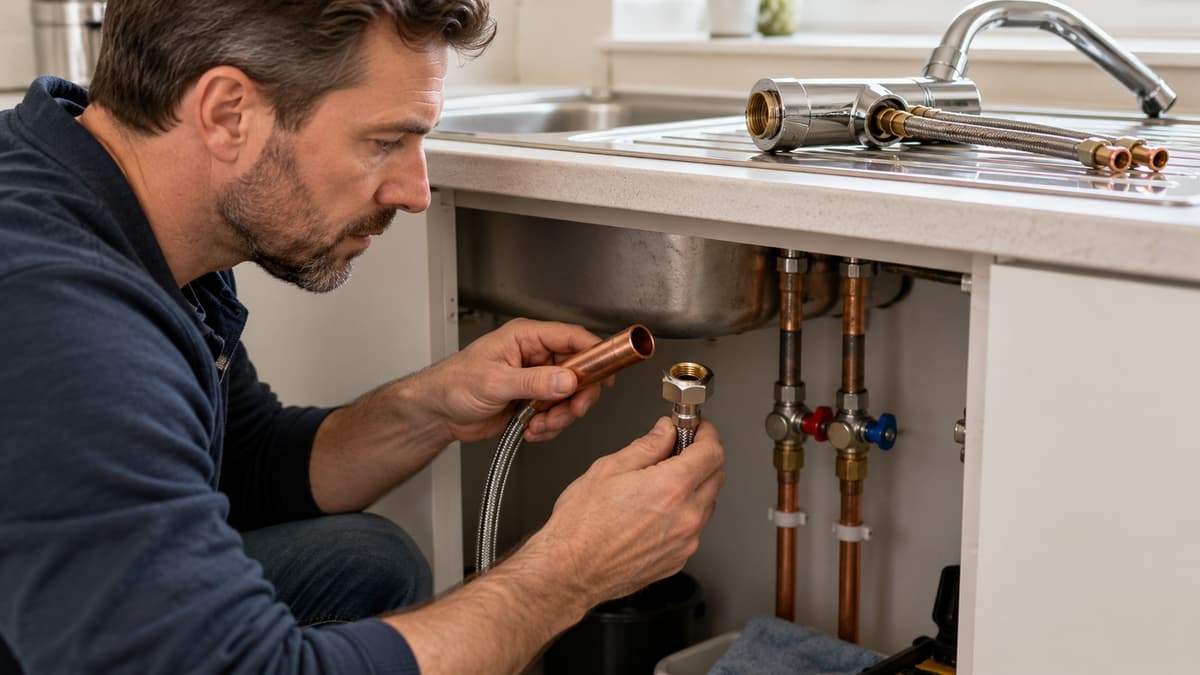
Which copper pipe size a kitchen tap needs
15 mm, 22 mm, and a half-inch tap tail are easy to mix up on a kitchen supply.