Condensate pipe trace heating: when the run still freezes

A frozen outside condensate pipe can lock out your boiler overnight. See when an internal drain, 19 mm insulation, or trace heating is the right UK step.
On this page
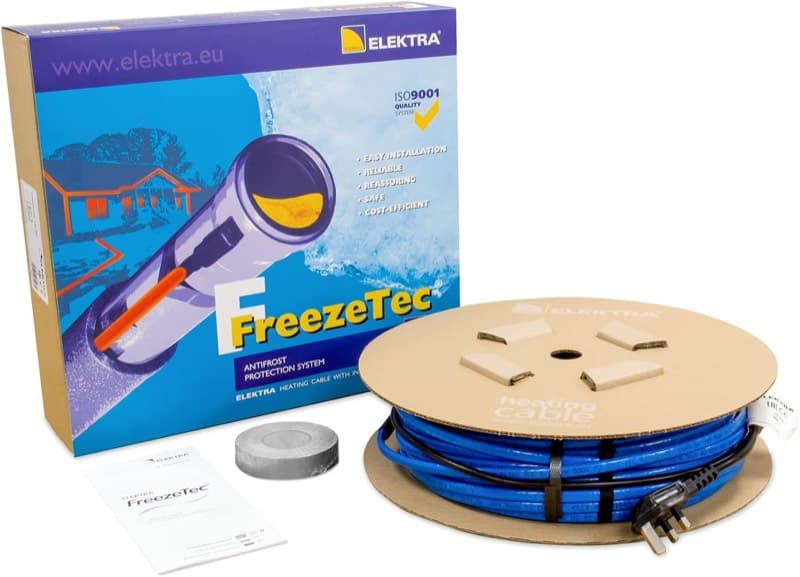
The heating stops on the first hard frost, the radiators stay cold, and the plastic pipe that leaves the boiler through the outside wall is solid with ice. That pipe carries condensate, the water a condensing boiler produces while it runs. When the water cannot get away, the boiler shuts the burner down, and you lose heat and hot water together.
Condensate pipe trace heating is the cable many households search for at that point. It earns its place on a run that still has to stay outdoors, once an internal drain and the right insulation have been considered. The cable maker's instructions, and a competent person for the mains connection, still sit between a listing and a working boiler.
In short
Terminate the condensate inside, on a foul drain, wherever the building allows it. If the pipe must stay outside, HHIC guidance that cites BS 6798 asks for at least 30 mm inside diameter and insulation, and the installer guide recommends at least 19 mm Class O insulation on a 32 mm external pipe. Trace heating, with a thermostat and the cable maker's instructions, is an extra for that external length. It leaves the route, the bore and the lagging in place.
Internal termination is the first answer
Walk outside before you open a shopping tab. The plastic pipe on the wall, dropping from the boiler towards a gully or ending in the air, is an external boiler condensate run. A still night below freezing can turn that trickle into ice. A kettle of warm water may clear one morning. The next cold week is still there.
HHIC's news note on BS 6798 says the pipe should terminate internally wherever possible. The installer guide prefers an internal connection to a foul drain, so the pipe sits in the heated part of the house. After a lockout, the first question is whether this discharge can reach that drain. A longer path across a kitchen or a cupboard is often why the pipe was left outside, and the guidance still treats the outdoor run as the exception. If you cannot see a stack or an internal waste nearby, note that for the engineer rather than guessing a connection from the pavement.
Leave the boiler case shut. The trap and the flue seal sit behind that panel. From the hallway and the garden you can already see that the pipe leaves the building, and you can measure how far it runs in the open. A Gas Safe registered engineer changes the connection. Book that visit before you spend money on a cable.
What an external run has to have
Some houses cannot take the condensate inside without a large rebuild. A flat whose only soil pipe sits beyond a neighbour's wall is a fair example. When the run stays outside, HHIC's news note, citing BS 6798, calls for at least 30 mm inside diameter and insulation. A narrow overflow-style tube is a common sight on older installs, and it ices first because there is little water and a lot of cold surface.
The installer guide adds a separate figure. For 32 mm external pipes it recommends at least 19 mm Class O insulation. Class O is the letter O, as that guide writes the class. It describes lagging thickness on that pipe size. It is not a score for a heating cable, and it does not show that an amazon.co.uk listing meets BS 6798. Thirty millimetres is the bore. Nineteen millimetres is the insulation on a 32 mm external pipe. A slim foam sleeve from the same basket as the cable can miss both.
Foam that has pulled back from an elbow leaves the bend bare, and the bend is where ice often starts. Crushed foam you cannot pinch out to a real thickness is no longer the 19 mm layer the guide describes. A cable on a pipe still well under 30 mm inside diameter leaves the water path small. Measure the exposed length with a tape. That length is what any cable has to cover.
Where condensate pipe trace heating fits
The installer guide allows a heating cable once the pipe is outside: increase the bore, insulate, and add the cable in line with the maker's instructions. Benchmark's copy says the arrangement uses an external thermostat, and that the other condensate rules stay in force. The heated length has to cover the exposed length. A cable that stops short leaves a cold joint that can still freeze.
The top pick in our pipe trace heating comparison is the Elektra FreezeTec 3 m kit, amazon.co.uk ASIN B00HQEX4DS, stated at 12 W per metre, 36 W and 230 V, with a built-in thermostat. The title names a condensate pipe, and the comparison shelf price is £57.49. Three metres suits a short drop. The 5 m kit, ASIN B00HQEX6W2, is £66.49 at 60 W and shares the 4.5 from 48 reviews, so use it when the run is nearer five metres.
Benchmark speaks of an external thermostat. Elektra states a built-in one, and the captured file does not print the switch temperatures. A shared review mentions warmth below 2°C. A 2017 review reports no current in an ice bucket at about −3°C. We compared amazon.co.uk listings and did not freeze-test the kit. A qualifying purchase through our links can earn a commission at no extra cost to you. Confirm the live page, including the plug, because £57.49 can change.
What a cable listing does not tell you
A title that says condensate shows the seller had a boiler in mind. It does not show that your pipe is 30 mm inside, that the lagging is 19 mm Class O, or that the boiler maker allows a cable on that model. Those facts sit in the HHIC guidance, the boiler instructions, and the pipe on your wall. The buying guide separates stated watts, voltage and thermostat claims from titles that only say the cable is for pipes.
Read the supply before the stars. UK mains are 230 V, so a listing that states 230 V can be checked against that. A listing at 200 V, or with the voltage missing, is a different purchase even when the photo shows a blue coil. The captured FreezeTec file does not state a BS 1363 plug, and a British socket expects a UK three-pin plug the page actually names. If the live listing is silent, ask the seller before the parcel arrives.
Self-regulating and thermostat are different claims. FreezeTec is worded as a built-in thermostat, while other tapes leave the control blank. The page on self-regulating and constant-wattage cables keeps those constructions apart. Stars, including the shared pool of 48, are other buyers' comments, not a BS 6798 result. The skip list sits on the top pick page.
When a Gas Safe engineer takes the job
Book a Gas Safe registered engineer when the condensate connection has to change. That includes an internal foul drain, a pipe still around 21 mm, and any job that means opening the boiler. A 21 mm mark sits under the 30 mm inside-diameter figure in the HHIC news note, and you still need to know whether 21 mm is the inside or the outside. If the marking is ambiguous, stop. A cable on an undersized pipe leaves that part of the guidance unmet.
Hand the mains side to a competent person. Connecting a kit is electrical work, and this guide will not describe cores or a plug pattern. HSE publishes electrical guidance for duty holders. It is not the condensate installer guide, and it is not a wiring method for a boiler pipe. Follow the cable maker and the boiler maker, and give both documents to the person who connects the supply.
HHIC and the Energy and Utilities Alliance have argued for stronger Building Regulations enforcement, because frozen runs keep taking boilers offline. That is an industry position, not a notice on your house. Before the visit, photograph the route and measure the exposed length, the pipe size and the lagging. A new cable on an undersized, bare pipe misses the supported order: internal connection, then bore and insulation, then a thermostat-controlled heated length. A listing cannot sign the boiler off.
Common questions
Why does the boiler stop when the condensate pipe freezes?
Should a boiler condensate pipe be inside?
What diameter does an external condensate pipe need?
Is insulation enough without a heating cable?
Does condensate pipe trace heating need a thermostat?
Can I fit a condensate heating cable myself?
What if the condensate pipe is already 21 mm?
Who should change a non-compliant condensate run?

Peter F. is the editor for DIY & tools at productscompared.co.uk. Comparisons in this category are checked against amazon.co.uk listings, review evidence and public UK sources.
Related articles

Lag pipes before a cold snap
Match the lagging to the pipe and cover the fittings before the temperature drops.

How often to check pipe lagging
Split foam and a bare condensate bend show up in autumn, well before the thaw.
The fall an underground drainage pipe needs
A 100 mm underground drain that is too flat blocks, and a short cut does not set the fall.