Underground drainage pipe fall: 1:40 in millimetres
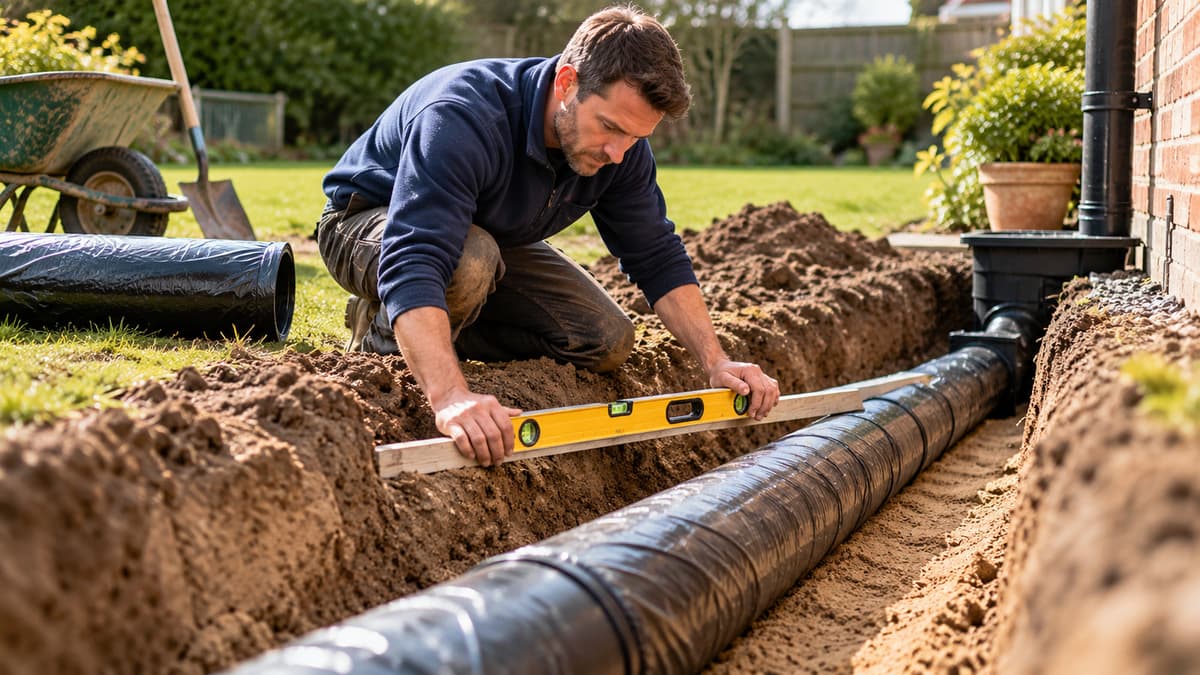
A low-flow 100 mm foul drain needs an underground drainage pipe fall of 1:40, or 25 mm per metre. A one-metre shop pipe does not set that gradient for you.
On this page
You have a short run of foul drain to lay from a gully across the garden, the 110 mm pipe is still in its wrap, and the trench bed looks almost level. Level is the failure. Too flat a 100 mm pipe holds solids, and the underground drainage pipe fall is a measured drop along the trench, not a feature printed on a one-metre length from amazon.co.uk.
The figures below are the LABC reading of Approved Document H for England and Wales. Scotland and Northern Ireland have their own technical handbooks. Nothing here designs a connection to a public sewer.
In short
A 100 mm foul drain carrying under 1 litre a second wants a fall of 1:40, which is 25 mm per metre. Where the flow is over 1 litre a second and a WC is connected, LABC allows 1:80, or 12.5 mm per metre. A short plastic length from a shop does not create either gradient, so you set the drop in the trench bed.
What underground drainage pipe fall a foul pipe needs
Foul water has to keep moving. LABC, writing up Approved Document H, says an underground foul drain is at least 75 mm, and 100 mm if it serves a WC. Under 1 litre a second, that 100 mm pipe wants 1:40. Over 1 litre a second, and with a WC connected, LABC allows 1:80, while a 150 mm drain can be 1:150. Keep those as the LABC reading.
Council pages often compress the table. Redbridge states 1:80 where a WC is on a 100/110 mm pipe, and 1:150 on 150/160 mm where there are enough WCs, and that version drops the low-flow 1:40 case. If the summaries disagree, follow the Approved Document and use LABC's flow split. If you do not know whether the run is under or over 1 litre a second, keep the steeper figure, because a small flow leaves solids on a flat invert. Several WCs can be the higher-flow case, and that judgement is design work.
Set pegs at each end, pull a string line, and measure the drop with a tape before any pipe touches the bed. Backfilling first locks a flat bed in place. These millimetres are the England and Wales route, including the Welsh Government copy of the same document. They are not the Scottish or Northern Ireland handbook.
What 1:40 and 1:80 mean in millimetres
1:40 is one unit down for every 40 along. A metre is 1,000 mm, so the fall is 25 mm per metre, and 1:80 is 12.5 mm per metre. Four metres at 1:40 drops 100 mm, and six metres drops 150 mm. The same six metres at 1:80 drops only 75 mm, which a sagging string will hide. A one-metre offcut falling 25 mm along its own body says nothing about the rest of the lawn.
A 600 mm spirit level can check the ratio on a straight bed. At 1:40 the downhill end wants a 15 mm packer, because 600 divided by 40 is 15, and at 1:80 the packer is 7.5 mm. Check two or three positions rather than one reading at the gully. If you are 10 mm short at the end of a four-metre run, the pipe will not invent that drop after you joint it. Using 12.5 mm per metre on a low-flow 100 mm pipe is the flat drain LABC is trying to stop.
Pipe size before you pick a gradient
Gradient comes after diameter. LABC's minimum for underground foul drainage is 75 mm, and the pipe becomes 100 mm as soon as a WC connects, so a run that might gain a loo is already a 100 mm job. Buying 75 mm today forces a second trench later. The 1:150 figure belongs to 150 mm pipe, about 6.7 mm per metre, and it is not a substitute on a 100 mm pipe. Shops often print 110 mm on the pipe the guidance calls 100 mm, which Redbridge pairs as 100/110 mm.
Solvent-weld waste and ring-seal underground pipe can share a headline size and still be different systems. The PVC pipe comparison is about waste joints, not a buried foul run with a rodding point. On amazon.co.uk the eco-filtration listing is a 1 m black solvent-weld waste pipe at a stated 110 mm and £19.99, with no ring seal and no British Standard named. A stored size of 11 cm by 10.2 cm does not describe that metre. Five short UK reviews, inside a 4.2 from 17, never show a trench.
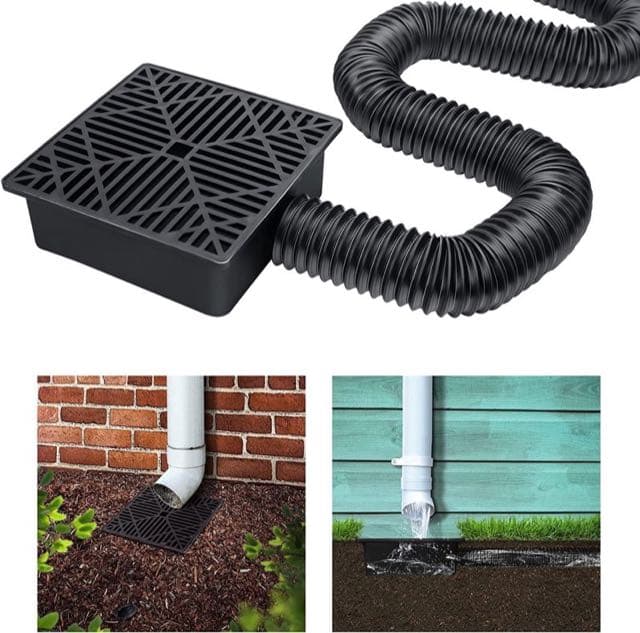
The GIONAR catch-basin kit, the highest score in the set, is £20.99 and includes a basin, a pipe stated from 16.14 inches to 5.1 feet, a hose adapter, and a grate. The amazon.co.uk line is 4.4 from 134 ratings for short rainwater runs. There is no 110 mm socket, and a stored 41 cm outside diameter conflicts with a 6.5 cm width. A qualifying purchase through our links can earn a commission at no extra cost to you. Neither box sets the fall, so the gaps stay on the underground drainage pipe page.
Why a long plastic pipe ends up with a backfall
A fall on the pegs can disappear once the pipe is in. LABC points out that long plastic pipes can bow and create a backfall, a short length that slopes the wrong way so solids sit in the hollow. At 1:80 you have 12.5 mm of drop per metre, so a pipe on a socket at each end that sags 20 mm in the middle has already built a sump. The upstream face falls in and the downstream face rises. Packing soil only under the collars, where the pipe looks supported, is the usual way that hollow appears.
Plastic moves a little once the trench is warm and the backfill is on it, so a fair line at noon can hold water by the weekend. You meet it as a slow gully or a rod that stops in the same place, and rodding clears the wad without adding the missing fall. Lay the pipe on a continuous bed, and check the invert at the sockets and halfway between them before you cover the crown. Lower a high joint by easing the bed. Forcing the barrel down with a boot starts the next kink.
LABC names the bow. The note we used does not give a trench width, a gravel grade, or a clip spacing, and this article will not invent them. A rigid solvent-weld waste pipe is a poor stand-in even when the diameter looks right, because underground plastic is specified around flexible joints.
Where a garden drain stops being a DIY job
You can measure 25 mm per metre and still be outside the job a shopper should finish alone. Approved Document H covers underground foul drainage from the building to the sewer, and it expects a connection to a public sewer where that is practicable. Opening the sewer and agreeing the invert are not a weekend with a 1 m offcut. This page cannot tell you that your gully is notifiable. Building control applies the document in England and Wales, while Scotland and Northern Ireland use their own technical handbooks.
If the public sewer sits higher than the garden outlet, no underground drainage pipe fall in the lawn will lift the sewage. Extra steepness only uses depth you may not have. Put a tape on both inverts, and if the sewer end is the high end, backfill and get someone who designs drains. A pump or a new route is that design, and it is not inside a catch-basin kit whose pipe stops at 5.1 feet. The one-metre solvent-weld pipe at £19.99 has the same limit: it does not keep a foul run self-cleansing.
We checked the LABC article, the 2015 Approved Document H, the Welsh Government copy of that guidance, the Redbridge summary, and the amazon.co.uk listings above, in October 2026. Redbridge stays secondary to the Approved Document. We did not dig a test trench or reproduce British Standard text.
Common questions
What fall does a 100 mm foul pipe need?
What is 1:40 in millimetres per metre?
Is rainwater the same fall as a foul drain?
Can I use 75 mm if there is no WC?
Why do long plastic pipes end up with a backfall?
Do I need building control for a new drain?
What if the public sewer is higher than my garden?
Is a 1 m offcut from a shop the right product?

Peter F. is the editor for DIY & tools at productscompared.co.uk. Comparisons in this category are checked against amazon.co.uk listings, review evidence and public UK sources.
Related articles

MDPE or PVC for a garden water run
Blue MDPE is the drinking-water pipe. Black poly and PVC are a different job once the run is buried in the garden.

Push-fit or solvent weld for waste pipe
The two waste systems can share a nominal size and still refuse to join. Check the socket before you buy a length.

When a tube is not as described
If the amazon.co.uk title and the technical block disagree, the remedy sits with the seller under the Consumer Rights Act.