Independent comparisons. We may earn from shop links. More info

Self-regulating vs constant-wattage heat trace on a plastic pipe

Updated: October 2026

Two listings can both say “self-regulating” and behave nothing like each other once they are taped to a plastic pipe. One is a cable whose output falls as that spot on the pipe warms. The other is a fixed-wattage tape that keeps putting the same heat out until something else switches it off, or until the pipe softens. Self regulating vs constant wattage heat trace is that split, and the amazon.co.uk row that shows the failure is a 4 m tape stated at 160 W. This page is the construction and the melt, not a length picker. The ten products sit on the [pipe trace heating comparison](/hub/rods-and-pipes/pipe-trace-heating).

Two listings can both say “self-regulating” and behave nothing like each other once they are taped to a plastic pipe. One is a cable whose output falls as that spot on the pipe warms.

Our top picks

On this page

What self-regulating means

In the construction Chromalox describes, a self-regulating cable has a polymer core between two bus wires. As the polymer warms, its resistance rises and the local output falls. The adjustment is along the cable, not a single on-off switch for the whole lead. That is why a maker can talk about overlap without an instant burnout, and why the same word on a marketplace title is not proof you bought that core. How to read watts, voltage and length before you care about the adjective is the pipe trace heating buying guide.

What constant wattage means

Constant-wattage tape is a fixed output. Chromalox’s account is the clear public split: it does not turn itself down as the pipe warms, it must not be overlapped, and it needs a controller. Leave it on with no thermostat and the pipe is the thing that eventually limits the temperature, which on plastic means the pipe moves. It is a poor default for a domestic condensate line. If the listing says the thermostat is not included, the cable in your hand is the heater only.

Why a thermostat still appears

DEVI’s DEVIpipeheat 10 V3 is the correction to the line that self-regulating “cannot overheat, full stop”. Output falls as the pipe warms, and it never falls to zero. DEVI still requires a thermostat and a 30 mA RCD. Elektra’s captured listings say a built-in thermostat, state 12 W/m, and do not use the words self-regulating in the bullets. Do not relabel Elektra as self-regulating because a thermostat is present. If there is no sheet, the fitting sequence on the how to fit page tells you to stop rather than strip the cable and joint it.

What the 160 W listing shows

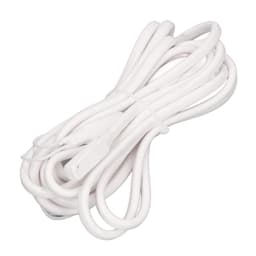
The 4 m silicone tape, amazon.co.uk ASIN B0BNF3496D, is stated at 160 W and AC 200 V. The thermostat is not included. The listing does not call it self-regulating. Reviewers say it is not regulated and keeps getting hotter. They describe melted insulation, a melted pipe, water pouring out, and a pipe that burst. That is what fixed heat looks like on a pipe that cannot refuse it. Prefer that pattern on plastic, and skip the 160 W tape. On a plastic condensate pipe, the 12 W/m thermostat kits are the pattern to take back to the best pipe heating cable page, and the 160 W tape stays off the pipe.

Common questions

What is the difference in the cable itself?
Self-regulating cable, in Chromalox’s description, uses a polymer between the bus wires so a warm section draws less and a cold section draws more. Constant wattage holds a fixed output and needs a controller because the cable will not ease off as the pipe warms. The title on a listing can use the first phrase for either construction. The watts line and the thermostat line tell you more than the adjective.
Can I overlap a self-regulating cable?
Only if that maker says so. Heat Trace Ltd says Freezstop Regular will not burn out when overlapped, because output follows pipe temperature. That is one product. A constant-wattage tape must not be overlapped. A sealed plug-in kit with no sheet is not an invitation to experiment at the elbow. If you cannot see whether two passes touch, do not make the second pass.
Why do some makers still fit a thermostat?
Because output can fall and still not reach zero. DEVI says that explicitly for DEVIpipeheat 10 V3, and still requires a thermostat and a 30 mA RCD. The thermostat switches the circuit. The polymer, where it exists, only trims the local heat. Elektra’s listings include a built-in thermostat and do not describe the cable as self-regulating. Both facts can be true together.
Why did a heat cable melt a plastic pipe?
The 4 m tape at 160 W on AC 200 V has no thermostat in the box, and reviewers say it kept getting hotter until insulation and pipe melted. One report is a burst pipe and water pouring out. A plastic wall is a poor heat sink for a fixed load left on. Adding foil and lagging does not fix a tape that has no controller. That listing is the one to skip, not a cable to “use carefully”.
Does “self-regulating” on an amazon title prove the construction?
No. heninhill prints the word and also prints a 5°C and 10°C thermostat and 25 W/m at 10°C, without a voltage. Oumefar prints self-regulating and PTC on a 40 W, AC 220 V, 1 m cable with no reviews. Spacnana prints it on a 10 m cable whose size field says 220V. The word is a claim. A stated falling output, a stated thermostat, and a stated 230 V supply are the checks.
Can I cut either type, and which belongs on a plastic condensate pipe?
Cut only a cable whose maker sells it as cut-to-length. Heat Trace Ltd says that for Freezstop. A finished plug-in kit is not that drum, and the heninhill 6 m listing asks about cutting and does not answer. On a plastic condensate pipe, prefer a modest output with a thermostat, the 12 W/m and 230 V pattern, and do not use the 160 W tape. Overlap and cutting stay on the maker’s sheet, not on the title.

Related pages

Sources

Public UK sources and the amazon.co.uk listings in the research digest, checked on 15 October 2026. Shelf prices can change.

  1. HHIC installer guide: condensate pipe and trace heating (retrieved 15 October 2026)
  2. HHIC householder note: thawing a frozen condensate pipe (retrieved 15 October 2026)
  3. NBS: BS EN IEC/IEEE 62395-2:2026 (retrieved 15 October 2026)
  4. IET Part P FAQ (retrieved 15 October 2026)
  5. Planning Portal: electrical work and building regulations (retrieved 15 October 2026)
  6. Elektra FreezeTec heating cables (retrieved 15 October 2026)
  7. Ofgem: energy price cap, 1 October to 31 December 2026 (retrieved 15 October 2026)
  8. Baxi: how to prevent a boiler condensate pipe from freezing (retrieved 15 October 2026)
  9. Heat Trace Freezstop self-regulating cable (retrieved 15 October 2026)
  10. DEVI DEVIpipeheat 10 V3 (retrieved 15 October 2026)