Copper pipe size for kitchen tap: match the supply
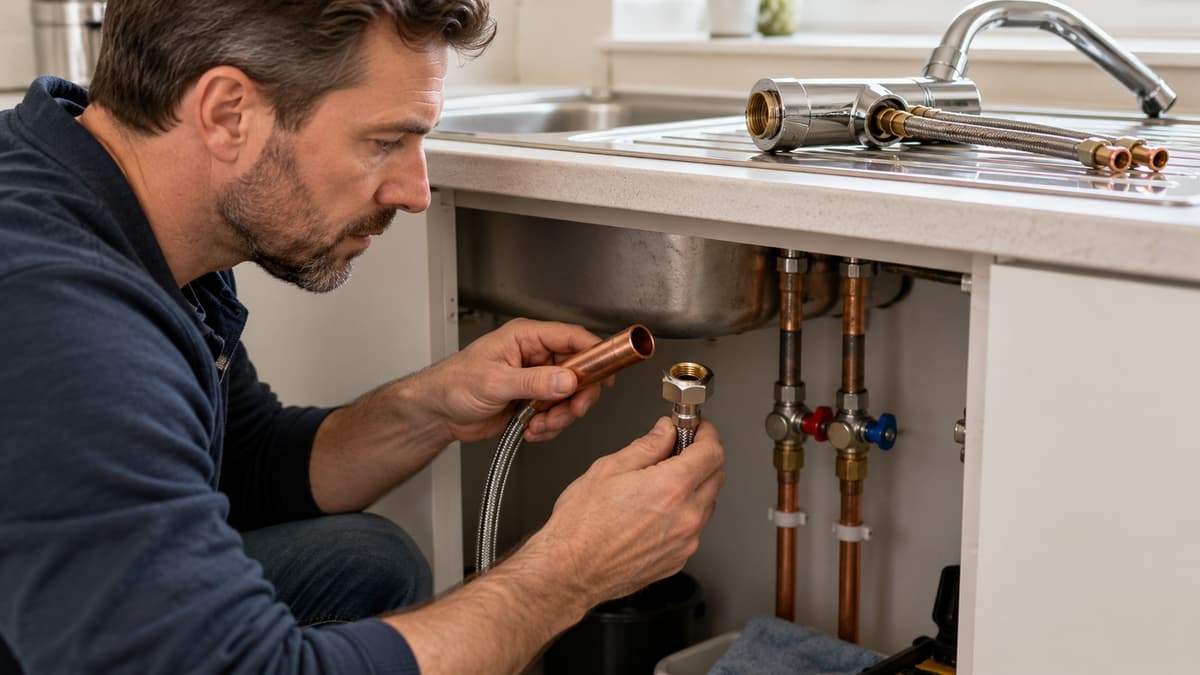
A UK kitchen tap usually takes 15 mm copper into a 1/2 inch BSP tail. See when 22 mm, 10 mm microbore, or an old half-inch pipe changes which fitting you buy.
On this page

The old mixer is on the drainer, both isolating valves are shut, and the copper under the sink does not look like the figure on the new box. Copper pipe size for kitchen tap work is that mismatch. In a normal UK kitchen the supply is 15 mm copper, hot and cold, and the tail you tighten onto is a thread, most often 1/2 inch BSP. Buy the tube for the pipe you can measure, and buy the nut for the thread on the tap.
A trade size guide treats 15 mm as the usual tap size and steps up to 22 mm when one pipe feeds several outlets. The cupboard may still be 10 mm microbore, or old imperial half-inch copper that meets 15 mm only through an adaptor. The copper pipe comparison is about the tube you buy, not the tap tail.
In short
For one kitchen tap, use 15 mm copper and a connector that matches the tail in your hand, usually a 1/2 inch BSP thread. Step the branch up to 22 mm only when that one pipe feeds several outlets, then reduce to 15 mm at the tap. Leave 10 mm microbore and old half-inch imperial pipe on the adaptor that names both ends, and treat the 40 mm waste as a separate system.
15 mm is the usual kitchen supply
Fifteen millimetre copper is the outside diameter those guides give a single tap. Expect two pipes under the sink, hot and cold, each taken from a larger main. For one kitchen mixer, 15 mm is enough when the pipe you are joining is already 15 mm and still round. They do not print a flow rate, and this article does not invent litres per minute.
Measure the outside, not the bore and not the hole in the tap. Shut both valves, open the mixer, and confirm the supplies stop.
- Isolate hot and cold, open the mixer until the flow stops, and watch the joints for a minute.
- Measure the outside of each pipe, and write hot and cold separately, because older houses mix sizes.
- Read the thread on the new tap before you buy a connector.
- Buy a fitting that prints both ends, such as 15 mm by 1/2 inch, and keep a 15 mm olive on 15 mm pipe.
The same 15 mm pipe asked to carry the tap, a dishwasher and a washing machine needs a 22 mm section upstream. How those diameters sit together is on 15 mm and 22 mm copper pipe.
The tap tail is a thread
The 1/2 inch tap tail is the thread the connector screws onto, not a second name for 15 mm copper. Kitchen connector guidance treats 15 mm copper into a 1/2 inch BSP tail as the usual pair. An end-feed straight connector in 15 mm by 1/2 inch, made to EN 1254-1, is that pair as a solder fitting. Compression and flexible connectors make the same join.
Some mixers are 3/4 inch. Some monoblocs use M10 tails, a 10 mm thread, often as a pair of studs. M10 is not 10 mm pipe. A 1/2 inch nut will cross that thread or fail to catch. Match the tail you removed. If the box only says "standard", look at the metal.
A flexible connector still has 15 mm on the copper and the mixer thread on the other end. Choose a length that reaches in a gentle curve, because a hose folded under the bowl kinks. If the copper is 22 mm, reduce to 15 mm before a connector made for 15 mm. Solder, an olive, or a push-fit at the marked depth will not repair the wrong thread.
22 mm, 10 mm, and old half-inch pipe
Twenty-two millimetre copper is for several outlets on one pipe, not for a bigger tap. Reduce from 22 mm to 15 mm where the tap branch leaves the larger pipe, and keep the last piece at 15 mm for a half-inch tail. Forcing 22 mm into a 15 mm fitting ovalises the end, and the joint weeps. If you cannot see a safe place to reduce an incoming main, leave that branch to a plumber.
Eight millimetre and 10 mm are microbore. Size guides allow them to feed a monobloc, so a microbore tap can be a real installation, and it is still not the usual 15 mm kitchen run. A 15 mm connector will not enter 10 mm pipe. Use a reducer that names both sizes, or replace the visible length. Do not improvise on a run that disappears into a manifold you cannot trace.
A boiling-water tap often brings its own inlet kit. Follow that inlet, and do not cut a 15 mm cold supply down to 10 mm because the unit looks small. Imperial half inch joins 15 mm with an adaptor that names both ends. The outsides are close enough to force the wrong olive, and that joint weeps later. Measure hot and cold separately. If a magnet sticks, or the metal is soft and dull grey, stop.
What you buy in a copper-pipe comparison
In the copper pipe comparison the top pick is the PlumbUniverse 15 mm pipe at 1 metre, £9.49, with 4.4 from 164 reviews on amazon.co.uk. Reviewers use it for a short under-sink repair where the pipe is recognised as 15 mm. The listing allows solder-ring and compression joints, and it limits push-fit to water. Prices and stars are the UK figures for this comparison in October 2026. Links onward to amazon.co.uk are affiliate links. A qualifying purchase can earn a commission at no extra cost to you.
The wall line prints "1" with no unit, and BS EN 1057 is not stated, so a gas bullet is not a reason to fit gas. Beside a 3 metre merchant length, 1 metre looks dear. Dented arrivals will not enter a fitting, so check the stick before you joint it. A 100 mm or 200 mm offcut can still say 15 mm in the title, so read the length line.
Buying checks sit in the copper pipe buying guide, and the shortlist is on which copper pipe to buy. If you need a BS EN 1057 stamp, the listing has to say so. A stamped 15 mm tube may show a 0.7 mm wall. This top pick does not. Jointing a sound end is covered in how to join copper pipe.
The waste is a different pipe
The pipe that leaves the bowl is not the pipe that feeds the tap. Kitchen notes put hot and cold at 15 mm from a larger main, and the waste at 40 mm. Forty millimetre waste is plastic, push-fit or solvent weld, on its own fittings. A 15 mm copper connector has nowhere to go on that waste. Buy 40 mm waste and 15 mm supply as two parts if you are replacing the trap as well.
Fall on an underground drain belongs to Approved Document H, not to a kitchen summary. A short waste in the cupboard still needs to run downhill into the trap without a sag.
A dishwasher or washing machine sits under the Water Supply (Water Fittings) Regulations 1999 and needs an air gap or a proper trap. This article is not a compliance certificate. The tap's 15 mm supplies are a separate joint from that appliance hose.
Where the job stops being a fitting swap
A fitting swap is the connector, and at most a short length of 15 mm you can see, on pipes whose isolating valves hold.
Stop when a valve leaks, when you cannot find a valve, or when shutting it kills another supply. Stop if the metal is lead, or if you cannot tell copper from a coated other pipe. A magnet and a scrape are as far as identification goes. Gas stays outside this job. The top pick does not state BS EN 1057, and a bullet is not a route to work on gas.
Do not open a chase and guess whether the hidden pipe is 15 mm, 22 mm or imperial. Cut only what you can size. A dented end or a crushed olive is a replacement, and jointing paste does not turn 22 mm into 15 mm. If the waste leaves the cupboard for the ground, Approved Document H remains the reference.
Common questions
Is 15 mm the right copper pipe for a kitchen tap?
When do I need 22 mm copper in a kitchen?
What is a 1/2 inch tap tail if the pipe is metric?
Can I feed a kitchen tap with 10 mm microbore?
Do I need a pipe insert on 15 mm copper?
What size is the kitchen waste, as against the supply?
Can I join old imperial half-inch pipe to 15 mm?
When should a plumber take over a kitchen tap supply?

Peter F. is the editor for DIY & tools at productscompared.co.uk. Comparisons in this category are checked against amazon.co.uk listings, review evidence and public UK sources.
Related articles

Joining copper pipe without solder
Push-fit and press-fit are both heat-free joints on 15 mm copper, and they are not the same fitting.

Push-fit or solvent weld for waste pipe
A 40 mm kitchen waste is a different system from the 15 mm copper supply under the sink.

Lag pipes before a cold snap
Lagging has to match the pipe and cover the fittings before the temperature drops.