Push-fit copper pipe fittings: joint you can reach

Push-fit copper pipe fittings join a 15 mm repair without a flame if you can still reach the joint. Press-fit is the heat-free joint that should stay put.
On this page

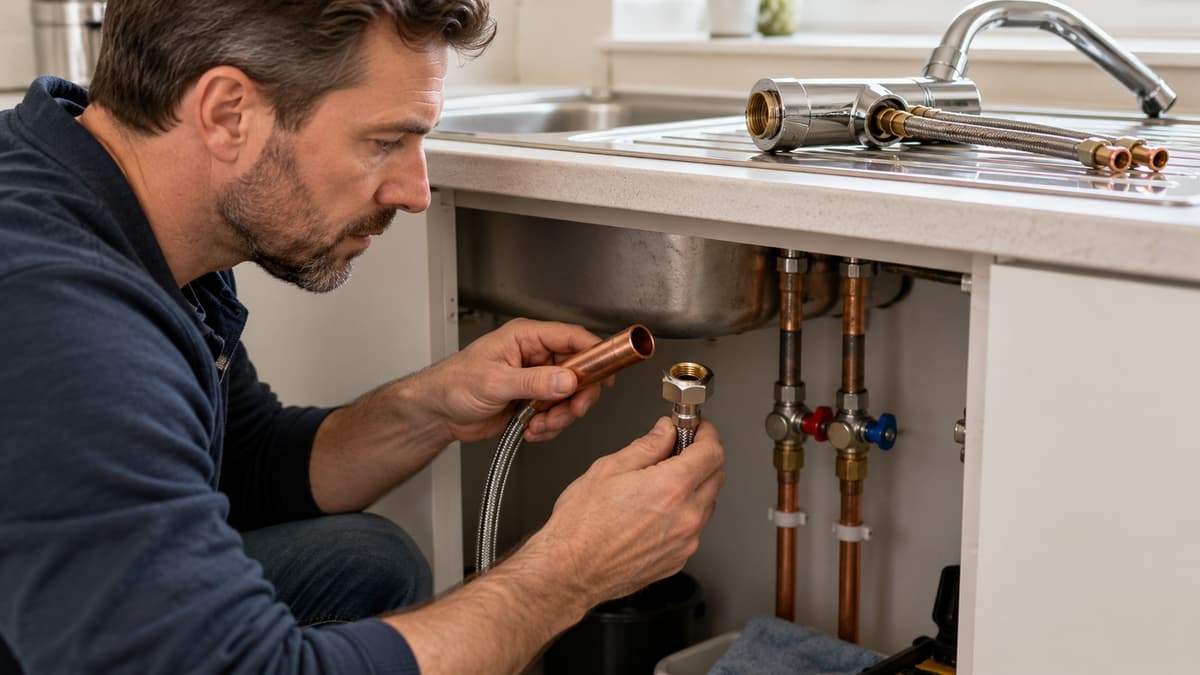
The stopcock is off, a bowl is under the cabinet, and the 15 mm copper to the kitchen tap is weeping at a coupling you will not heat with a torch. Push-fit copper pipe fittings and a copper press joint both avoid a flame. They are not the same joint. One is a collet you can release later. The other is pressed and meant to stay.
Use the joint that matches the access you will still have. If you can get a hand to it after the shelves go back, a demountable push-fit on copper is the repair to make. If the joint will sit in a wall or a void you are about to close, a pressed joint is the heat-free option that does not rely on you coming back. Solder belongs only where you already work with a flame safely. This guide does not show you how to light one.
In short
Use push-fit copper pipe fittings on 15 mm copper where you can reach the collet again. Use a copper press fitting where the joint must stay put, and only with the jaws that match that profile. John Guest does not require an insert on copper, and it asks for 450 mm between a Speedfit fitting and a soldered joint so flux stays off the plastic. A listing on amazon.co.uk is not a WRAS approval.
Push-fit where you can reach the joint
John Guest describes Speedfit as a push-fit for copper or plastic, with no tools and no hot works. On a 15 mm elbow the joint is a collet that grips the tube and an O-ring that seals it. You push the pipe home. You do not tighten a nut and you do not heat the fitting. That suits a cupboard under a sink, or a short repair you may undo when the tap changes.
Because you can release the collet, the same joint is a poor choice once plasterboard, tiles, or a bath panel will hide it. If you cannot get a hand back to the fitting, do not use push-fit and hope the O-ring is the last word.
John Guest states that no insert is required on copper. Plastic tube can oval, so plastic systems use a support insert. Copper at this size holds its shape, so leave the insert in the packet. Keep a soldered joint 450 mm away from a Speedfit fitting already on the pipe, so flux does not reach the plastic. Wipe the end that will enter the fitting. An old flux stain is not harmless just because the solder looks tidy.
The push takes seconds. Cutting square, drying the pipe, and proving the joint takes the rest. As a rule of thumb, an awkward cupboard costs more time than the fitting. Chrome, paint, or a dent from an old compression nut leaves the O-ring on a surface it was not asked to seal. Clean back to round, bare copper, or cut that end off.
Press-fit when the joint should stay
Copper press fit is the other heat-free joint, and it is permanent. Brymec describes its range as flame-free, made to BS EN 1254-7, for copper tube to BS EN 1057. You do not release it next year. Flowflex sells an M-profile range on the same idea: heat-free, and listed with WRAS. You need the press tool and the jaws for that profile. Hand pressure will not close an M-profile fitting.
Choose press for a concealed run, a ceiling void, or a repair you will lag and box in. You still need room to sit the jaws square before the void is closed. If a joist forces the tool onto an angle, do not press and hope the indicator has done its job.
The two systems are not spare parts for each other. A push-fit coupling in a press run, or a press socket on pipe prepared only for a collet, is a guess. Buy the fitting that matches the decision you have already made: reach it later, or leave it closed. Hiring jaws can make sense on a longer heating alteration. It is a poor bargain for one weeping 15 mm coupling you can reach with a demountable fitting. If you cannot get the correct jaws, do not switch to solder in a place you had ruled out for a flame. Keep that joint accessible, or hand the concealed run to a plumber.
The tube still has to be copper the fitting was approved on. A stick that never mentions BS EN 1057 is a weaker match, even at 15 mm outside diameter. The copper pipe comparison sets those lengths side by side.
Cut square and fully home
These joints fail on the pipe end more often than on the brand. The seal needs a round, square, clean 15 mm end, pushed to the stop. A slanted cut leaves a gap. A burr on the outside edge cuts the O-ring as you push, and a burr inside sheds copper into the tap. Work in this order.
- Isolate the supply and drain until the open end stays dry, because a wet push can feel seated early.
- Cut the copper square and remove any ridge the cutter leaves.
- Deburr outside and inside so the edge cannot cut the seal.
- Mark the insertion depth from the bag, then push until the mark meets the mouth and the pipe hits the stop.
- Check the collet all round, or press with the matching jaws and the check the maker prints.
If the mark stays proud, the pipe is short of the stop, so pull it and push again. Do not use PTFE tape here: it is for threads and can hold the pipe off the O-ring. Clean chrome, paint, and old solder back to bare tube, and keep plastic Speedfit at least 450 mm from a soldered joint.
Dented copper will not seal. The top pick in that comparison is a 1 m PlumbUniverse length at about £9.49, with 4.4 from 164 amazon.co.uk reviews, and dented arrivals come up in those reviews. Cut past a dent or reject the stick. The listing allows push-fit for water and does not name BS EN 1057. A qualifying purchase through our links can earn us a commission at no extra cost to you. We did not laboratory-test these joints. The rules come from the makers and WRAS, and the price is from that amazon.co.uk listing.
Approvals, not a brand promise
The Water Supply (Water Fittings) Regulations 1999 expect fittings on wholesome water to be suitable. WRAS is the scheme you can look up before you buy. The Tectite Sprint entry covers push-fit for BS EN 1057 copper, with pressure and temperature bands that differ for copper and for plastic. Use the band on that entry. Do not copy a plastic-pipe figure onto copper, and do not assume every push-fit bag on amazon.co.uk is in the directory.
A listing says the fitting is suitable when you use it as the approval describes. It does not rescue a short insertion, an oval pipe, or a collet buried in a wall. Brymec's press pages put BS EN 1254-7 beside BS EN 1057: pressed fittings of that type, on copper tube of that type. If either number is missing from the packet, you do not yet know you are in that pair.
Gas sits outside this repair. A bullet that mentions gas is not a reason to joint a gas pipe with a water push-fit. Domestic gas work belongs with a competent person. Heating water can sit inside a Speedfit or press range only inside the band that maker prints. If the packet is silent, do not invent a figure and carry on.
An accessible joint on round 15 mm copper, with an approval that names that tube, is the push-fit job to do yourself. A covered joint, or a press profile when you have no jaws, is a plumber's hour. Match the pipe first. The fitting cannot correct a damaged stick.
Common questions
Can I join 15 mm copper without a blowtorch?
Do I need a pipe insert on copper?
Can I take a push-fit joint apart?
Is press-fit the same as push-fit?
Can the joint be buried in a wall?
What temperature and pressure are stated?
Will flux from a nearby soldered joint damage plastic?
When is this a plumber's job?

Peter F. is the editor for DIY & tools at productscompared.co.uk. Comparisons in this category are checked against amazon.co.uk listings, review evidence and public UK sources.
Related articles
Which copper pipe size a kitchen tap needs
15 mm is the usual kitchen tap connection, but the run in the cabinet is not always the same size.

Push-fit or solvent weld for waste pipe
Basin wastes can look the same diameter until one is push-fit and the other needs solvent cement.

Lag pipes before a cold snap
Loft and garage pipes need lagging that covers the fittings before the temperature drops.