Independent comparisons. We may earn from shop links. More info

How to use a mini greenhouse

Updated: October 2026

You have put the cover on, or you are about to, and the trays are still on the kitchen floor. How to use a mini greenhouse comes down to three habits: stand it where a wall breaks the gust, open the zip before the small volume cooks the plants, and harden them off before they leave the film. Products Compared used the RHS greenhouse pages and the amazon.co.uk listings in our [mini greenhouse comparison](/hub/raised-beds-greenhouses-and-compost/mini-greenhouse), dated 16 October 2026. We did not log temperatures inside these covers. A qualifying purchase through our links can earn a commission at no extra cost to you.

You have put the cover on, or you are about to, and the trays are still on the kitchen floor.

Our top picks

JUNGLE STONE JUNGLE STONE 4-tier PE

Best overall

JUNGLE STONE JUNGLE STONE 4-tier PE
6.0/10about £28.99
VOUNOT VOUNOT 4-tier 135 g/m²

Best value

VOUNOT VOUNOT 4-tier 135 g/m²
5.9/10about £24.63
On this page

Put it against a wall

The RHS puts a mini greenhouse against a wall or fence, in sun, rather than in the open. A wall cuts the wind on one face and gives the light frame something nearby to tie to if the listing did not include stakes. Credible printed weights in this set, ignoring the 200 g lines, run from Ohuhu at 3 kg to JUNGLE STONE at 4.5 kg. That is not enough mass to ignore a gust. Pegs fail on paving in JUNGLE STONE’s UK reviews, which is why a skirt full of stone, or a compost bag, shows up so often. Drilling a balcony or a rented railing is not a weekend improvisation. That consent sits on the balcony page.

Use the zip as the vent

The RHS says smaller houses overheat, and that the door has to do the work when roof vents are missing. These racks are that case. These houses are door-vented. None of the nine has a ridge vent. You open the roll-up door, or the tunnel’s mesh windows, while you are still outside with a cup of tea, not after the leaves have flopped. There is no timetable in degrees on these listings, and this page will not invent one. On a mild, bright day the zip is at least partly open whenever you are at home to glance at it. You close it if a cold wind is ripping through, or at night while the plants are still soft, and you open it again before the sun is on the film. Pots under film miss the rain, so you still check the compost with a finger.

Match the plant to the gap

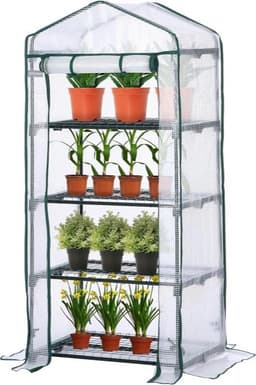
Shelves shade whatever sits below them. The RHS makes that point for mini greenhouses, and it matches what UK reviewers do when a plant gets tall: they take a shelf out. On JUNGLE STONE, plants over about 12 inches are the same complaint. An 80 cm two-tier will start a tomato and then run out of headroom. A 160 cm four-tier gives you more air above a tray and still will not turn four shelves into four full-size tomato crops. The tunnel is the odd one. There is no shelf to remove. The 90 cm height is the limit of that model.

Harden off, then move them

Plants raised under film are soft. Hardening off is the week you stop treating the zip as a permanent roof. You open the house for longer each day, you let the plants feel a breeze while you are there to put them back, and only then do they spend a night outside the cover. Take the house down, or at least the cover off, when the job is finished or when a gale is forecast and you cannot tie the frame. If poles were missing or the zip failed the first time you used it, that is a fault to raise with the seller under the Consumer Rights Act 2015. Mains power inside a wet cover is the point where you stop and use an electrician. Part P of the Building Regulations is not waived because the structure is called a greenhouse.

Common questions

Can tomatoes live in an 80 cm house?
They can start there. UK reviews of the short two-tier use it for a tomato and then run out of height. A full cordon wants a taller gap or a shelf removed in a 158–160 cm rack, and even then one shelf is the crop, not all four. The tunnel’s 90 cm cover is a bed, not a tall glasshouse.
Should I remove a shelf?
Yes, when the plant is taller than the gap. UK reviews on JUNGLE STONE and the VOUNOT four-tier say that in plain language: leave a shelf out, or the stems bend. Seed trays can stay on the levels you still have. Do not force a tall pot into a 12-inch gap because the title said four tiers.
Can it stay shut on a hot April afternoon?
No, not if the sun is on the film and you are at home to open it. Small houses overheat, which is the RHS point about volume. April can do that in Britain without feeling like summer in the shade. If you will be out all day, crack the zip before you leave rather than sealing it “to keep the warmth in”.
Do I water less because it is covered?
You water by the compost, not by the rain the film has blocked. Wall sites and balconies miss showers. A shut house can still dry a small pot on a bright day, and it can also stay soggy if you water and never open the zip. Check the soil. The cover is not an irrigation system.
When do I take it down?
When the plants have been hardened off and moved, or when a gale is coming and you cannot peg or tie the frame. Leaving a few kilograms of film shut and unfixed is how these houses fail. If the cover split on first use, talk to the seller rather than treating tape as the design.

Related pages

Sources

Public UK sources from the research digest, last checked on 17 October 2026.

  1. RHS — Coldframes and mini-greenhouses (retrieved 17.10.2026)
  2. RHS — Ventilation and shading (retrieved 17.10.2026)
  3. RHS — Choosing a greenhouse (retrieved 17.10.2026)
  4. Class E, GPDO 2015 (retrieved 17.10.2026)
  5. Building Regulations 2010, Class 3 (retrieved 17.10.2026)
  6. mygov.scot — Build a shed, garage or greenhouse (retrieved 17.10.2026)
  7. Consumer Rights Act 2015, section 9 (retrieved 17.10.2026)
  8. Wickes plastic 4-tier greenhouse (retrieved 17.10.2026)