Radiant heater running cost
A title that says cheap to run is usually a 400 W switch, not a discount on the unit rate. Radiant heater running cost is the kilowatts you will leave on, multiplied by your price per kWh. Fan, quartz, halogen and carbon at the same watts cost the same per hour. The settings are on the [radiant heater comparison](/hub/portable-heaters/radiant-heater). Peter F. used the Ofgem cap for 1 October to 31 December 2026, the Centre for Sustainable Energy, and energy.org.uk. This is not a quote from your bill. A qualifying purchase can earn a commission at no extra cost to you.
A title that says cheap to run is usually a 400 W switch, not a discount on the unit rate. Radiant heater running cost is the kilowatts you will leave on, multiplied by your price per kWh.
A title that says cheap to run is usually a 400 W switch, not a discount on the unit rate. Radiant heater running cost is the kilowatts you will leave on, multiplied by your price per kWh. Fan, quartz, halogen and carbon at the same watts cost the same per hour. The settings are on the radiant heater comparison. Peter F. used the Ofgem cap for 1 October to 31 December 2026, the Centre for Sustainable Energy, and energy.org.uk. This is not a quote from your bill. A qualifying purchase can earn a commission at no extra cost to you.
Our top picks
| Badge | Product | Settings | Full output | Element | Note | Price | Offer |
|---|---|---|---|---|---|---|---|
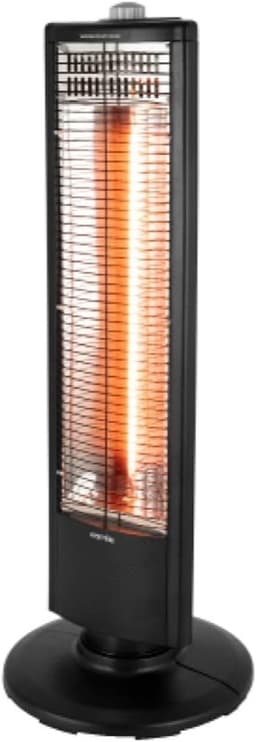
| Best overall |  Warmlite Warmlite WL42013 carbon tower | 500 W and 1,000 W | 1,000 W | Carbon fibre | 8.8 | about £56.46 | View offer |
| Alternative |  Daewoo Daewoo HEA1893 ceramic bar | 600 W and 1,200 W | 1,200 W | Ceramic bar | 8.6 | about £24.49 | View offer |
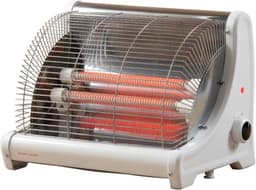
| Alternative |  Warmlite Warmlite WL42005 3-bar halogen | 400 W, 800 W and 1,200 W | 1,200 W | Halogen | 8.2 | about £21.45 | View offer |

On this page
The rate to use this quarter
Pence for the settings in this set
What the sum does not prove
Figures that do not belong in the hour
Common questions
What does 400 W cost for an hour?
What does 800 W cost, and 1,200 W?
Is a radiant heater cheaper per hour than a fan heater at the same watts?
Does the standing charge belong in the hourly figure?
Why do older pages still say about 36p for 1,200 W?
The Status listing says 3,000 W. What do I multiply?
If I only feel the heat in the beam, am I using fewer units?
Related pages
Sources
Public UK sources for clearance, the hourly arithmetic, and the room-heater standard. Listing prices, stars, and review counts are from amazon.co.uk.
- Electrical Safety First — Portable heaters (retrieved 21 October 2026)
- Devon and Somerset Fire and Rescue Service — Heaters (retrieved 21 October 2026)
- Norfolk County Council — Portable heaters (retrieved 21 October 2026)
- GOV.UK — Fire safety in the winter (retrieved 21 October 2026)
- Ofgem — Energy price cap, 1 October to 31 December 2026 (retrieved 21 October 2026)
- Centre for Sustainable Energy — Room heaters (retrieved 21 October 2026)
- energy.org.uk — Electric heaters compared (retrieved 21 October 2026)
- BSI — BS EN 60335-2-30, room heaters (retrieved 21 October 2026)