Independent comparisons. We may earn from shop links. More info

Radiant heater buying guide

Updated: 21 October 2026

You want heat on your legs, not a fan stirring a cold flat, and the amazon.co.uk titles all sound alike. A radiant heater buying guide has to separate the element, the wattage you will actually run, and the safety lines the listing really states. The seven heaters in the [radiant heater comparison](/hub/portable-heaters/radiant-heater) run from a £13.99 quartz bar to a £56.46 carbon tower. Peter F. compared these listings and public UK safety notes on 21 October 2026. This is not a lab test. A qualifying purchase can earn a commission at no extra cost to you.

You want heat on your legs, not a fan stirring a cold flat, and the amazon.co.uk titles all sound alike.

Our top picks

On this page

What a radiant heater is doing

A radiant heater warms the person and the furniture in the beam. The Centre for Sustainable Energy describes that heat as directional, so your shins warm quickly while the air behind the sofa can stay cold. An 800 W beam is a personal heater, not a whole-flat heater. The same wattage uses the same electricity per hour, whether the element is halogen, quartz, ceramic or carbon fibre. energy.org.uk makes that point. A low energy title is usually a lower setting, such as 400 W or 500 W. These heaters sit inside BS EN 60335-2-30. That names the product family. It is not a score for any of these seven.

Element, glare and the seven shapes

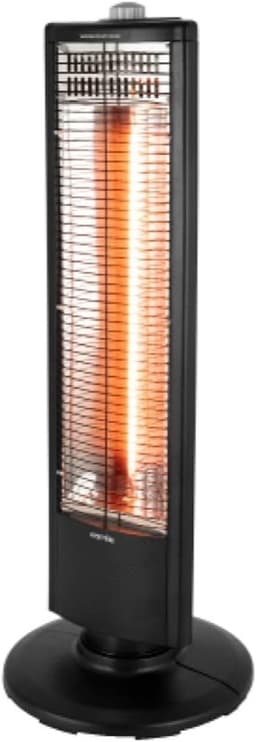
Halogen bars glow hard. The Warmlite WL42005 is the three-bar, at 400 W, 800 W and 1,200 W, with 120° oscillation. Reviewers call it bright, which matters on a video call, even though 4.1 from 2,153 reviews is the largest file here. Quartz is duller, and it is still radiant. Staywarm, Status, Geepas and SONBION sit around 800 W. Geepas reviews often prefer that glow to a three-bar, and tube failures within weeks still show up. A spare-tube size is not stated. The Daewoo HEA1893 is the ceramic two-bar, 600 W and 1,200 W. Its element line says radiant and its method line says convection, while reviews describe bars, not a fan. The Warmlite WL42013 is the only carbon tower, at 500 W or 1,000 W. Patio carbon lamps are a different product. The two Warmlite bodies are on halogen versus carbon.

The lines that have to be on the listing

Electrical Safety First asks for a tip-over switch, a UK plug, and about a metre of clearance. Tip-over is stated on six listings and not on the carbon tower. Overheat protection is a separate cut-out. It is not stated on the Daewoo or the Status. A timer is not stated on these seven. The Staywarm line that says a manual thermostat describes a 400 W and 800 W dial, not a room stat. An oscillation angle is printed only on the two Warmlite listings. The Geepas names oscillation and does not give degrees. No IP rating is stated. A Status bathroom bullet is not a zone approval. Under BS 7671, zone 1 is for fixed equipment.

Conflicts you should not smooth over

If two fields disagree, ask the seller or pick another ASIN. The Status title says 400 W and 800 W and the table says 3,000 W. The Daewoo is 4.3 from 95 reviews, under the 100-review floor for the top pick. The Geepas temperature lines are in Fahrenheit. The Staywarm mounting line says wall mount while the bullets describe a fold-away stand. The carbon tower's usage line says indoor and recommended uses also say outdoor, with no IP rating. Who should skip each model is on the best radiant heater page.

Common questions

Does a radiant heater heat the room or the person?
It heats what the beam hits. The Centre for Sustainable Energy treats radiant room heaters as directional, so your legs warm up while the rest of the room can stay cool. That can be enough at a desk. It is a poor match if you need the whole flat at one temperature. The wattage still draws the units for the setting you chose.
Why do the coverage numbers not match?
They are not measuring the same thing. The Staywarm listing says 1000 cm, which is a length, not a floor area. The carbon tower lists coverage as 270 with the unit not stated. Neither figure is a tested room size for this page. Use the wattage and where you will sit.
What if the title says 800 W and the table says 3,000 W?
That is the Status QH-800. The title says 400 W and 800 W. The table says 3,000 W and 6.67 A. At 240 V that current is about 1,600 W, so it agrees with neither printed power. Ask the seller which plate is on the unit, or skip it. Do not multiply 3,000 W into a running-cost sum.
Is oscillation real if only the special-features line says so?
Only if an angle is stated. The Warmlite halogen lists 120° and the carbon tower lists 70°. The Geepas mentions oscillation and does not state degrees, so you cannot plan a sweep from that line. A feature word without a number is not a specification.
Are the tubes replaceable?
A replaceable-tube size is not stated on these listings. Reviewers on the quartz and halogen bars report tubes failing within weeks or a few months, and several say spares are not on sale. If you cannot see a tube code before you pay, assume a dead bar means a return, not a five-minute swap.
Can I use it in a bathroom if a bullet says so?
No IP rating is stated on any of the seven. The Status bullet names bathrooms, and that is not a zone rating. Zone 1 under BS 7671 is for fixed equipment. Keep these portable heaters out of the bathroom. A qualified electrician installs fixed, correctly rated equipment, which these listings are not.
What must be on the listing before I pay?
You want the element, the wattage you will use, and a tip-over line if you need that cut-out. You also want the conflicts resolved: Status watts, Daewoo method, Geepas angle, Staywarm mounting, and carbon indoor or outdoor. A timer, a spare tube and an IP rating are not stated here, so do not pay as if they were.

Related pages

Sources

Public UK sources for clearance, the hourly arithmetic, and the room-heater standard. Listing prices, stars, and review counts are from amazon.co.uk.

  1. Electrical Safety First — Portable heaters (retrieved 21 October 2026)
  2. Devon and Somerset Fire and Rescue Service — Heaters (retrieved 21 October 2026)
  3. Norfolk County Council — Portable heaters (retrieved 21 October 2026)
  4. GOV.UK — Fire safety in the winter (retrieved 21 October 2026)
  5. Ofgem — Energy price cap, 1 October to 31 December 2026 (retrieved 21 October 2026)
  6. Centre for Sustainable Energy — Room heaters (retrieved 21 October 2026)
  7. energy.org.uk — Electric heaters compared (retrieved 21 October 2026)
  8. BSI — BS EN 60335-2-30, room heaters (retrieved 21 October 2026)