Independent comparisons. We may earn from shop links. More info

Halogen vs carbon infrared heater

Updated: 21 October 2026

The two Warmlite boxes can look like the same heater in different clothes. One is a three-bar halogen that glows across the room. The other is a tall carbon tower. A halogen vs carbon infrared heater choice, inside this comparison, is the WL42005 against the WL42013, with an 800 W quartz bar if both fail the room. The table is the [radiant heater comparison](/hub/portable-heaters/radiant-heater). Peter F. compared the listings on 21 October 2026. This is not a lab test. A qualifying purchase can earn a commission at no extra cost to you.

The two Warmlite boxes can look like the same heater in different clothes. One is a three-bar halogen that glows across the room. The other is a tall carbon tower.

Our top picks

On this page

Two Warmlite heaters, not two technologies in the abstract

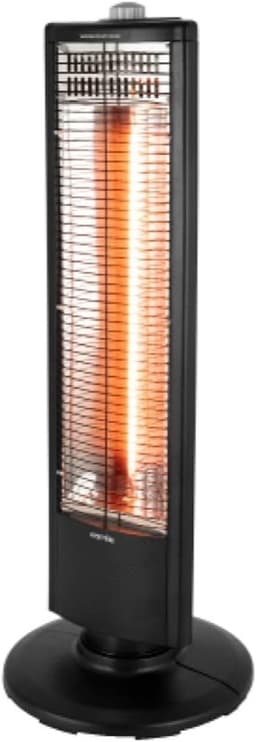
The Warmlite WL42005 at £21.45 is the three-bar halogen: 4.1 from 2,153 reviews, 400 W to 1,200 W, 120° oscillation, and both cut-outs stated. Reviewers call it bright and awkward on carpet. The Warmlite WL42013 at £56.46 is the carbon tower: 4.4 from 1,197 reviews, 500 W and 1,000 W, 70° oscillation, and no tip-over switch stated. Reviewers praise heat at 500 W and call the base floppy. Frico's note on carbon versus halogen is about commercial lamps, not these two ASINs. At 26.32p per kWh, full power is about 31.6p an hour on the halogen and about 26.3p on the tower. On the low settings, 400 W is about 10.5p and 500 W is about 13.2p.

Glare, height and what the reviews say they heat

The halogen is the bright one, which matters on a video call. The carbon tower is the one reviewers describe as heat on the person at 500 W, without that glow. Both are beam heaters, and Electrical Safety First still wants the clearance. The halogen is a low bar you can point. The carbon body is 80.5 cm tall. Carbon is not fewer units per watt. Feeling warmer at 500 W is a lower setting. The order of those checks is the buying guide.

The safety line that is missing on one of them

The halogen listing states a tip-over switch. The carbon listing does not. Electrical Safety First asks for that switch on a portable heater, which is the condition on the top pick. Choose the WL42005 when you want the switch in writing and you can live with glare and a pin that reviews say fails on carpet. Choose the WL42013 when you will check the base and you accept the missing line. The tower's usage line says indoor. Recommended uses also say outdoor, and no IP rating is stated, so it is not a patio heater. A spare tube is not stated on the halogen.

When neither is the one

Take an 800 W quartz bar when the halogen is too bright and the tower is too tall, too dear, or too uncertain on tip-over. The Geepas at £14.99 is 4.2 from 323 reviews, with both cut-outs stated, a short lead and tubes with no spare. The SONBION at £39.95 is 4.2 from 511 reviews, with quiet heat at a desk and switches that sit low. Those skips are on the best radiant heater page. If you need a patio lamp, neither Warmlite in this file is that product.

Common questions

Which is brighter?
The Warmlite WL42005 three-bar is the one reviewers call bright. The WL42013 carbon tower is the one they describe as heat on the body without that glow. No listing prints a lux figure. If you are on camera, the halogen is the one to skip. If you want the light as a side effect, the halogen is the one that provides it.
Which costs more per hour at full power?
At 26.32p per kWh, the halogen at 1,200 W is about 31.6p an hour and the carbon tower at 1,000 W is about 26.3p. On the low settings the halogen's 400 W is about 10.5p and the tower's 500 W is about 13.2p. The £56.46 tower costs more to buy. It does not always cost more to run. The standing charge is not inside those hours.
Does carbon heat the room and halogen heat the person?
Both of these listings are beam heaters. Reviewers feel them on the person in front. The air behind you can stay cold either way. Carbon is not a convector in this file, and the halogen is not a fan. A method line that says convection belongs to the Daewoo ceramic bar, and even that listing's reviews describe bars.
Which has a tip-over switch on the listing?
The WL42005 halogen states a tip-over switch and overheat protection. The WL42013 states overheat protection, and a tip-over switch is not stated. If you want that cut-out in writing, the halogen is the one of this pair. Reviews still say its pin can fail on carpet, so the switch is not a promise that every rug will work.
Is the carbon tower a patio heater?
No. The usage line says indoor. Another line says outdoor, and no IP rating is stated. Do not treat the WL42013 as a patio heater. Outdoor carbon lamps in other guides are a different product. This tower's cable is 2 yards, and its tip-over line is missing.
When is an 800 W quartz bar the better third choice?
When glare rules out the three-bar and you will not buy a tower with no stated tip-over switch. The Geepas at £14.99 is the cheaper quartz option, with spare-tube and lead gaps. The SONBION at £39.95 has the larger quiet-heat review file and switches that sit low. Their full skips are on the best page.
Will the carbon base stand up?
Reviewers call the WL42013 base floppy and the body top-heavy. The listing includes a base and four screws, and the weight is 2.2 kg. Fit the base, stand it on a hard floor, and stop if it leans. A tip-over switch is not stated, so you cannot rely on a cut-out the page does not mention.

Related pages

Sources

Public UK sources for clearance, the hourly arithmetic, and the room-heater standard. Listing prices, stars, and review counts are from amazon.co.uk.

  1. Electrical Safety First — Portable heaters (retrieved 21 October 2026)
  2. Devon and Somerset Fire and Rescue Service — Heaters (retrieved 21 October 2026)
  3. Norfolk County Council — Portable heaters (retrieved 21 October 2026)
  4. GOV.UK — Fire safety in the winter (retrieved 21 October 2026)
  5. Ofgem — Energy price cap, 1 October to 31 December 2026 (retrieved 21 October 2026)
  6. Centre for Sustainable Energy — Room heaters (retrieved 21 October 2026)
  7. energy.org.uk — Electric heaters compared (retrieved 21 October 2026)
  8. BSI — BS EN 60335-2-30, room heaters (retrieved 21 October 2026)