Independent comparisons. We may earn from shop links. More info

How to use an industrial fan heater

Updated: October 2026

The heater is already in the garage, and the first question is where it can stand before you turn the dial. This is how to use an industrial fan heater once you have chosen one: placement, the first minutes of cold air, what a click means, and when you unplug. The [industrial space heater comparison](/hub/portable-heaters/industrial-space-heater) is where the twelve amazon.co.uk listings were set out, stored on 16 October 2026. The Products Compared editorial team used those listings and public UK safety guidance. We did not run a lab test. If you have not chosen yet, see the [best industrial space heater](/hub/portable-heaters/industrial-space-heater/sub/industrial-space-heater-best) page.

The heater is already in the garage, and the first question is where it can stand before you turn the dial.

Our top picks

On this page

Place it before you switch it on

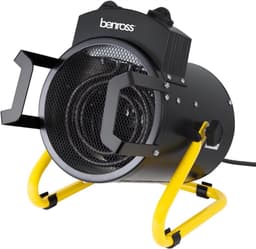
Put the heater on a clear, level floor, about one metre from anything that can burn. Electrical Safety First and Devon and Somerset Fire and Rescue both use that clearance, and both say not to dry washing on the heater. A Benross review describes a lead of about 1.5 m, and several DAHTEC listings state 1.60 m. If the socket is further away, move the heater. Plug it into a wall socket on its own. Electrical Safety First says not to use an extension lead. A coiled reel can be rated only a few amps until it is unwound, and Benross reviewers describe fuses opening on shared leads. If you only need to take the edge off, start on fan-only where the listing has one: 25 W, 40 W or 52 W, depending on the model. When you leave, switch off and unplug. The lead limit is on the 3 kW heater and a 13 A plug page.

What the first minutes feel like

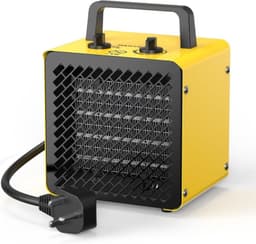
A coil or a stainless element often blows cold until it is hot. Benross reviewers say the fan moves cold air first, then the garage warms, and the noise is closer to a workshop tool than to a 45 dB bullet. One stored comment timed a small insulated workshop of about 770 cubic feet from about 6 °C to 15 °C in 25 minutes. That is one room, not yours. A seller note on the 9 kW coil listing says a heating-element heater can take about 5–10 minutes to feel comparable with ceramic. The 2 kW ceramic BGP1506-02 claims noticeable warmth in about 3 seconds. Reviewers still describe a short throw. The compact BGP2305-20 states airflow up to 142 m³/h from a 1.3 kg body, so the warm air stays close. If the air stays cold after a normal warm-up, or the smell is electrical, stop.

A click can be normal or a warning

A thermostat is supposed to click off when the set point is reached and on again when the air cools. Reviewers of the small PTC fan describe that cycle in a shed or office. A thermal cut-out is the other click. Smartwares’ support note says a short shut-off usually means overheat or blocked airflow. Unplug, let it cool, clear the grille, and try once. If it cuts out again, stop. Do not bypass the cut-out. The Benross stored special-features line does not name an overheat cut-out, while the manufacturer’s page does. Follow the unit in your hand. The BGP2305-20 states overheat protection and does not state a tip-over switch. One review says it keeps running if it falls on its face, so if you kick it, switch it off at the wall before you pick it up.

When you stop using it

Stop if the plug, the socket or the lead is hot, if you smell burning plastic, or if the case scorches. Electrical Safety First treats a hot plug as a reason to unplug and not to try the same socket again. Stored reviews include hot plugs on the Benross, a burning smell on the BGP3003-28, and a 16 A fuse on the 2.8 kW ceramic. Do not fit a larger fuse to make a lead work. Unplug when you leave, even for lunch. Devon and Somerset Fire and Rescue mention an annual PAT test. HSE leaflet INDG236 does not set a yearly legal timetable for every workplace heater, so treat the fire-service line as their advice. A new 400 V outlet, a scorched plug, or any LPG connection is where you stop and get a competent person. This page does not tell you how to light the propane heater.

Common questions

Where do you put a portable fan heater?
Stand it on a level floor, about one metre from anything that can burn, with the grille clear and the lead going to a wall socket. Do not dry clothes on it. Several listings state a lead of about 1.5 m to 1.6 m. Move the heater closer to the socket rather than adding a reel. US ceiling-height figures are not the rule for this portable UK fan.
Can you use an extension lead?
Electrical Safety First says a portable heater should go into a wall socket, not an extension lead. A coiled reel may only be rated a few amps until it is unwound. Benross reviewers describe fuses opening on shared leads at a stated 13.64 A. If the heater’s own lead does not reach, change where it stands. Do not share the socket with another high-load tool.
Why does it blow cold at first?
A coil or tubular element needs time before the air is warm, and the fan runs during that wait. Benross reviewers describe a cold blow, then heat. One small workshop took about 25 minutes to move from about 6 °C to 15 °C. A seller note on a coil listing allows about 5–10 minutes. If the air stays cold after that, or the smell is electrical, unplug it.
What does it mean when it clicks off?
If the room is warm and the heater returns after a few minutes, that is usually the thermostat. If it dies quickly with the grille blocked, treat it as a thermal cut-out. Unplug, cool, clear the inlet, and try once. A second cut-out means stop. One review of the small PTC fan also says there is no shut-off if the heater falls, so a tip is a manual switch-off.
What do you do if the plug is hot?
Switch off and unplug. A hot plug, melted plastic or a burning smell is a stop, not a cue to try a heavier fuse. Stored reviews include hot sockets on the Benross, a burning smell on the BGP3003-28, and an overheating plug on the 2.8 kW ceramic. Leave the heater off until the socket has been checked.
When do you stop and call someone?
Get an electrician for a scorched plug or socket, a repeating cut-out, or any new 400 V supply for the 9 kW heater. Get a person competent with LPG before you connect the propane unit. This page does not give a lighting sequence. A burning smell after months of use, as in one BGP3003-28 review, means that heater stays unplugged.

Related pages

Sources

Public UK sources for the safety and price-cap points. Listings and review counts are from the stored amazon.co.uk pages. Last updated 16 October 2026.

  1. Workplace (Health, Safety and Welfare) Regulations 1992, regulation 7 (retrieved 16 October 2026)
  2. HSE: The law on workplace temperature (retrieved 16 October 2026)
  3. HSE INDG236: Maintaining portable electrical equipment (retrieved 16 October 2026)
  4. HSE: Carbon monoxide on construction sites (retrieved 16 October 2026)
  5. Plugs and Sockets (Safety) Regulations 1994, Part II (retrieved 16 October 2026)
  6. Electrical Safety First: Portable heaters (retrieved 16 October 2026)
  7. IET Wiring Matters, September 2025: 3 kW loads on 13 A accessories (retrieved 16 October 2026)
  8. Ofgem: Energy price cap unit rates, 1 October to 31 December 2026 (retrieved 16 October 2026)
  9. Liquid Gas UK: Consumer Guidance Sheet 39 (retrieved 16 October 2026)
  10. Calor: Guidelines for the safe use of mobile heaters (2024) (retrieved 16 October 2026)