Independent comparisons. We may earn from shop links. More info

3 kW heater on a 13 amp plug

Updated: October 2026

You have one double socket on the garage wall and a listing that says 2.8 kW or 3 kW as if the number were only about warmth. A 3 kW heater on a 13 amp plug is a question about current and heat in the pins, before it is a question about square metres. The [industrial space heater comparison](/hub/portable-heaters/industrial-space-heater) includes the amperage lines from the amazon.co.uk files stored on 16 October 2026. The Products Compared editorial team used those listings and public UK sources on plugs and leads. We did not test a socket in a lab.

You have one double socket on the garage wall and a listing that says 2.8 kW or 3 kW as if the number were only about warmth.

Our top picks

On this page

What a 13 A socket is being asked to do

A BS 1363 plug is the normal UK three-pin plug, and the fuse protects the lead. The Plugs and Sockets etc. (Safety) Regulations 1994 require a standard plug and a correct fuse on an appliance designed for no more than 13 A. They do not say every 3 kW heater is a comfortable long-term load. The Institution of Engineering and Technology, in Wiring Matters for September 2025, says a long full-power load on BS 1363 is generally kept to about 2.7 kW, about 11.7 A. The arithmetic is the same if a fan sits on high for hours. At 230 V, 3,000 W is about 13.0 A, 2,800 W is about 12.2 A, and 2,000 W is about 8.7 A. A trade catalogue puts heaters up to 2.8 kW on a 13 A plug and describes 3 kW as a 16 A blue socket. Those trade lines are not the statute. A 3 kW plug-in is a poor match for a long run at full power. The rest of the buying order is on the industrial space heater buying guide.

What these heaters print

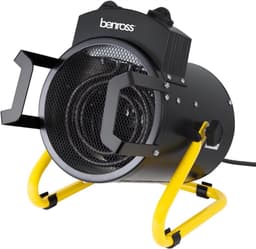
Use the printed amperage when you have it. The 2 kW ceramics BGP1506-02 and BGP2305-20 both state 8.33 A. The BGP1308-02 and the steel BGP3001-20-1 state 9.09 A. Those sit under the IET’s about-2.7 kW line with margin. The black BGP3003-28 states 12.7 A and does not state a voltage. The yellow page of the same model states 11.67 A. The 2.8 kW ceramic BGP1506-28 states 12.73 A at 220 V. The Benross 42450 states 13.64 A at 220 V, which is 3,000 W divided by 220, already above a 13 A fuse on the listing’s own voltage. The AAOBOSI states neither voltage nor current. One review of the BGP1506-28 found a 16 A fuse, so a 13 A extension would not take the plug.

Hot plugs and extension leads

A plug warms when the current is high, the contact is poor, or the lead is doing a job it was not rated for. GDHS’s trade note says hot plugs are more common on 3 kW products, and names extension leads as a cause. In the first 50 Benross texts, reviewers describe a red-hot plug or socket and fuses opening on a shared lead. One BGP3003-28 review reports a burning smell at the plug or cable after a few months. Electrical Safety First says a hot plug or a burning smell means stop. Do not daisy-chain leads, and do not share the lead with other high-load tools. A heavier fuse is not the fix. A 16 A fuse in a 13 A plug is a fault in that ceramic review, not an upgrade to copy. If the pins are hot, unplug and leave the heater off. The unplug steps are on the how to use an industrial fan heater page.

The heater that is not a plug-in

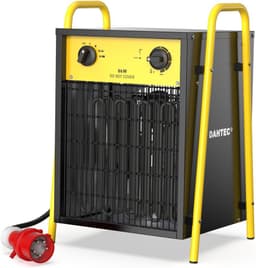
The DAHTEC IFHO3-90-G, at £126.65, states 400 V three-phase, with settings of 52 W, 4,500 W and 9,000 W, and IP24. The page says it cannot be used on a 220–240 V household socket. There is no review line and no amperage in the stored file. A 1.60 m cable does not turn it into a garage plug. Fitting that supply is an electrician’s job. An adaptor is not a workaround this page will describe. For a normal UK socket, the 2 kW listings at 8.33 A or 9.09 A are the ones with margin. The 2.8 kW and 3 kW rows are the edge. The 9 kW row is a different supply.

Common questions

Can a 3 kW fan heater use a normal UK plug?
Some are sold with a BS 1363 plug, and a long run at 3 kW is still about 13 A at 230 V. The IET’s figure for a long full-power load on that plug is about 2.7 kW. The Benross listing prints 13.64 A at 220 V. Give it a sound wall socket on its own and stop if the plug warms.
What current do these listings actually print?
The 2 kW ceramics print 8.33 A. The BGP1308-02 and the steel 2 kW fan print 9.09 A. The black 2.8 kW BGP3003-28 prints 12.7 A, the yellow page prints 11.67 A, and the 2.8 kW ceramic prints 12.73 A at 220 V. The Benross prints 13.64 A at 220 V. The 9 kW unit states 400 V and does not print an amp figure.
Why does the plug get hot?
High current, a tired socket, or a coiled or shared extension lead heats the pins. Benross reviewers describe sockets hot enough to worry about melted plastic. A BGP3003-28 review describes a burning smell at the plug after a few months. GDHS notes that 3 kW products show this more often. Heat in the plug is a fault to stop for, not a running-in period.
Is a heavier fuse the fix?
No. The fuse protects the flexible lead. A larger fuse so that a heater will run is the wrong direction, and this page will not give a fitting method. One stored review found a 16 A fuse in the 2.8 kW ceramic, and a 13 A extension would not accept that plug. If the fuse is wrong, or the plug is hot, stop and sort the supply.
Which listing is not a 13 A heater at all?
The DAHTEC IFHO3-90-G. It states 400 V three-phase and says it cannot run on a 220–240 V household socket. Settings are 52 W, 4.5 kW and 9 kW. There is no review line in the stored file. An electrician has to provide that supply. This page does not describe an adaptor.
When do you call an electrician?
Call one if you need a 16 A industrial socket, a new circuit, or the 400 V supply the 9 kW listing states. Call one if a socket has scorched, a plug has melted, or the same heater keeps warming the pins. Do not keep searching for a lead that will take it. The heater can wait. The socket should not.

Related pages

Sources

Public UK sources for the safety and price-cap points. Listings and review counts are from the stored amazon.co.uk pages. Last updated 16 October 2026.

  1. Workplace (Health, Safety and Welfare) Regulations 1992, regulation 7 (retrieved 16 October 2026)
  2. HSE: The law on workplace temperature (retrieved 16 October 2026)
  3. HSE INDG236: Maintaining portable electrical equipment (retrieved 16 October 2026)
  4. HSE: Carbon monoxide on construction sites (retrieved 16 October 2026)
  5. Plugs and Sockets (Safety) Regulations 1994, Part II (retrieved 16 October 2026)
  6. Electrical Safety First: Portable heaters (retrieved 16 October 2026)
  7. IET Wiring Matters, September 2025: 3 kW loads on 13 A accessories (retrieved 16 October 2026)
  8. Ofgem: Energy price cap unit rates, 1 October to 31 December 2026 (retrieved 16 October 2026)
  9. Liquid Gas UK: Consumer Guidance Sheet 39 (retrieved 16 October 2026)
  10. Calor: Guidelines for the safe use of mobile heaters (2024) (retrieved 16 October 2026)