Independent comparisons. We may earn from shop links. More info

Electric vs propane space heater

Updated: October 2026

The double garage still feels cold after a 3 kW fan, and the next listing is a propane blower that claims 50 kW. An electric vs propane space heater choice, in this set, is one propane ASIN against the electric rows. The [industrial space heater comparison](/hub/portable-heaters/industrial-space-heater) holds those amazon.co.uk listings as stored on 16 October 2026, from £29.74 to £135.15. The Products Compared editorial team used those files and public UK guidance. We did not run a lab test. If the limit is the wall socket, start with the [3 kW heater and a 13 A plug](/hub/portable-heaters/industrial-space-heater/sub/industrial-space-heater-13-amp) page.

The double garage still feels cold after a 3 kW fan, and the next listing is a propane blower that claims 50 kW. An electric vs propane space heater choice, in this set, is one propane ASIN against the electric rows.

Our top picks

On this page

When the electric listings are enough

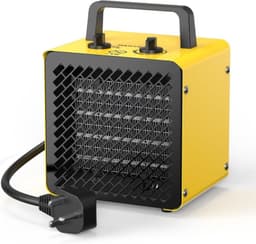
A normal UK socket can feed the 2 kW listings here with margin. The BGP1506-02 and the BGP2305-20 state 8.33 A. Reviewers use them in a small enclosed garage or workshop, and say the throw is short in a larger bay. The Benross 42450 states 3 kW and 13.64 A at 220 V, with 796 reviews and a repeated hot-plug theme. It can lift a small closed garage after a slow start, and it is a poor tool on a shared lead. If 2–3 kW is enough once the door is shut, stay electric and avoid a flame in the room. The 9 kW DAHTEC IFHO3-90-G is the electric step up, and only on 400 V three-phase. The listing says it cannot run on a household socket, and the file has no reviews. Propane is the alternative after that supply is unavailable, not the first reply to a cold morning. The order of checks is on the industrial space heater buying guide.

What the 50 kW listing is

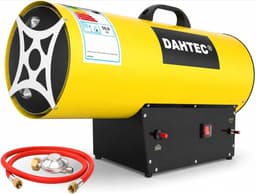
The DAHTEC BGA1401-50-18, ASIN B0FG2GK7ST, is titled as a 50 kW portable industrial gas heater, also given as 170,600 BTU/h, at £135.15. It weighs 10.6 kg, measures 66.5 × 25 × 41 cm, and the bullets describe forced air, an adjustable flame, piezo ignition, and a gas cut-off if the temperature rises excessively. The highlight states 3.63 kg/h. Coverage is claimed at 5,382 sq ft, which is the listing’s figure, not a survey of your building. It shows 4.8 stars from 8 reviews, with two UK texts in the file. Both say it gets hot quickly. One describes a pitched-roof double garage from 10 °C to 20 °C in about 10 minutes and about 3.5 kg/h. That is a warmth report, not a ventilation test. No included list names a regulator, hose or cylinder.

Ventilation, petrol vapour, and pressure

This listing is direct-fired propane, so combustion products go into the space with the heated air. The Health and Safety Executive warns that LPG heaters in enclosed spaces can kill, prefers electric heat where you can provide it, and calls for ventilation at high and low level. A carbon monoxide alarm to BS EN 50291-1 is UKHSA advice. An alarm does not replace air. Calor’s mobile-heater guidance says not to use that class of LPG heater in a garage, because petrol vapour may be present. The printed working pressure is 1,500 mbar (1.5 bar). Liquid Gas UK puts a domestic propane regulator at a nominal 37 mbar. A Bullfinch note carried by Calor specifies high-pressure propane nearer 0.5–1 bar. A 37 mbar regulator is the wrong class unless the nameplate says otherwise, and the nameplate is not in the file. This page does not give fitting steps.

Which to choose, with one condition

Choose electric when you have a suitable socket and a space a few kilowatts can touch. That includes a single enclosed garage on a sound 13 A circuit, and any room where you cannot confirm airflow or where petrol may be nearby. The BGP1506-02 at £46.75 is the electric row with 87 reviews and a stated 8.33 A. The £29.74 BGP2305-20 is the cheaper small-room fan, with early-failure reviews you should read first. Choose the 50 kW propane blower only where electric heat cannot be supplied, ventilation is real, petrol vapour is absent, and the regulator matches 1,500 mbar rather than 37 mbar. Do not turn 3.63 kg/h into a pound cost, and do not call this unit a cabinet heater or an indirect heater.

Common questions

When is electric the right side of this choice?
Electric is right when a normal socket, or a proper 400 V supply, can feed a heater that matches the room. The 2 kW listings state about 8–9 A. The Benross states 13.64 A and needs a socket of its own. You then have no combustion products and no regulator to match. For a small closed garage, that is enough reason to stay electric even when a 50 kW title looks faster.
When is the 50 kW propane listing even a candidate?
It is a candidate when a few kilowatts cannot heat the space and you cannot add a suitable electric supply, including three-phase for the 9 kW listing. It still needs real ventilation, no petrol vapour, and a regulator in the same class as the printed 1,500 mbar. A 4.8 from eight reviews, with two texts in the file, does not remove those conditions.
Can you run it in a garage where a car is kept?
Calor’s mobile-heater guidance says not to use that class of LPG heater in a garage, because petrol vapour may be present. The HSE treats LPG heat in an enclosed space as a carbon monoxide risk and prefers electric heat where you can provide it. This listing’s room types include garage. That line does not override the vapour warning. If a car or a petrol can lives there, use electric heat on a suitable socket.
What pressure does the listing print, and what is 37 mbar?
The bullet prints 1,500 mbar, which is 1.5 bar. A UK domestic propane regulator is nominally 37 mbar on Liquid Gas UK’s sheet. Industrial blowers in the Bullfinch note sit nearer 0.5–1 bar. A 37 mbar regulator is the wrong class for 1,500 mbar unless the heater’s nameplate says otherwise. That nameplate is not in the stored file. If you cannot match the pressure, do not buy the heater for that cylinder.
Is a regulator in the box?
No included-components list names a regulator, a hose or a cylinder. The £135.15 price is for the heater as listed. You would still need the correct high-pressure regulator and propane supply, matched to the nameplate, before it could run. This page does not describe how to connect them. If those parts are a mystery, the electric listings are the simpler buy.
Does a short warm-up make it safe in a closed room?
No. The review that timed 10 °C to 20 °C in about 10 minutes shows heat, not air quality. Highlight fuel use is 3.63 kg/h, close to the review’s 3.5 kg/h, and no cylinder price is stored, so this page will not quote a running cost. Combustion products stay in the room while the flame is lit. You still need high-and-low ventilation, no petrol vapour, and a carbon monoxide alarm.

Related pages

Sources

Public UK sources for the safety and price-cap points. Listings and review counts are from the stored amazon.co.uk pages. Last updated 16 October 2026.

  1. Workplace (Health, Safety and Welfare) Regulations 1992, regulation 7 (retrieved 16 October 2026)
  2. HSE: The law on workplace temperature (retrieved 16 October 2026)
  3. HSE INDG236: Maintaining portable electrical equipment (retrieved 16 October 2026)
  4. HSE: Carbon monoxide on construction sites (retrieved 16 October 2026)
  5. Plugs and Sockets (Safety) Regulations 1994, Part II (retrieved 16 October 2026)
  6. Electrical Safety First: Portable heaters (retrieved 16 October 2026)
  7. IET Wiring Matters, September 2025: 3 kW loads on 13 A accessories (retrieved 16 October 2026)
  8. Ofgem: Energy price cap unit rates, 1 October to 31 December 2026 (retrieved 16 October 2026)
  9. Liquid Gas UK: Consumer Guidance Sheet 39 (retrieved 16 October 2026)
  10. Calor: Guidelines for the safe use of mobile heaters (2024) (retrieved 16 October 2026)