Independent comparisons. We may earn from shop links. More info

Boat varnish buying guide: choose the right tin for the job

Updated: October 2026

You may be looking at a weathered tiller, a front door or a run of brightwork and wondering whether every tin marked “yacht varnish” does much the same thing. It does not. This boat varnish buying guide puts the decisions in order: location, timber, film type and quantity. Our [boat varnish comparison](/hub/paints-and-varnishes/boat-varnish) shows the nine amazon.co.uk listings we kept. None was lab-tested, so the claims below come from listings and manufacturers’ published information.

You may be looking at a weathered tiller, a front door or a run of brightwork and wondering whether every tin marked “yacht varnish” does much the same thing. It does not.

Our top picks

On this page

Start with where the film is allowed to go

Yacht varnish is generally a clear or amber exterior film for wood exposed to weather above the waterline. That includes rails, tillers and other brightwork, but it can also include smooth exterior joinery such as doors and window frames. The name on the tin does not make it an underwater coating. Epifanes explicitly states interior and exterior use above the waterline, while Sadolin’s technical information rules out constant immersion. The next exclusion is an underfoot surface. Ronseal says its yacht varnish is not suitable for decking, and Owatrol warns that Deks Olje D2 is slippery when wet. Those limits matter on both a walked-on boat deck and garden decking. If you are coating a hull that remains immersed, you are choosing an antifouling or another specified underwater system, not ordinary yacht varnish. The above-the-waterline guide explains that boundary in detail. Treat silence on an amazon.co.uk listing as missing information, not permission.

Check the timber and the coating already on it

Bare softwood, oily teak, intact one-pack varnish and an unknown two-pack coating are not the same starting surface. On bare, dry timber, a compatible first coat can key into the grain. On old varnish, the existing film must be sound and compatible; loose, cracked or milky areas need more than a quick coat over the top. If you cannot identify the existing system, a small test area is safer than assuming that any clear finish will bond. Surface oil on teak and other hardwoods can interfere with adhesion, so remove it before the maker’s specified first coat. Owatrol Deks Olje D2 takes a different route: it is a gloss finish used after Deks Olje D1. Treat it as a two-product system, not a one-tin varnish. Sheen also deserves a test patch. “Clear” describes transparency, not an absence of colour: Sadolin can leave a light golden tone on pale timber, and Epifanes is an amber transparent varnish. Our gloss-or-satin comparison covers the visual trade-off without confusing it with compatibility.

Choose one-pack varnish or an oil-varnish system

Most products here are solvent-borne, one-pack yacht varnishes. They cure without mixing a hardener and are sold in gloss, satin or both. Rustins names tung oil, the 250 ml Ronseal listing names polyurethane, and Sadolin describes an alkyd system. Deks Olje D2 is the outlier. It is designed as the glossy finishing stage after D1 and is listed for tropical hardwood as well as other interior and exterior wood above the waterline. Its listing states 10–12 m² per litre and no sanding between coats, but you should not detach those claims from the D1 requirement. It is a sensible candidate for someone already committed to that system, not a direct replacement for a small tin used on an isolated repair. Once you have chosen a family, follow that maker’s clock for thinning, coats and recoating. Do not borrow one brand’s timetable for another.

Match the pack and price to the surface

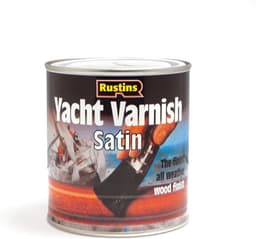
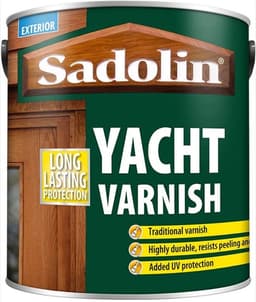
A 250–375 ml tin can make sense for a tiller, a touch-up or a short section of trim. The 250 ml Ronseal gloss costs £12.62 and states 16 m² per litre, but its small pack works out at roughly £50 per litre. For a door, several window frames or a longer run of rail, 750 ml or 1 litre gives you more room for multiple coats. Sadolin’s 750 ml tin was £15 with up to 13 m² per litre stated, while the 1-litre Ronseal gloss was £25 with 16 m² per litre. Rustins satin was £23.13 for 1 litre and stated 12.5 m² per litre. Price per litre is useful only after the product fits the surface. Buying a cheap tin twice, or stripping an incompatible film, costs more than choosing by place and system first.

Common questions

Is boat varnish the same as yacht varnish in a UK shop?
The terms often overlap in UK retail listings: both usually describe a clear or amber exterior wood film for marine brightwork and sometimes exterior joinery. The name is not a technical approval. Check the manufacturer’s stated surface, waterline limit, compatibility, coats and recoat time rather than assuming every product carrying either term has the same scope.
What should I check before price?
Check whether the product is allowed in the location, whether it suits the timber and existing film, and whether its sheen and colour shift are acceptable. Then compare the maker’s coat schedule, temperature limit and coverage. Pack price comes last because a cheap but incompatible or undersized tin is not good value.
How much varnish do I need for a tiller?
A 250–375 ml pack may be enough for a small tiller or touch-up, but the answer depends on surface area, wastage, coat count and the maker’s coverage rate. Do not estimate from pack size alone when a listing omits coverage. End grain and weathered timber may also absorb more during preparation and early coats.
Why does the International 375 ml listing not answer coverage or UV?
The captured amazon.co.uk file contains a title, pack size and basic catalogue data but no product bullets giving coverage, finish or UV protection. That is a limitation of the evidence, not proof that the product lacks those properties. Verify the current tin label or manufacturer’s technical sheet before choosing it for a specified job.
What should yacht varnish never replace?
It should not replace antifouling on an immersed hull, a coating expressly designed for walked-on decks, or professional repair of rotten timber. It should also not be assumed compatible with an unidentified epoxy or two-pack system. Those jobs require a specified system, and underwater or structurally damaged wood is a sensible point to involve a boatyard.

Related pages

Sources

Public UK sources and maker sheets used for the limits on this page. Prices, stars and review counts are from the amazon.co.uk listings. We did not run a lab test.

  1. SI 2012/1715 Schedule 2 — VOC limits (retrieved 17 October 2026)
  2. HSE — Coatings and solvent vapour (retrieved 17 October 2026)
  3. GOV.UK — Hazardous waste disposal (retrieved 17 October 2026)
  4. Rustins yacht varnish product data sheet, February 2018 (retrieved 17 October 2026)
  5. Ronseal — Yacht varnish (retrieved 17 October 2026)
  6. Sadolin yacht varnish technical sheet (retrieved 17 October 2026)
  7. Epifanes — Clear varnish with UV filter (retrieved 17 October 2026)
  8. Owatrol — Deks Olje D2 (retrieved 17 October 2026)