Laser level or spirit level: which tool for the job

A laser level or spirit level is a job choice. Keep the bubble for a short board, and use a cross-line laser when one height has to run across the room.
On this page

The 1200 mm spirit level is on the floor, and the shelf brackets are still in the packet. You can lay that long bubble on the board, or you can set up a cross-line laser and throw a line across the wall. Laser level or spirit level is that choice: how long the mark is, and whether the same height has to appear again beyond one placement of the vial.
If the timber is short enough for the vial, the bubble answers it. If the wall is longer than the bar, the laser holds the line while you mark. We compared twelve cross-line lasers on amazon.co.uk in October 2026, priced from £18.69 to £154.00, using those listings plus BuildWiz, Homebuilding, Bosch DIY UK, and GOV.UK. This is not a lab test. A qualifying purchase through our amazon.co.uk links can earn us a commission at no extra cost to you.
In short
Keep the spirit level for any board you can put the vial on, including one shelf shorter than a 1200 mm level. Use a laser when the line is longer than a metre or two, or when the same height has to repeat, and judge that laser by the accuracy figure the listing actually prints. The bubble stays in the bag as the check after a knock.
What each tool is for
A spirit level is a vial in a straight bar. You set it on the shelf, the worktop, or the door head, and the bubble reports that contact length. A torpedo level is the same idea in a shorter body. Homebuilding treats a torpedo and a self-levelling laser as different tools: the torpedo still needs a surface, and the laser throws a line you pencil on the wall.
A cross-line laser hangs a pendulum and projects a horizontal line and a vertical line. Unlock it on a floor or a tripod and wait until the line is steady. Most listings in this set state a window of about ±4°. The Bosch GLL 2-10 listing states that it levels itself in under four seconds. A flash means the base is outside that window, or the pendulum is still locked, so you mark brackets and tile from a steady line only.
Bosch's UK pages say cross-line lasers take over many aligning jobs from a spirit level, and they still publish a millimetre-per-metre figure per model. BuildWiz's rule of thumb is the one to use on the day: the laser earns its place when the line is longer than a metre or two, or when the same height must repeat. A locked pendulum is for the bag and for a slope you mean to set.
One shelf versus a room
A single shelf is usually a bubble job. An 800 mm board is shorter than a 1200 mm level, so the vial sits on the timber and you drill. A laser level for shelves still has to put the line at shelf height. Many kits include a stand of about 66 cm, and reviewers in this set often call that stand the weak part. A shelf above a worktop sits higher than 66 cm, so you add a taller stand or a camera tripod on the 1/4 inch thread.
The laser earns that setup when the same height repeats, such as three shelves on one wall. UK reviews of the GLL 2-10, against 4.5 from 1,704 amazon.co.uk ratings, say it agrees with a spirit level for pictures and rails. Those notes are not a lab.
A 4 m tile course flips the choice. A 1200 mm level covers less than a third of that wall, so you reset it at least three times, and each restart can creep before the corner. A cross-line laser holds one height for the run. UK reviews of the GCL 2-15, against 4.6 from 7,977 ratings, mention tiling and kitchens. Scale the stated ±0.3 mm/m in a straight line and four metres is 1.2 mm either way. That is arithmetic on the claim, not a wall we measured.
Our tiling page assumes you already trust the line. A single cross lights only the wall in front of it, so sockets on four walls mean you turn the tool or step up to a 360° plane. The buying guide covers that step.
Accuracy is a stated figure
The word laser is not a tolerance. The figure you can compare is the one that names a unit. Bosch states ±0.3 mm/m on the GLL 2-10, at £89.95, and on the GCL 2-15, at £119.99. The GCL 2-15 adds two plumb points and a class 2 label, which is why it is the top pick in this set once you need a line and a stated millimetre-per-metre claim. A shelf you can span remains a bubble job.
Other bullets use a different kind of number. Lusweimi states ±3 mm over 10 m. RockSeed states ±2.5 mm and does not say per metre, so you cannot read that as ±2.5 mm at one metre and again at ten. The GLL 20-22 G, at £154.00, prints ±0.3 mm in the English fields we used, without per metre. Price and a green beam do not fill in the unit. The rows are on the cross line laser comparison.
Your long bubble reads the surface under the vial. On an 800 mm shelf that is the whole question. On a 4 m wall a slope hides at the joins. After a hard knock, self-levelling does not prove the old calibration is intact, which is Homebuilding's point. If they disagree over 1200 mm, stop, and let a professional or a laser that has passed a fuller check take the tile or the rail.
Keep the spirit level
Do I still need a spirit level once a laser is in the cupboard? Yes.
The laser's work is a tile gauge, sockets around a room, wall units, and pictures that share a top edge. With plumb points, as on the GCL 2-15, you can also drop a mark through to the ceiling. A 1200 mm level on the floor cannot carry that point.
The laser steps aside on the board in your hands, and whenever you cannot see the beam. Direct sun hides red and green. Pulse mode plus a receiver is the workaround on listings that include one, and many householder cubes leave the receiver out. A spirit level on a fence rail still reads in full sun. Colour indoors is covered on our green or red beam page. For one shelf, the vial on the timber is the direct reading.
Keep the long level for the day the cube falls off the stand. Ordinary setup, before any knock, is on our how to use a cross line laser page. Price leaves this split alone: the Nikotek was £18.69, a DOVOH green cross £49.99, and the GCL 2-15 £119.99. Lock the pendulum in the bag, and take the lock off again for level work.
Where both tools stop
Stop if the line is flashing. Bring the base inside the window the listing states, often about ±4°, and wait for a steady beam. Stop if you are about to mark from a locked pendulum when you wanted level. Stop if a drop leaves the bubble and the line in disagreement over the length of the level. None of these twelve listings states a home calibration screw, and bending the pendulum can leave the line worse than the knock.
Structural marks, including steel and a load-bearing opening, are outside both of these tools. A householder's cube and a 1200 mm level are for shelves, tiles, sockets, and pictures. Outdoor level over tens of metres is a rotary laser with a detector. A cross-line cube is the indoor line.
Class 2, where a listing states it, is visible light. GOV.UK treats a brief glance as low risk because you look away, and it warns that some products marked class 2 measure far higher. Keep the beam off people, drivers, and aircraft. Glasses in the kit are not certified protective eyewear. For a room line, the top pick here for a stated ±0.3 mm/m and plumb points is the Bosch GCL 2-15. The long level stays in the bag either way.
Common questions
Should I sell the spirit level if I buy a laser?
Which is better for one shelf?
Which is better for a 4 m tile course?
Can I use the spirit level to test the laser?
Is a laser more accurate by default?
Is a laser overkill for one shelf?
Can a laser replace a 1200 mm level?

Peter F. is the editor for DIY & tools at productscompared.co.uk. Comparisons in this category are checked against amazon.co.uk listings, review evidence and public UK sources.
Related articles
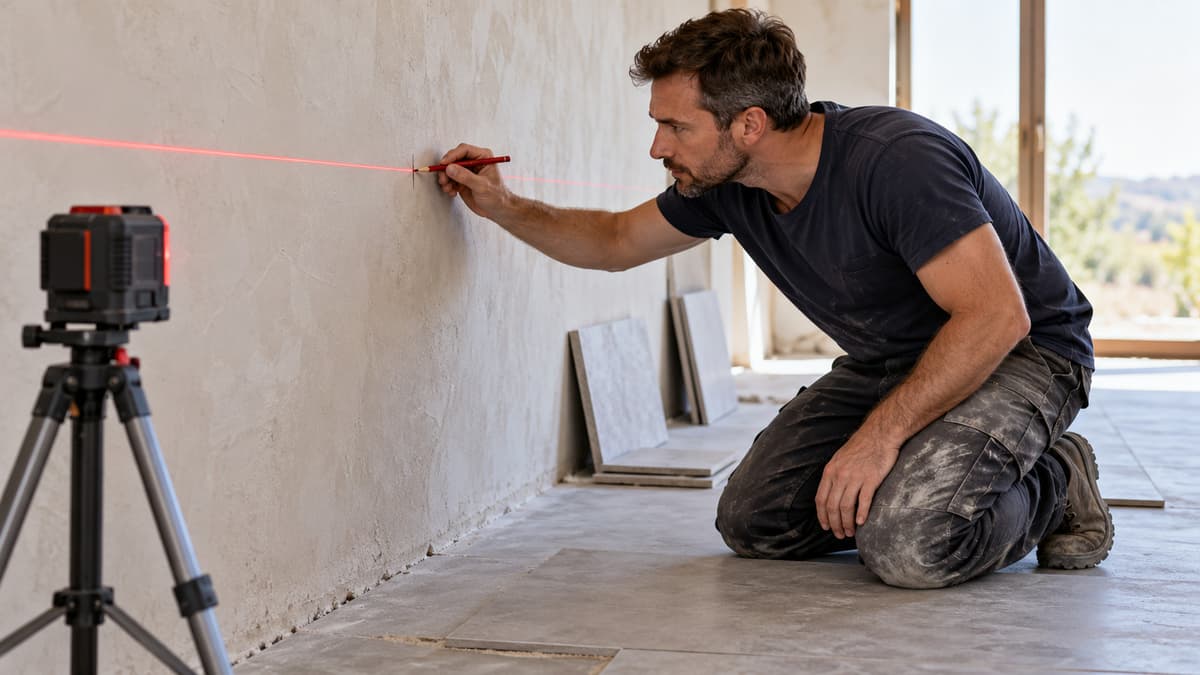
How to check a laser level after a drop
A scuffed cube can still light up and miss the old marks. Check the wall before the next finished line.
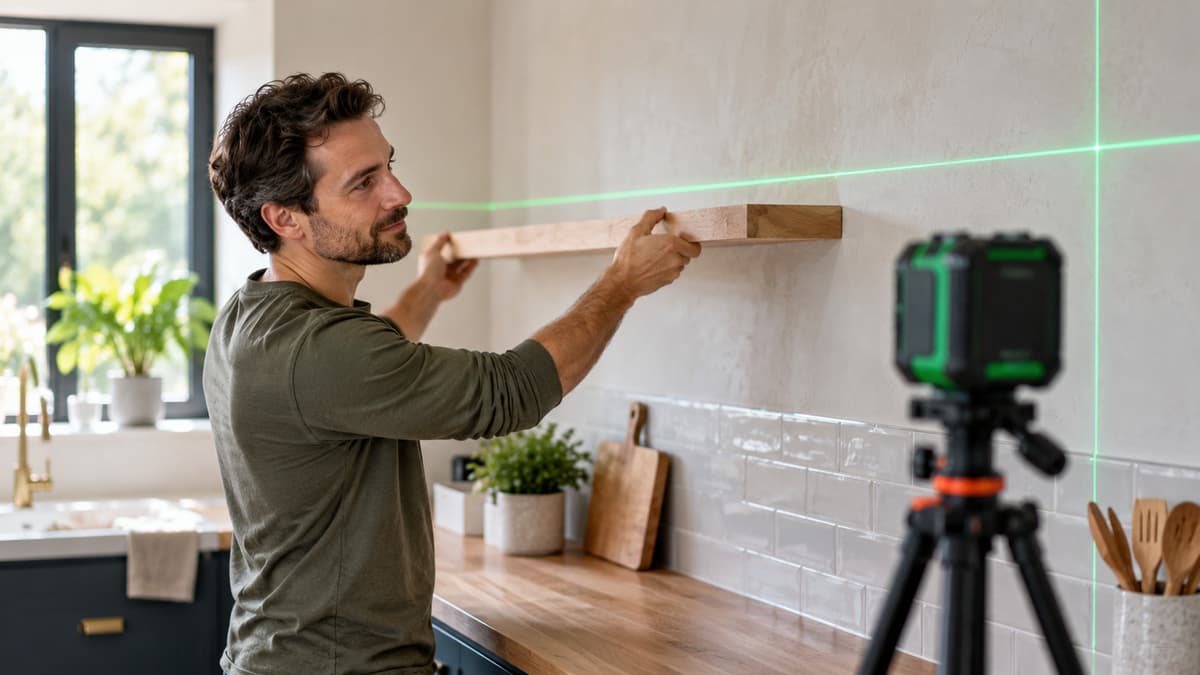
What a laser level costs in the UK
Shelf prices on amazon.co.uk in this set run from about £19 to £154. The figure on the box decides the band.
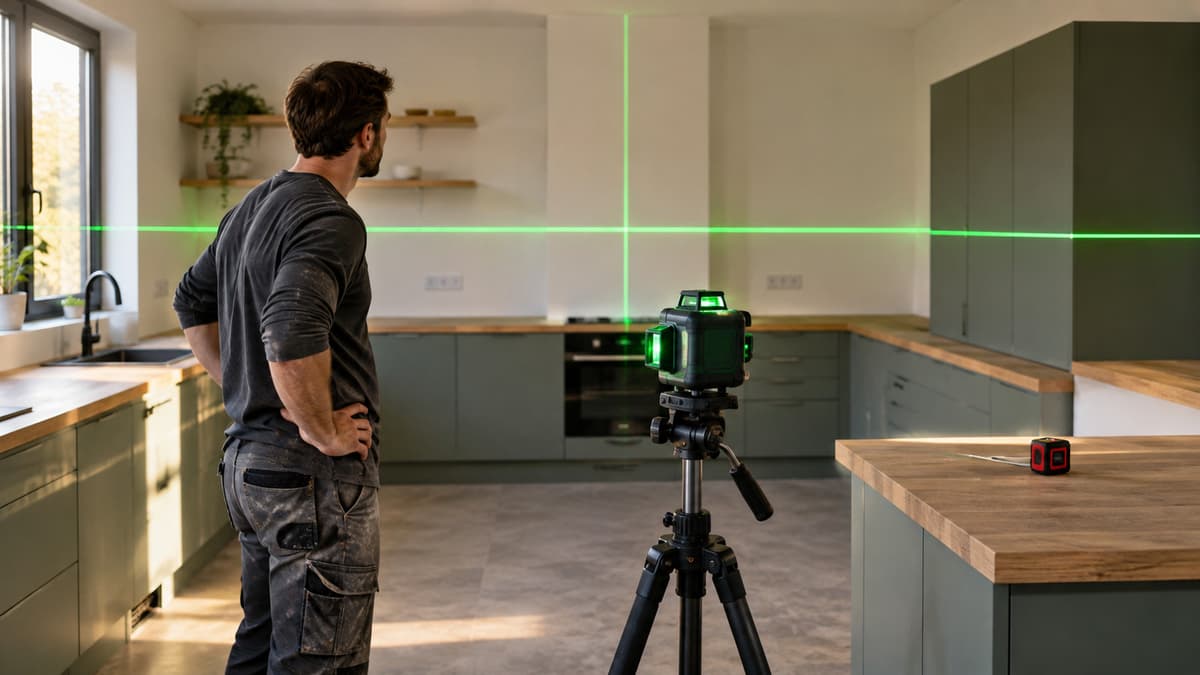
When a 360 degree laser level is worth it
A single cross covers the wall in front of you. A 360 degree plane is for several walls from one setup.