Laser level dropped accuracy: check before you mark
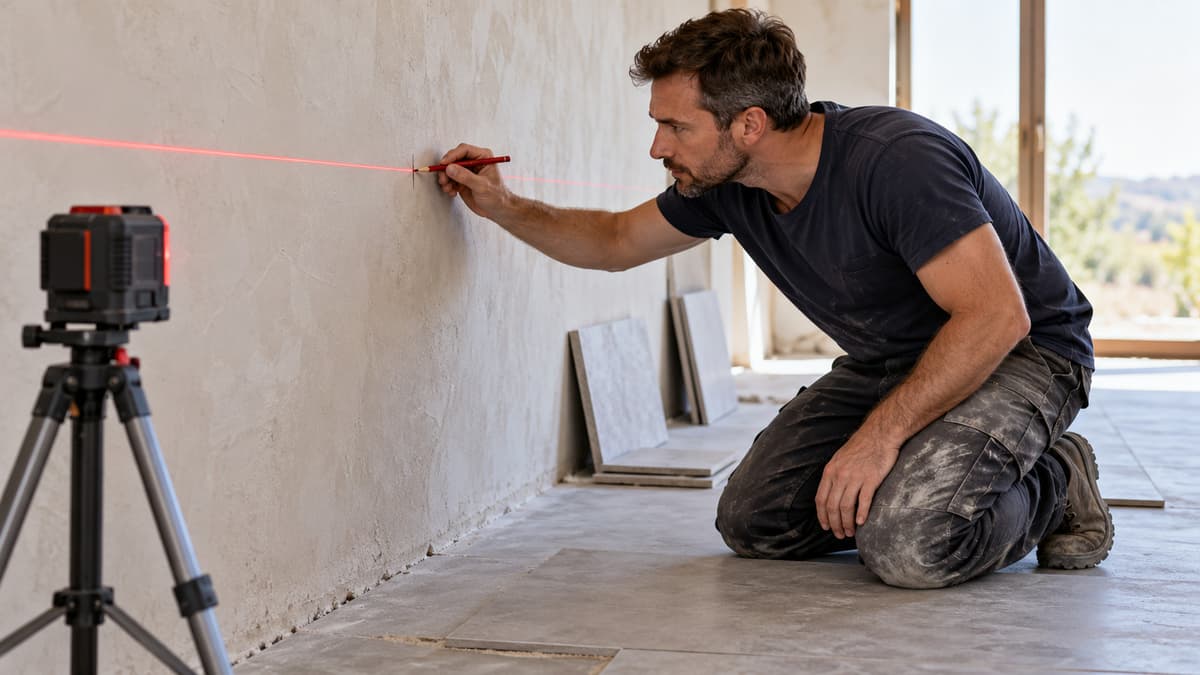
A drop can leave a self-levelling laser looking normal while the line is off. Check laser level dropped accuracy on the wall, then stop if the marks disagree.
On this page

The cube was on the stand, you turned with a tile in one hand, and the laser hit the floor. The housing is only scuffed, the beam still switches on, and the pendulum still swings. Laser level dropped accuracy is the part the scuff does not show: a self-levelling tool can look normal and still throw a line that is no longer the line you set this morning. Before the next finished mark, check it on the wall. A picture row can come down. A splashback, a socket line, or a course of wall tile cannot.
We compared twelve amazon.co.uk cross-line listings in October 2026, using public manuals and UK laser-safety advice. We did not drop these tools in a lab, and a shelf price is not a repair quote. A qualifying purchase through our amazon.co.uk links can earn us a commission at no extra cost to you.
In short
After a knock, self-levelling does not prove the old calibration is still there. Unlock the pendulum, let the line settle without flashing, and see whether it still hits the same marks when you turn the tool and again on a second wall. If those marks disagree, stop: a short spirit-level check is only a screen, and none of these twelve listings states a screw that puts the accuracy back.
Why a knock changes the line
Homebuilding's advice is the right starting point: after a hard knock, check the tool, because self-levelling does not guarantee that the old calibration is still intact. The pendulum can still hang, the diode can still light, and the line can still look straight. What a knock can shift is the link between that hanging weight and the beam.
The Stanley dot-and-cross manual tells you to check accuracy often, and again after a drop. One UK review of a Huepar kit in our set blamed a weak bracket for a dropped laser. That is a single report, not a test of every stand.
Most listings here state a self-levelling window of about ±4°. The Huepar 703CG states 3.5°, and SAVSEC states ±3°. A flash means you are outside that window, or the pendulum is still locked. It does not mean the calibration survived. Check the tool unlocked. A locked line is for travel and for a deliberate angle, not a level line.
IP54, printed on the Bosch GLL 2-10, the GCL 2-15, and several cheaper cubes, describes dust and water splash. IP65 on the GLL 20-22 G is not a drop height either. Do the check indoors, where you can see the centre of the line. Direct sun hides red and green. How the beam shows, and when a receiver is the workaround, is on our green or red beam page.
A simple wall check
You need a bare wall, a pencil, and a stand that does not wobble while you turn the tool. Ten minutes is a fair rule of thumb for one wall and a second wall, if the beam settles. You are checking this laser, not copying a tolerance from another box.
- Set the laser on a stable stand, close to level, and unlock the pendulum. Do not copy another model's switch: the Bosch GLL 2-10 listing does not state a lock.
- Wait until the beam is steady. If it flashes, level the base and make sure the lock is off. A flashing line is not a reading.
- Pencil the centre of the horizontal line at the left, the middle, and the right, on a surface you can wipe. Do not cut this test into finished tile.
- Rotate the tool 180° on the same spot and let it settle again.
- Repeat the marks on a second wall. A hit on the first and a miss on the next is a fail. A laser level knocked over can look honest face-on and drift once you turn it.
- Check a vertical line against a door frame you already trust. A horizontal pass does not clear the vertical.
If the new line sits on the pencil marks, the tool agrees with itself over that run. A gap you would reject in a tile joint is a fail for finished work. Everyday setup, before any knock, is on our how to use a cross line laser page.
What a spirit level can show
Lay a bubble level along the beam. If the laser calls the line level and the bubble does not, stop. You should not mark from that tool.
The limit is the length of the level in your hand. Agreement over 600 mm, or over a 1.8 m builder's level, is agreement over that run only. It does not sample the far end of a 4 m wall, and it does not prove the ±0.3 mm/m a Bosch listing states. The short check is a screen: useful before a picture hook, thin for a wall of tile.
Check the floor or the shelf with the same level before you blame the diode, and read the bright core, not the faint halo. If the bubble and the turned marks agree, you can hang a picture or mark one shelf. You have screened the tool, not recalibrated it. For a kitchen or a bathroom, that screen is not a pass against the figure on the box. What a replacement listing states is in the buying guide.
Do not copy another model's error table
DeWalt's cross-line manual describes a wall-mark test and says a failed check needs a service centre. DeWalt and Stanley also publish allowable-error figures for their own models. Those millimetres stay with those models. Do not copy them onto a Nikotek or a RockSeed because the shape of the beam looks similar.
In the twelve amazon.co.uk listings on our cross line laser comparison, stated accuracy is not one number. The Bosch GLL 2-10 and the GCL 2-15 state ±0.3 mm/m. As a claim, that is 3 mm at 10 m, and it is the maker's figure, not our bench. Lusweimi states ±3 mm over 10 m. RockSeed states ±2.5 mm with no per-metre unit, so you cannot rewrite it as the Bosch sentence.
A Huepar cross prints ±1/9 inch at 33 feet. The Nikotek cube at £18.69 and the DOVOH C2-120G at £49.99 print no numeric accuracy in the fields we used. You cannot pass either of them against 0.3 mm per metre, and a home check cannot create a claim the listing never made. With no table and no calibration screw, the marks either agree for the roughness of this screen, or they do not and you stop.
Shelf prices here run from £18.69 to £154.00. The Bosch GCL 2-15, our top pick for ±0.3 mm/m plus two plumb points, was £119.99, with Class 2, IP54, and 4.6 from 7,977 reviews. One returned unit threw two horizontal lines, and a doubled line is a reason to stop.
When to stop using it
Stop if the turned marks miss, a second wall disagrees, or the bubble and the beam disagree. Stop if the housing is cracked, the window is chipped, the pendulum rattles, the beam stays split, or the line settles only with the pendulum locked. A tiled course and a socket height should wait.
Do not open the case to bend the pendulum back. No listing in this set states a user calibration screw, and we do not have a repair price, so a shelf price is not a reason to keep marking.
Class 2, where a listing states it, sits under BS EN 60825-1, the standard GOV.UK cites. A brief glance is low risk because you look away, and the beam is not safe to stare into. Dazzle still matters on a ladder, so do not aim at anyone while you read the marks. Kit glasses are not certified eyewear. A missing class is a reason to pause, not proof the output is under 1 mW.
If two walls and a short spirit level agree, you can go back to pictures, one shelf, or a pencil line you can rub out. For a room of tile, being wrong costs more than waiting. Our tiling notes assume a line you trust. After a failed check, you do not have that.
Common questions
Is a short spirit-level check enough after the laser was knocked over?
Can I adjust the pendulum myself?
What if the laser agrees on one wall and not the next?
Should I keep tiling after the laser was dropped?
Does IP54 mean the laser survives a drop?
Does a flashing line after a fall mean the diode has failed?
When should I replace the laser instead of sending it away?

Peter F. is the editor for DIY & tools at productscompared.co.uk. Comparisons in this category are checked against amazon.co.uk listings, review evidence and public UK sources.
Related articles

Why a laser level line flashes
A flashing line usually means the base is outside the self-levelling window, or the pendulum is still locked.
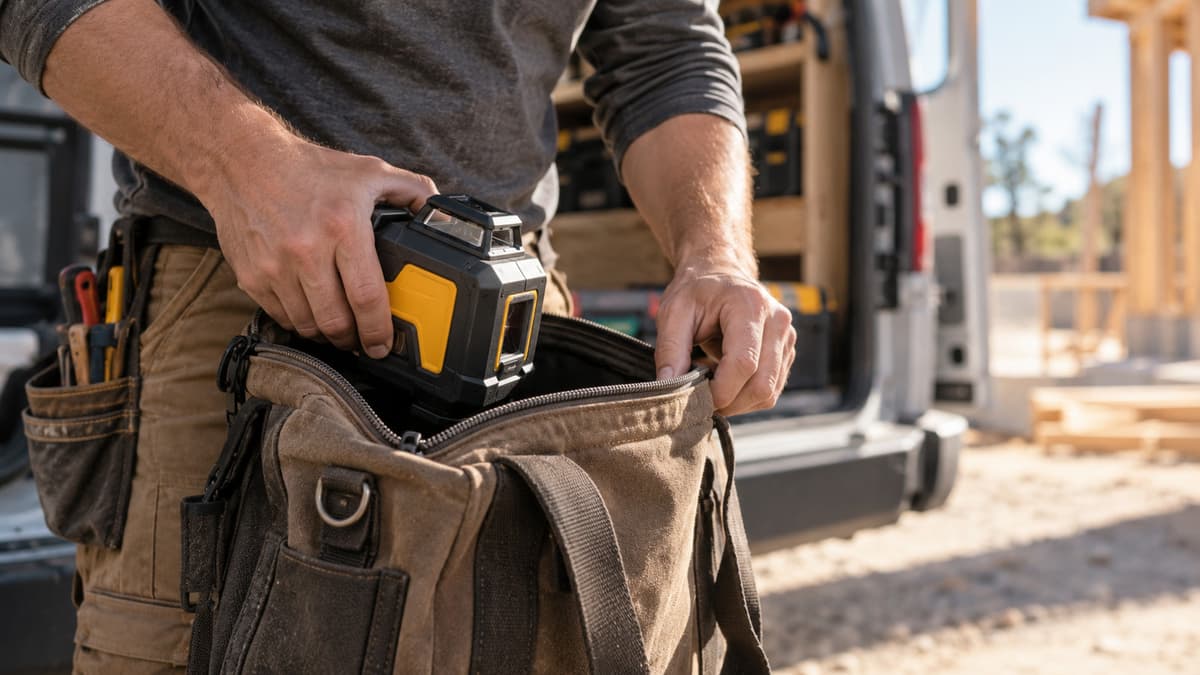
Lock the pendulum before you pack the laser
The lock is for travel and for angles. A locked line is not level, and an unlocked pendulum takes the next knock.

Laser level or spirit level
A spirit level screens a short run. A laser throws the line across the room. After a drop, the bubble is only a screen.