Class 2 laser level safe: what a home glance allows
Class 2 laser level safe use at home means a brief glance, then you look away. A missing label, kit glasses, and UK work rules are the limits that matter.
On this page

You have the cross-line laser on a stand in the hall, the line is on the wall for a shelf, and someone walks through the beam. The search behind that moment is class 2 laser level safe, and the useful answer is a limit. On a tool that really is Class 2, a brief glance is low risk because you look away, and a stare is hazardous. Dazzle on a ladder is the hazard that shows up in a house before any argument about standards.
We read twelve amazon.co.uk cross-line listings in October 2026, five of which print Class 2 or Class II, using GOV.UK's laser radiation safety advice, the Health and Safety Executive lasers page, and the Control of Artificial Optical Radiation at Work Regulations 2010. Listing figures are maker claims, and this is not a lab measurement of any diode. A qualifying purchase through our links can earn a commission at no extra cost to you.
In short
A class 2 laser level is visible light from 400 to 700 nm: a brief glance is low risk because you look away, and a stare is hazardous. GOV.UK warns that some products marked Class 2 measure as Class 3B or Class 4, so a printed class on an amazon.co.uk listing is the seller's claim. If the listing states no class, or the housing says Class 3B or Class 4, stop and use the twelve-model cross line laser comparison only for tools whose label you have actually read.
What Class 2 means on a laser level
BS EN 60825-1:2014+A11:2021 is the classification standard GOV.UK cites. Holding your eye in the beam to see if the diode is lit is the hazardous case. Dazzle still matters two metres up a ladder with a bracket in one hand, and a stare remains hazardous.
BS EN 50689:2021, also cited by GOV.UK, allows consumer laser products as Class 1, Class 2, or a restricted Class 3R. Class 3B and Class 4 sit outside that allowance. None of the twelve listings print Class 3R, Class 3B, or Class 4.
Five amazon.co.uk listings do print a class. The Bosch GCL 2-15 at £119.99 states Class 2, ±0.3 mm/m, and IP54, with 4.6 from 7,977 ratings. The Huepar 703CG at £144.32 states Class 2 under IEC/EN 60825-1:2014 and under 1 mW. The Nikotek cube at £18.69 and the Lusweimi at £34.99 state Class II, the Lusweimi with ±3 mm over 10 metres, and the SAVSEC SV-Y04CG at £75.99 states Class 2 under 1 mW. Class II on these pages sits beside "under 1 mW", so treat it as that seller's Class 2 claim and match the sticker on the tool.
The GCL 2-15 is the top pick because Class 2 sits next to a millimetre-per-metre figure and plumb points, and there is no tripod in the box. The cross line laser buying guide orders coverage and mount. Daylight on the far wall is a separate limit from class.
What you still must not do with the beam
The Health and Safety Executive's line for this class is to avoid staring into the beam and to avoid aiming it at anyone's face. GOV.UK adds dazzle on a ladder, on stairs, and in a doorway. One UK review of the GCL 2-15 returned a unit because it dazzled and threw two horizontal lines. A beam sold as Class 2 can still blank your view for a moment, and on a step that moment is a fall risk.
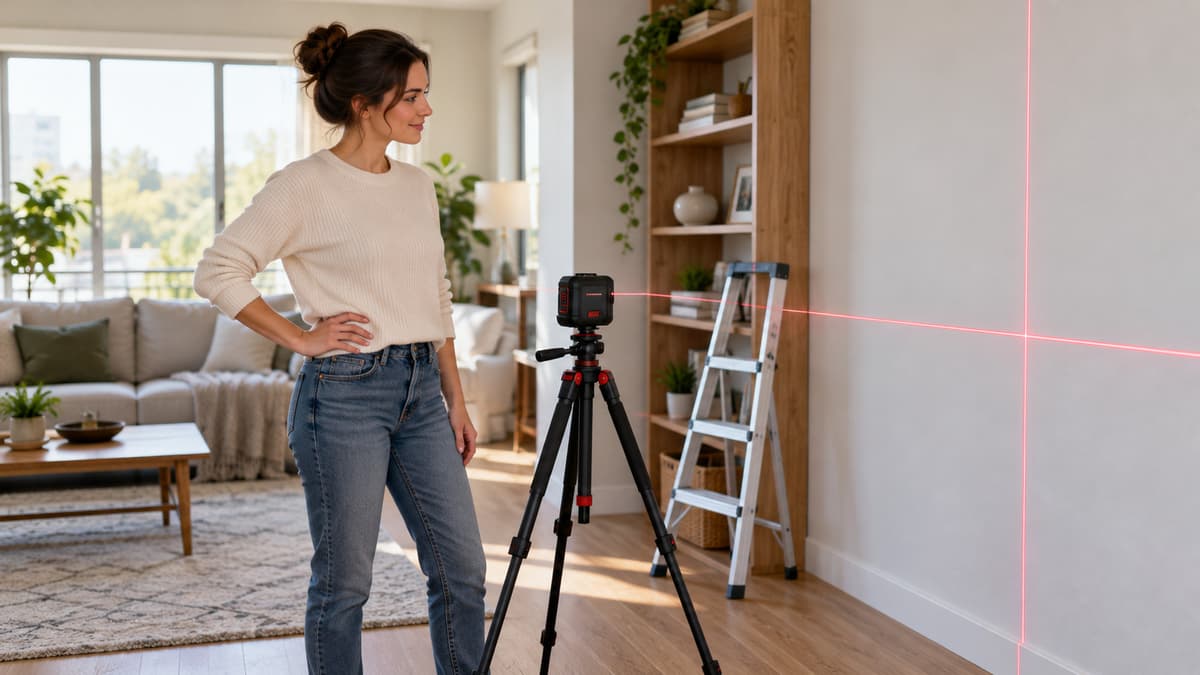
Aim the fan at the wall or ceiling you are marking, and stand beside the aperture. Check the laser is on by looking at the line on the plaster. A hallway glance is the exposure the class is written around. Ten seconds with your eye at the diode, while you tweak a bracket, is the exposure it treats as hazardous. Let someone pass a doorway before you look back at the mark.
Keep the beam off people, drivers, and aircraft, including a line through a window toward a road. Wait until anyone on a ladder is down before you sweep through that space. Children get the same rule: the line stays on the wall, and the tool goes in the bag when you leave. A locked pendulum sets an angle for travel or for a slope you chose, the class stays the same, and a locked line is not level. Setup order is on the how to use a cross line laser page.
When the listing states no class
Seven listings state no laser class: the Bosch GLL 2-10 at £89.95, the Bosch GLL 20-22 G at £154.00, the DOVOH C2-120G at £49.99, the Huepar cross with a 100 cm tripod at £55.99, the RockSeed LV1 at £22.99, the RockSeed LV1GT at £29.99, and the Nikotek kit with a 66 cm tripod at £29.99. The dearest tool in the set is in that blank group. The Nikotek cube at £18.69 states Class II under 1 mW, and the separate tripod listing leaves the class empty. Paying for the stand can drop the only class line the cheaper page wrote.
Read the housing, the manual, and the rating plate when the bullet is blank. A small tool sold for shelves is not automatically Class 2. GOV.UK warns that some products marked Class 2 measure as Class 3B or Class 4, so a printed "under 1 mW" leaves the output unproved. We metered nothing. Believe the sticker when it disagrees with the amazon.co.uk bullet.
Leave a Class 3B or Class 4 tool switched off, and get a professional for a missing label, that mark, or a structural line. A listing that promised Class 2 and a tool marked Class 3B is a Consumer Rights Act 2015 mismatch. Prefer a page that names IEC/EN 60825-1:2014, as the Huepar 703CG and the SAVSEC do, or Class 2 beside ±0.3 mm/m, as the GCL 2-15 does. The rows are in the cross line laser comparison.
Home use and the workplace rules
The Control of Artificial Optical Radiation at Work Regulations 2010 apply to employers. A householder with no employees, hanging a rail at home, is outside that duty. If you employ people, or the laser is part of your job, the workplace frame applies: risk assessment, controls, and training where the tool is Class 3B or Class 4. That still applies inside someone else's house. Sunday DIY on your own does not create those employer duties.
A Class 3B or Class 4 device in a kitchen keeps its class. The room does not relabel it. If a tradesperson is in your house, the employer duties sit with their employer. Ask which class is on the tool before anyone switches it on near a stair.
At home and at work, keep the beam out of eyes, treat dazzle on a ladder as a fall risk, and refuse a label you cannot read. Protective eyewear that HSE describes for higher classes belongs to that work. Outdoor level over tens of metres is usually a rotary with a detector, outside these twelve. Pulse mode is a visibility feature. It leaves the laser class where the label put it, and direct sun hides red and green lines alike.
Kit glasses, colour, and dazzle
The SAVSEC box includes green glasses with the remote, bracket, and 5200 mAh pack, at £75.99 and 2.57 kg, with 4.1 from 105 ratings. The glasses make the line easier to see on the wall. They are not certified protective eyewear, and HSE's eyewear discussion is for higher classes. You are meant to watch the line on the plaster.
Green is sold as easier indoors than red, and "four times brighter" on Huepar and SAVSEC pages is the maker's claim. Colour is not the class, and the dazzle report in this set is on the red GCL 2-15. If you cannot see the line, dim the room or add a receiver where pulse mode is stated. The DOVOH at £49.99 and the SAVSEC state pulse mode, and neither box includes the receiver. Colour is on the green or red cross line laser page.
Stars from 4.1 to 4.6 are amazon.co.uk ratings, and they do not meter the diode. If your vision stays disturbed after a catch in the eye, contact a doctor or NHS 111, because another stare is the exposure Class 2 treats as hazardous.
Common questions
Is a Class 2 laser level safe for a glance?
Is a green laser level more dangerous than a red one?
What is BS EN 50689?
Are the glasses in a laser level kit real protection?
What if the amazon listing states no laser class?
Do UK workplace laser rules apply to DIY at home?
Does a Class 2 label prove the output is under 1 mW?

Peter F. is the editor for DIY & tools at productscompared.co.uk. Comparisons in this category are checked against amazon.co.uk listings, review evidence and public UK sources.
Related articles

Laser level flashing: the tilt is too steep
A flashing line is the tilt window or a locked pendulum. Tell those two cases apart before you mark a shelf from the beam.
Seeing a laser level in daylight
Sun hides a red or green line. Pulse mode plus a receiver is the workaround these listings describe, and class does not fix the sun.

Laser level or spirit level
A spirit level checks a short run in your hands. A cross-line throws a line across the room, and the glance rule still applies.