Jet wash stripes on paving: why a still lance etches
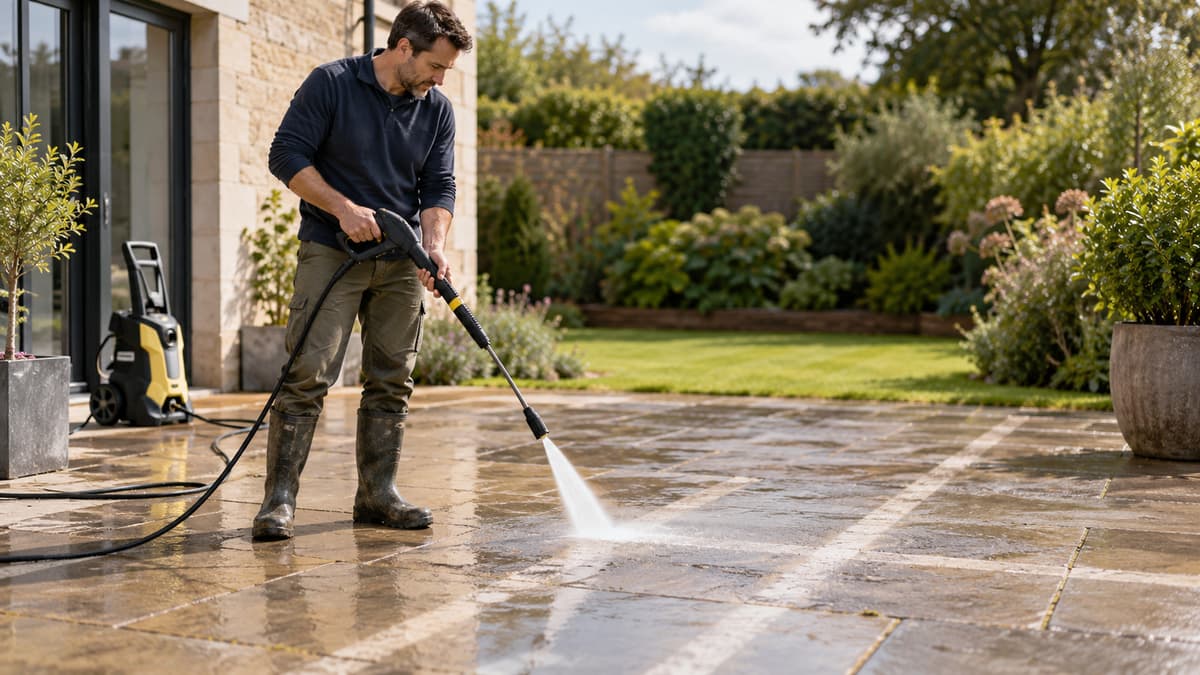
Jet wash stripes are pale lines a still lance cuts into paving. See how distance, fan width and dwell cause them, and when another wash deepens the groove.
On this page

You stepped back from a wet patio and the flags were crossed with pale, straight bands. The silt has gone and the bands have stayed, running the way you walked with the lance. Those jet wash stripes on paving are the track of a jet that paused close to the stone. A later rinse leaves the groove, and a second pass takes more of the surface away.
What you change is the distance, the width of the fan and the time the jet spends on one spot. A round surface head holds the spray down, and UK buyers still report streaks when it pauses. A labelled cleaner and a washer attachment are separate choices.
Products Compared read the amazon.co.uk listing for the Nilfisk Large Power Patio Cleaner, ASIN B096N7BZ9V, in October 2026, with London Stone's jet-wash notes, Which? guidance on pressure washers, and Floorseal's note on black spot. Nobody on this page ran a laboratory trial. A qualifying purchase through our links can earn a commission at no extra cost to you.
In short
Jet wash stripes on paving are eroded lines where a lance or a head dwelled on the face. London Stone starts at about 50 cm and about 45 degrees. Which? places patio-type washing at 500 to 1,200 psi with a 25 degree or 40 degree nozzle. A surface head cuts splash and can still streak if you pause. The large head on this listing was £77.98, apart from Which?'s around £50 remark.
What jet wash stripes on a patio actually are
A stripe is a band of stone worn harder than the flag beside it. As the patio dries it is often paler, and sometimes rougher under a fingertip, running the way you walked. A lance held still keeps the jet on the same few centimetres, so the narrow stream cuts a sharp edge. Those pressure washer marks on slabs are the cleaned line itself.
Algae sits where water lingers, on a shaded edge or along the fall towards a gully. Lichen black spot stays as dark dots after a wash, which is Floorseal's point about sandstone and pavers. Clean parallel bands that match your passes are the lance, and they remain when the flags are fully dry.
London Stone's jet-wash guide puts erosion with lost joints, chips and stripped sealant. A wash aimed at blending the colours thins the higher stone until the whole flag sits lower. Some pale lines are only a slab edge or a factory texture, stronger while the stone is wet. Read the patio dry, beside a flag you left alone. Wet Indian sandstone can mimic a stripe for an hour.
Distance, angle and nozzle
London Stone's figures are about 50 cm from the surface and about a 45 degree angle. That gap keeps the tip clear while a fan can still shift silt. Forty-five degrees sends the water along the flag so it shears dirt sideways. A lance a few centimetres off the slab is a jet wash too close. Held upright and still, it drills one spot.
Which? groups patios, decks, fences and sheds at 500 to 1,200 psi, with a 25 degree or 40 degree nozzle. Psi means pounds per square inch. A wider fan spreads the stream so each point takes less, provided the lance keeps moving. Which? also gives about 60 cm on wood. Keep that timber gap with decks and fences.
The Nilfisk large head lists a maximum of 2,000 psi on its amazon.co.uk listing. No British Standard for patio pressure was found. Which?'s band, London Stone's distance and that ceiling each stay with the source that published them.
Averaging 500 to 1,200 psi with a 2,000 psi ceiling invents a setting neither Which? nor the listing printed. On a spare slab at about 50 cm, sand that jumps, or a pale track inside a minute, means the jet is too close, too narrow or too slow.
A patio cleaner head versus a lance
A patio cleaner head is a round cover on the lance, with spinning jets behind a skirt. An open lance leaves the fan in the air, so dirty water blows back onto doors, render and your legs. The skirt holds the spray down and the jets share the blast around a circle. That circle is the gain over a wand held in one line.
The circle still marks the stone when you stop. Pause to shift a pot and the jets dwell, leaving a disc, a crescent or a short band. Overlap the same edge on every pass and those rings join into a track once the flags dry. UK reviews mention streaks beside lower splash. The skirt does not erase a pause.
Buyers report jets damaged by stones, and a damaged jet throws a tighter stream. Brush grit off the flags, and stop if the head rattles or the wet pattern turns ragged. Moss in tarmac is a weak result in those reviews, and one review is one account. Outside the compatibility list, stay with the lance at about 50 cm. Where growth remains, use the chemical cleaner or jet wash page rather than a harder jet.
The Nilfisk large head in this set
The washer attachment in this set is the Nilfisk Large Power Patio Cleaner, ASIN B096N7BZ9V. On the amazon.co.uk listing it was £77.98, rated 4.1 from 448 reviews. You supply the pressure washer, and the listing maximum is 2,000 psi. UK review themes are lower splash, streaks, jets damaged by stones, a compatibility list that fails some machines, and weak results on tarmac moss.
One owner reported about 20 square metres an hour, against about four hours with a rotary lance. The review does not state the area behind those four hours, so treat the pace as one owner's day on a large, flat run. It is a poor quote for a small or gritty terrace, where every stop wipes the pace out.
Which? says patio attachments often cost around £50. This large head was £77.98, and Nilfisk's mid patio cleaner, at £49.99 with a 250 mm head, is a different product. See it in the stone cleaner comparison. Check your model on the current listing before you buy. Keep 2,000 psi as a ceiling, not as the working pressure.
Lost pointing, sealant and soft stone
Lost pointing shows after the patio dries, when the joint is a groove and a slab ticks under your foot. A jet held in the gap, often while you chase a weed, washes the sand or mortar out. London Stone lists lost joints with erosion, chips and stripped sealant. Drying does not put the sand back. A chip is an arris hit by the blast or by grit.
Indian sandstone shows a close jet soonest, because the face is often softer than dense concrete. How to avoid stripes when jet washing Indian sandstone is the same discipline, kept tighter. Start near 50 cm and 45 degrees, on a 25 degree or 40 degree fan, and keep moving for the whole pass. A bright line is the cut. A blending pass takes more of the softer face.
A sealed patio can show dull tramlines where a close jet has stripped the coating, and that sheen can look like dirt. This page has no tin to name for a half-stripped coat. Everyday washing and growth sit on the patio paving cleaner page. An empty joint is the stop, because washing the groove widens it. A rocking slab needs a paving contractor first.
When to stop washing and change method
Stop at the first pale line, while the rest of the terrace is untouched. Give one corner about a minute at the distance and fan you mean to use. A mark inside that minute means the pressure, the gap or the dwell is already too much. Finishing the terrace copies the line onto every flag, and a later pass leaves the groove empty.
Black dots that remain after a careful wash are Floorseal's case: the water left the lichen in the stone. Parking the lance or this Nilfisk head on the dot turns a spot into a ring. A patio head does not inherit the dose on a stone-cleaner bottle.
A bird bath, a statue or a memorial is a small curved surface, and a patio lance is a blunt tool there. Where the tracks are shallow and the joints are full, leaving them can be the kinder result. No filler on this page is shown to restore a jet-cut texture. If the joints are empty or the slabs move, stabilise the paving before you wash again.
Common questions
Why does my patio look striped after jet washing?
How far should I stand from the slabs?
Is a round patio head better than a lance?
What psi should I use on paving?
Can jet-wash stripes be repaired?
Will a patio head remove black spots?
Does the Nilfisk head fit every washer?

Products Compared publishes British-English buying guides based on amazon.co.uk listings and public UK sources. We do not run a lab and we do not invent test scores.
Related articles

Choosing a patio surface cleaner
A round patio head is a washer attachment, and the coupling may not match the machine you own.
How often to clean paving
Sweep when debris lands, wash filmed flags, and skip a hard annual jet that strips joints and sealant.
How to clean a sandstone patio
Acid and a close jet both mark sandstone. A safe wash starts with the stone, then the pressure.