How to clean a sandstone patio: no acid, no close jet
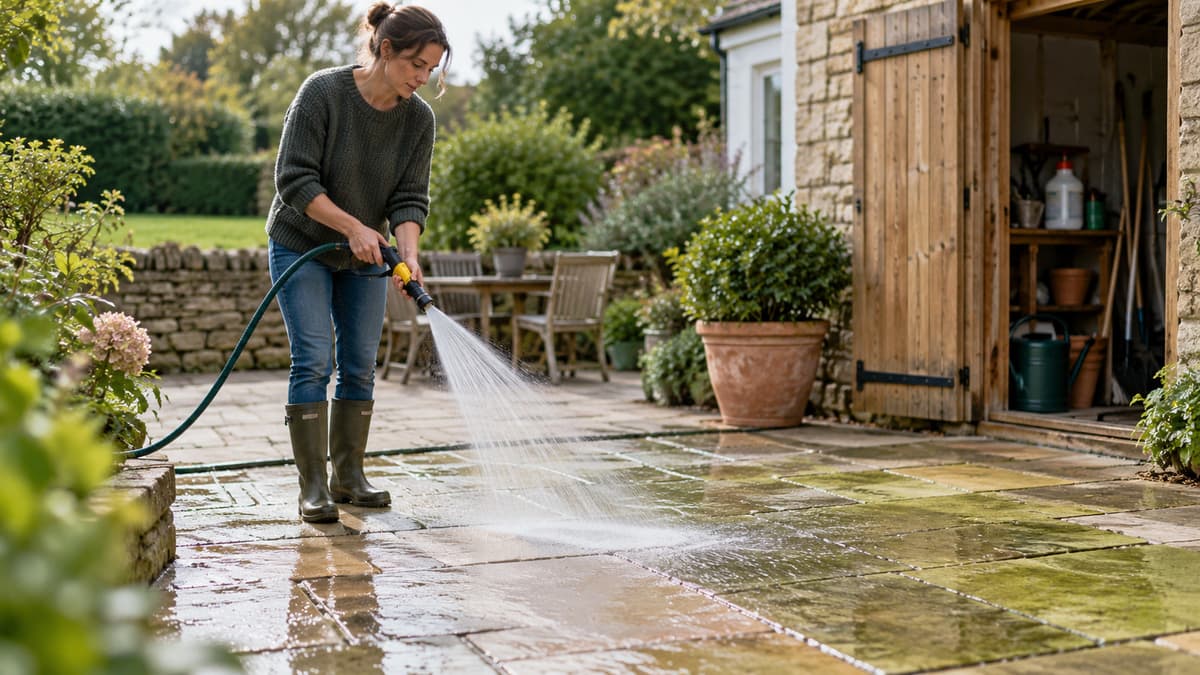
How to clean a sandstone patio without acid or a close jet. Sweep, sort film, spots and cement, wash from about 50 cm, and keep hydrochloric acid off the flags.
On this page

The flags have turned a dull green, and the bottle in the shed is brick acid. How to clean a sandstone patio, and still recognise the colour afterwards, comes down to two limits. Hydrochloric patio cleaner rust-stains Indian sandstone, including Kandla Grey, Raj, Camel and Autumn Brown, and Pavingexpert treats those iron marks as often permanent. A lance held close blows the jointing out, chips the edges and cuts a pale stripe into the slab.
Sweep the stone dry, sort film, black spots and cement, then wash from about 50 cm with a wide fan and the lance moving. Products Compared read the amazon.co.uk listings in this set on 15 October 2026, with London Stone, Pavingexpert, Which? and Floorseal. There is no laboratory test on this page. A purchase through a comparison link can earn us a commission at no extra cost to you.
In short
Sweep the patio dry, then separate green film, black spots and cement haze. Wash film from about 50 cm, at about 45 degrees, with the lance moving. Keep hydrochloric acid and vinegar off Indian sandstone. Cement needs an acid-free film remover and a scrub, and black spots often remain after a jet wash.
Name the sandstone before you mix anything
A sandstone patio cleaner only makes sense once you know the flags. Many British gardens are paved in Indian sandstone. Read the delivery note for Kandla Grey, Raj, Camel and Autumn Brown before you mix a bucket. Pavingexpert records that hydrochloric patio cleaners rust-stain these stones, and that the orange-brown mark is often permanent.
Where sandstone meets limestone, the limestone decides the bottle, because one bucket will cross the joint. London Stone keeps vinegar and brick acid off limestone. Keep vinegar, lemon, brick acid and a bathroom descaler off Indian sandstone as well. If you cannot name the flags, test one slab. Judge the clean on a dry flag, and stop if the patch turns sandy or orange.
Sweep, then sort film, spots and cement
Start while the patio is dry. A stiff brush takes off grit a jet would drive into the face. Move pots first. The ring under a pot is usually the darkest patch.
A film that smears on a wet finger is growth on the surface, so removing algae from sandstone is often a wash. Black spots that stay put are different. Floorseal describes black spot on sandstone patios as lichen in many cases, and states that it resists a pressure wash. Dwell times in that article belong to Floorseal's product and do not transfer to another bottle.
A pale haze or a hard lump on new paving is cement. A soak leaves cured cement in place, so use a labelled film remover and a scrub. Wash the film first and treat the cement on one patch. One bottle over every mark, because the front says patio, is how acid reaches stone that only had algae.
A careful wash, with distance and a wider fan
London Stone puts the lance about 50 cm off the slab, at about 45 degrees, on a medium pressure, and keeps it moving. Too close, and the machine lifts jointing sand, chips the edges and strips sealant. Which? places patio work at 500 to 1,200 psi, with a 25 or 40 degree nozzle. These sources contain no British Standard that sets one home pressure, so leave the washer's maximum unused.
The Nilfisk large patio cleaner in this set lists a maximum of 2,000 psi. That ceiling belongs to the attachment, and it is the wrong number to copy onto Indian sandstone. A Nilfisk mid patio cleaner at £49.99 is a different model. Liquids and heads are set out on the chemical or a jet wash page. Use a fan you can see, held at London Stone's distance.
- Sweep, then wet the flags, so the jet meets damp stone.
- Fit the wider fan, and keep a medium setting inside the Which? band if your gauge shows one.
- Hold the lance about 50 cm away at about 45 degrees, and keep it moving.
- Stop after one or two slabs and check the joint and the arris.
- Rinse loosened growth toward a drain you are allowed to use, and keep the plume out of the beds.
A lance held still etches a pale stripe that looks clean while the stone is wet and reads as damage once it dries. If those stripes are already there, stop adding to them.
When a labelled cleaner is the next step
Open a bottle for cement haze, or when film remains and the label names natural stone. People look for a pH neutral patio cleaner on acid-sensitive stone. In this set only the kitchen-top pack prints a pH, and that 7.0 is for worktops, so it is the wrong volume for a patio. This comparison has no Indian sandstone black-spot chemical with a published coverage for flags.
HG cement and lime film remover, 5 litres, ASIN B00BQWOIIG, was £57.20 on the amazon.co.uk listing read on 15 October 2026, with 3.7 from 178 ratings. The listing calls it acid-free, for cement and lime film. Wet the floor, apply the dissolved solution, leave it about 5 minutes, scrub, and rinse. The working mix in this comparison is 500 ml in 5 litres of water, over 10 to 15 square metres at a time. UK buyers still report hard scrubbing and lumps that remain. The listing leaves the cement in the grouting, and it is a poor match for algae.
Follow the dose on the tin if it differs. Dilution, a patch and a rinse are on how to use a stone cleaner. Match the stain in the stone cleaner comparison before a second chemical goes over the first. Stop if a dry test flag turns orange, goes sandy, or eats the arris.
What to skip: acid, vinegar and a grinding wheel
Brick acid is hydrochloric. Pavingexpert ties the rust stains to Kandla Grey, Raj, Camel and Autumn Brown, and treats the mark as often permanent. A later wash does not bring the colour back. If the patio has already gone orange, ask a paving contractor whether the face can be dressed. This page has no method that claims to lift the stain.
Vinegar, lemon and a bathroom descaler belong on that same list. London Stone keeps vinegar and brick acid off limestone patios. The buying guide keeps pumice and grinding wheels out of the patio column.
A diamond cup wheel cuts the stone and kicks up silica dust. The Health and Safety Executive cites a workplace exposure limit of 0.1 mg/m³ over eight hours for that dust, and one UK review of the cup in this set mentions vibration. Household bleach has no sandstone dose in these sources. Stone King, the 2 litre outdoor restorer, is sold for gravestones and ornaments. UK reviews report a chlorine smell, killed grass and bleached clothes, and the listing is not a coverage rate for flags. Wet plants before any runoff and keep the liquid off fabric.
After the wash, once the flags are dry
Let the patio dry before you decide the clean has worked. Sandstone holds water, so a blotchy afternoon flag can look even the next morning, or show a stripe that was hidden while wet. If the wash has emptied the joints, the slabs can rock. Refill them with suitable kiln-dried sand on a dry day, separate from the cleaner.
London Stone notes that a jet held too close strips sealant already on the stone. If the flags were sealed, the interval lives on that tin. These sources give no single reseal month. An unsealed patio has no same-day duty to start, and sealer on damp sandstone traps moisture.
Call a professional when the stone is already rust-stained, when slabs move underfoot, or when a patch test has shifted the colour. Outdoor flags, algae and joints are the subject of the patio and paving guide.
Common questions
How do I clean a sandstone patio without damaging it?
Can I use brick acid on Indian sandstone?
What pressure is safe on patio slabs?
Will a jet wash remove black spots?
How do I get cement film off new sandstone?
Should I seal the patio after washing?
Can I use bleach on sandstone?
How do I test a cleaner first?

Products Compared publishes British-English buying guides based on amazon.co.uk listings and public UK sources. We do not run a lab and we do not invent test scores.
Related articles
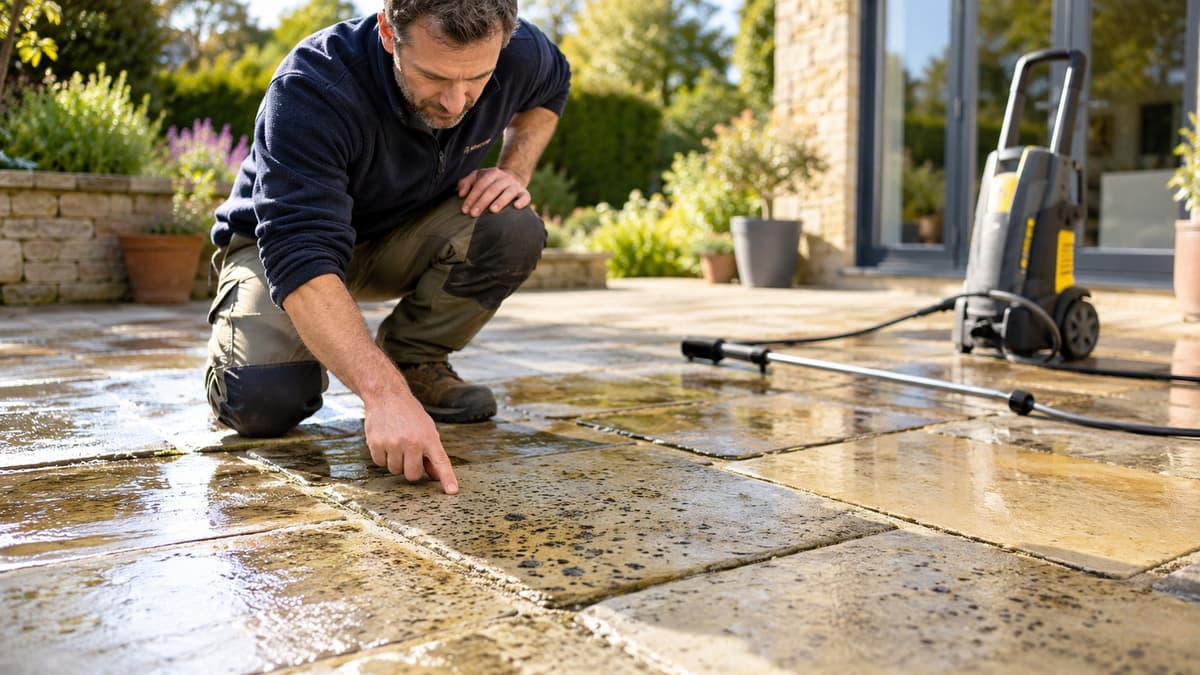
Black spots on patio slabs
Lichen black spot is not the same as algae film. You can see dark dots that survive a wash.

Acid and Indian sandstone
Hydrochloric patio cleaner rust-stains these stones: Kandla, Raj, Camel, Autumn Brown or black limestone.
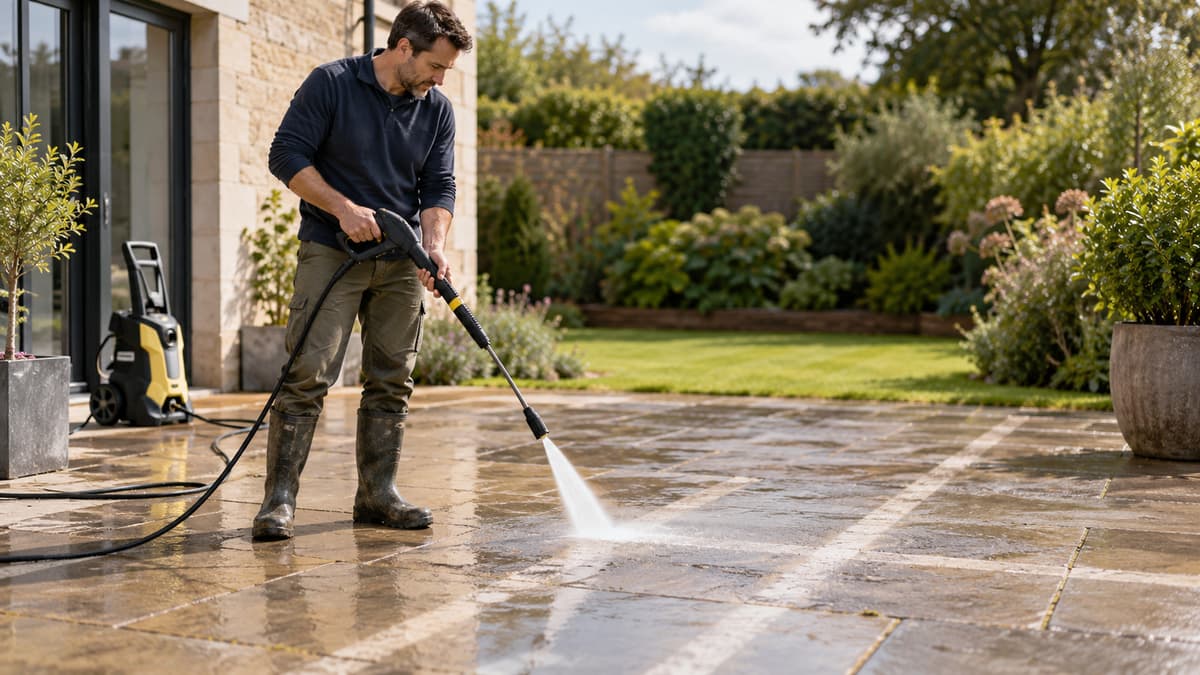
Jet-wash stripes on paving
Holding a lance still etches clean lines into the surface. You already striped the flags, or you are about to.