Independent comparisons. We may earn from shop links. More info

How to Clean a Sandstone Patio and Spare the Joints

Updated: 15.10.2026

A wet spring leaves a green film on the Indian sandstone outside the back door. A patio cleaner or a hard jet looks like the quick fix, and on this stone both can go wrong. Kandla Grey, Raj, Camel and Autumn Brown pick up orange rust from hydrochloric acid, and a close jet blows the sand out of the joints. How to clean a sandstone patio here means naming the flag and the mark before you wash. The wider set is in our [stone cleaner comparison](/hub/garden-supplies/stone-cleaner). Noted on 15 October 2026 from UK guides and amazon.co.uk listings, with no lab test. A qualifying purchase can earn a commission at no extra cost.

A wet spring leaves a green film on the Indian sandstone outside the back door. A patio cleaner or a hard jet looks like the quick fix, and on this stone both can go wrong.

Our top picks

On this page

Identify the flag before any chemical

Hydrochloric patio cleaner leaves orange rust on imported sandstone, and the stain is often permanent. Pavingexpert ties that reaction to Kandla Grey, Raj, Camel and Autumn Brown, and puts black limestone in the same warning. London Stone also rules out vinegar and brick acid on limestone. If the delivery note only says Indian sandstone, patch test one hidden edge. Those indoor steps are in how to use a stone cleaner. If the edge shifts towards orange, stop.

Algae, black spot and ordinary dirt

Green film often lifts with a careful wash. Black spots in sandstone often stay: Floorseal calls many of them lichen that survives pressure washing. No UK listing here publishes black-spot coverage for flags, so a 2 litre bottle is not a dose for your terrace. Stone King is sold for gravestones and ornaments, and it has no square-metre rate. UK reviews mention dead grass, bleached clothes, a chlorine smell, and no sprayer.

Cement haze on new paving

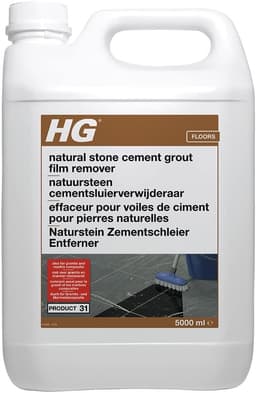
A milky film on new flags is cement residue, not algae. The 5 litre HG cement and grout film remover is acid-free on the listing. Wet the flags, leave it briefly, scrub, and rinse. UK reviews on Indian sandstone and black limestone say it needs hard scrubbing and leaves cured cement, so chip the thick blobs. Brick acid on Raj or Kandla can clear the haze and leave orange rust. Keep runoff out of the beds.

Jet washing without wrecking the joints

A jet clears loose dirt and empties the joints if you stand too close. London Stone suggests medium pressure, about 50 cm off the slab and about 45 degrees, with the lance moving. Which? suggests 500-1200 psi and a 25 degree or 40 degree nozzle for patios. That is Which?'s guidance, not a British Standard. The Nilfisk large patio cleaner is a surface head listed to 2,000 psi. UK reviews say it splashes less than a lance, but a pause leaves stripes. Compare head and lance in patio cleaner versus a pressure washer.

Plants, clothes and seals

Restorers with a chlorine smell bleach fabric and kill grass, even under a sheet, which is what UK Stone King reviews describe. Rinse plants first and keep the runoff out of the beds. A hard jet can also strip sealant. Stone King has no sprayer, and a splash bleaches a pale shirt. If your patch test turns orange, stop. You may have to leave black lichen rather than chase it into orange stains or empty joints.

Common questions

How do I clean an Indian sandstone patio safely?
Name the colour before you open a chemical. Pavingexpert links hydrochloric cleaners to orange rust on Kandla Grey, Raj, Camel and Autumn Brown, and that stain is often permanent. Patch test a hidden edge, and keep a jet about 50 cm off at about 45 degrees, as London Stone describes, using a wide fan. If the marks are lichen, a wash may leave them, and brick acid risks the same orange stain.
Why did my grey sandstone turn orange?
Hydrochloric acid in patio and brick cleaners reacts with iron in imported sandstone and leaves an orange rust stain. Pavingexpert records that on Kandla Grey, Raj, Camel and Autumn Brown, and on black limestone. The mark is often permanent, so a later rinse does not bring the grey back. Do not use that bottle on the rest of your terrace.
Will a jet wash remove black spots?
Often it will not. Floorseal says black spot on sandstone is frequently lichen and survives pressure washing, while green film on the surface usually lifts. More pressure can empty the joints and chip the edges. No UK listing compared here gives a coverage rate for black spot on these flags. If a careful wash has failed, leave the spots rather than switching to brick acid.
Can I use brick acid on Raj or Kandla?
No. Brick acid is hydrochloric, and Pavingexpert ties it to rust stains on Raj, Kandla Grey, Camel and Autumn Brown. London Stone also rules out brick acid and vinegar on limestone. For cement haze, stay with an acid-free film remover and scrub. Using acid because the first bottle was slow leaves a stain that is often permanent.
How do I get cement haze off new paving?
Wet the flags, apply an acid-free film remover, leave it briefly, scrub, and rinse. HG's 5 litre cement and grout film remover is acid-free on the listing. UK reviews on Indian black limestone and sandstone say it needs hard scrubbing and leaves cured cement, so chip the thick blobs off. Do not switch to brick acid, which can turn this sandstone orange.
What pressure is safe on patio slabs?
Which? suggests 500-1200 psi and a 25 degree or 40 degree nozzle for patios and similar surfaces. That is Which?'s guidance, not a British Standard. London Stone adds about 50 cm and about 45 degrees, at medium pressure, with the lance kept moving. The 2,000 psi figure on the Nilfisk large patio cleaner is the listing maximum, not the pressure for your sandstone. If you pause, a surface head can still leave stripes.

Related pages

Sources

Public UK sources and manufacturer pages used for this comparison, last accessed 15 October 2026.

  1. London Stone — How to clean a natural stone patio (retrieved 15.10.2026)
  2. London Stone — How to jet wash a patio (retrieved 15.10.2026)
  3. Pavingexpert — Acid stains on paving (retrieved 15.10.2026)
  4. Historic England — Caring for monuments (retrieved 15.10.2026)
  5. Church of England — Churchyard wildlife and lichens (retrieved 15.10.2026)
  6. HSE — COPR biocide requirements (retrieved 15.10.2026)
  7. HSE — Cleaning products and the corrosive pictogram (retrieved 15.10.2026)
  8. HSE — Silica dust from scabbling or grinding (retrieved 15.10.2026)
  9. HG UK — Natural stone cement and grout film remover (retrieved 15.10.2026)
  10. HG UK — Natural stone cleaner shine restorer (retrieved 15.10.2026)
  11. HG UK — Natural stone cleaner extra strong (retrieved 15.10.2026)
  12. legislation.gov.uk — Consumer Rights Act 2015, section 9 (retrieved 15.10.2026)