How often to clean a patio: wash when flags are dirty
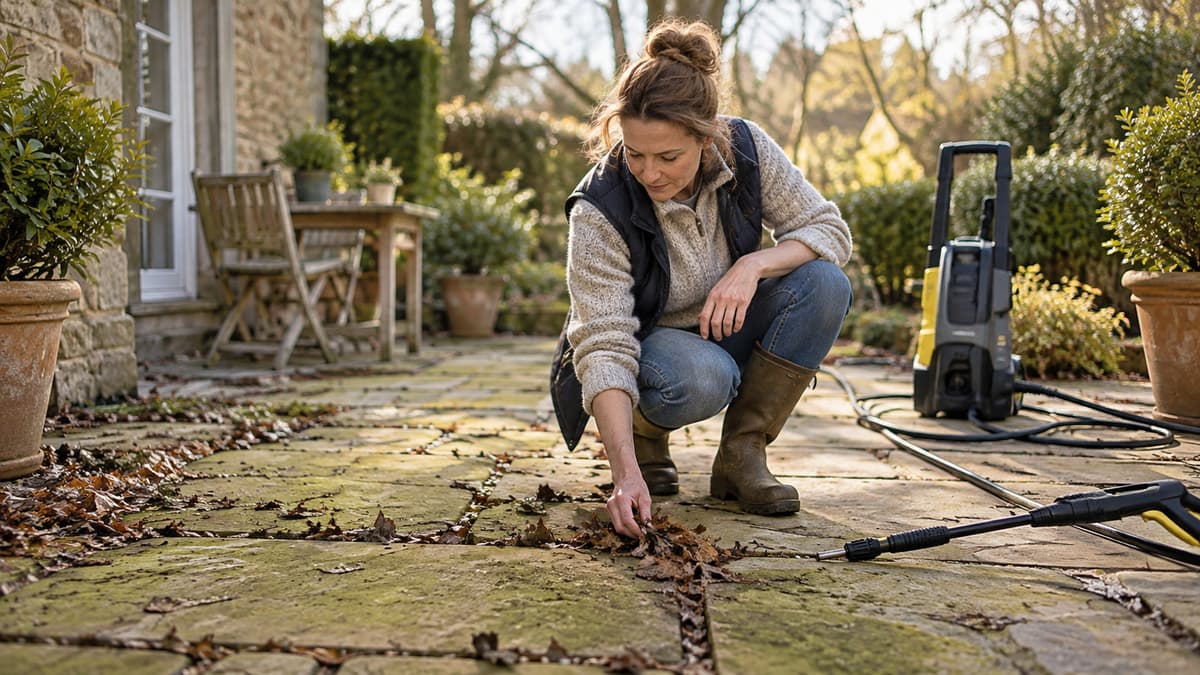
No British Standard sets how often to clean a patio. Sweep when debris lands, wash filmed flags, and skip a hard annual jet that strips joints and sealant.
On this page

The patio is green by March, the joints are packed with last year's leaves, and the pressure washer is already out because you did the same last spring. How often to clean a patio is what turns that habit into a decision. No British Standard found for this page sets an interval, and "twice a year" circulates without a source you can cite.
Clean when the flags are soiled. Sweep when leaves and soil land. Save a hard jet for a film you can see, not for a date. An indoor shine restorer runs on a bottle dose, and that dose is not an appointment for the paving outside.
Products Compared read the amazon.co.uk listing for HG shine restorer on 15 October 2026, with public notes from HG, London Stone, Which? and Floorseal. There is no laboratory test here. A purchase through a comparison link can earn us a commission at no extra cost to you.
In short
No British Standard sets how often to clean a patio, so twice a year is not a rule. Sweep when debris lands, and wash when the surface is filmed or slippery, after a patch test. A hard annual jet strips joints and sealant, and the 100 washes on a 5 litre HG bottle are indoor mop doses, not dates for the flags.
How often to clean a patio is not a fixed date
You clean a patio when it is dirty, and you leave it when it is not. London Stone's patio guide treats cleaning as a response to soiling, and it asks for a patch test before a cleaner leaves one small area. The gap is whatever sits on the stone. This page will not invent a month to fill it.
"Clean twice a year" appears in other articles with no standard behind it. A shaded terrace and a sunny path do not share a weekend. Walk the flags after rain and after the leaves drop in autumn. If the darker colour is only water in the pores, wait until the stone is dry, because wet sandstone looks stained at tea-time and ordinary the next morning.
A film that smears, or a slippery slab by the door, is a clean. A surface that still matches its dry summer colour is not.
Washing it anyway costs jointing sand, and London Stone's jet-wash guide calls that loss damage, not a thorough job.
Indoor stone has its own mopping clock
HG's mop advice is for indoor natural stone. The shine restorer dose is 50 ml in 5 litres of water, with no rinse. On the amazon.co.uk listing read on 15 October 2026, HG shine restorer 5 L, ASIN B00BQWOIKY, was £34.09, with 4.3 from 110 ratings. The listing names marble, slate, quartz and sandstone floors. It does not describe an outdoor patio treatment.
How often you mop natural stone indoors follows feet and that dose. A kitchen mopped twice a week and a hall mopped when it looks dull are indoor clocks. Neither says when the patio needs a lance. The stone cleaner comparison sets this bottle beside film removers and washer heads so you can see the split before you buy.
Among those 110 ratings, one reviewer saw no gain after three or four mops, and black granite left streaks. The 4.3 is that listing's count, not a promise every floor shines. For a different bottle, dose and a patch are on how to use a stone cleaner. The patio still waits on dirt, not on this bottle.
What a patio cleaning schedule should follow
Shade, leaves and the joints set the outdoor gap. Shady, damp flags grow algae sooner, which is a reason to sweep and to keep soil off the surface, not a reason to raise the pressure. Soil in the joints holds moisture. A broom after leaf fall does more for a shaded patio than a second hard wash in June.
This patio cleaning schedule is a response list, not a British Standard.
- Sweep leaves, soil and the grit under pots when they land, sooner under trees and on the damp side of the house.
- Wash when a film smears or the flags are slippery, and patch-test any bottle on one flag first.
- Leave a clean, sunny path alone, even in a month when the shaded side needed a pass.
- Stop if the joints are losing sand. Do not book another wash to finish what the last one loosened.
Maintaining Indian sandstone uses the same list. A dull wet colour is not a reason to hit harder, and softer sandstone shows a close blast as a pale stripe and a chipped edge. If you cannot name the flags, test one slab and judge it dry. Seal a sandstone patio only if that was already the plan, and only on stone that is clean and dry. These sources give no reseal month. Film and joints are covered on the patio and paving page.
How many times a year to pressure wash
How many times a year you should pressure wash paving is the question that wants a number. These sources do not give one. Which? publishes a band for a single session on patios and similar surfaces: about 500 to 1,200 psi, with a 25 or 40 degree nozzle. That is how hard the water hits while you wash. It is not a yearly allowance, and it is not a British Standard.
London Stone's jet-wash guide puts the lance about 50 cm off the slab, at about 45 degrees, on a medium pressure, kept moving. Too close, and the jet lifts sand, chips edges and strips sealant. Repeating that every spring is the same injury on a date.
Jet wash every year in March only if the dirt is there. A dark, wet patio often lightens as it dries. If autumn's wash held and winter left leaves, sweep. Wash the shaded half if it has filmed, and leave the sunny half until it has a film of its own. Once, not at all, or twice on the damp side are results of looking, not targets.
One hundred washes is a dilution sum
"About 100 washes" on the HG shine restorer sounds like a year's supply, or like a hundred trips onto the patio. It is a mixing sum. The dose is 50 ml in 5 litres of water. One litre is about 20 doses, because 1,000 ml divided by 50 ml is 20, and five litres is about 100. The listing's figure is that sum, not a calendar. It does not tell you to mop on Tuesdays or to empty the bottle on the flags before winter.
£34.09 divided by 100 is 34.09p, under 35p a wash, only if you measure 50 ml and use the bucket. A heavier pour, or a rinse the method does not ask for, breaks the sum. The price is the amazon.co.uk figure for ASIN B00BQWOIKY on 15 October 2026, not a live shelf price and not a cost per square metre of paving.
Black spot and cement are events, not seasons
Black spots that stay in the slab will not follow a mopping schedule. Floorseal, used on the patio pages in this set, treats many of them as lichen. A pressure wash often leaves them, and washing them with the green film stripes the stone and empties the joints while the dots remain. Lift loose film if it smears, let the flags dry, and treat the spots as their own job. Do not copy one brand's contact time onto another bottle.
Cement haze belongs to new paving, once. Slurry or mortar leaves a pale film or a lump at the start, not a March task you repeat because the flags look dull. A soak leaves cured cement in place, and an annual jet is not a film remover. Dull, damp stone in winter is not a new-build haze.
You can see the joints failing on the day. Sand piles at the low edge, gaps open, and a flag taps underfoot. London Stone ties that loss to a lance held too close, and another wash multiplies it. Stop. Re-filling joints with the right sand is a dry-day repair, not a shorter interval. If the slabs already rock, ask a paving contractor. Sweep when debris lands, wash when there is a film, and leave black spots, cement and the 100-wash bottle off the seasonal list.
Common questions
How often should I clean my patio?
Should I jet wash every spring?
How often do I mop an indoor stone floor?
Does shade change the interval?
Will frequent washing strip the sealant?
What does 100 washes on a 5 L bottle mean?
Should I clean black spots on a schedule?
When is a clean making the joints worse?

Products Compared publishes British-English buying guides based on amazon.co.uk listings and public UK sources. We do not run a lab and we do not invent test scores.
Related articles
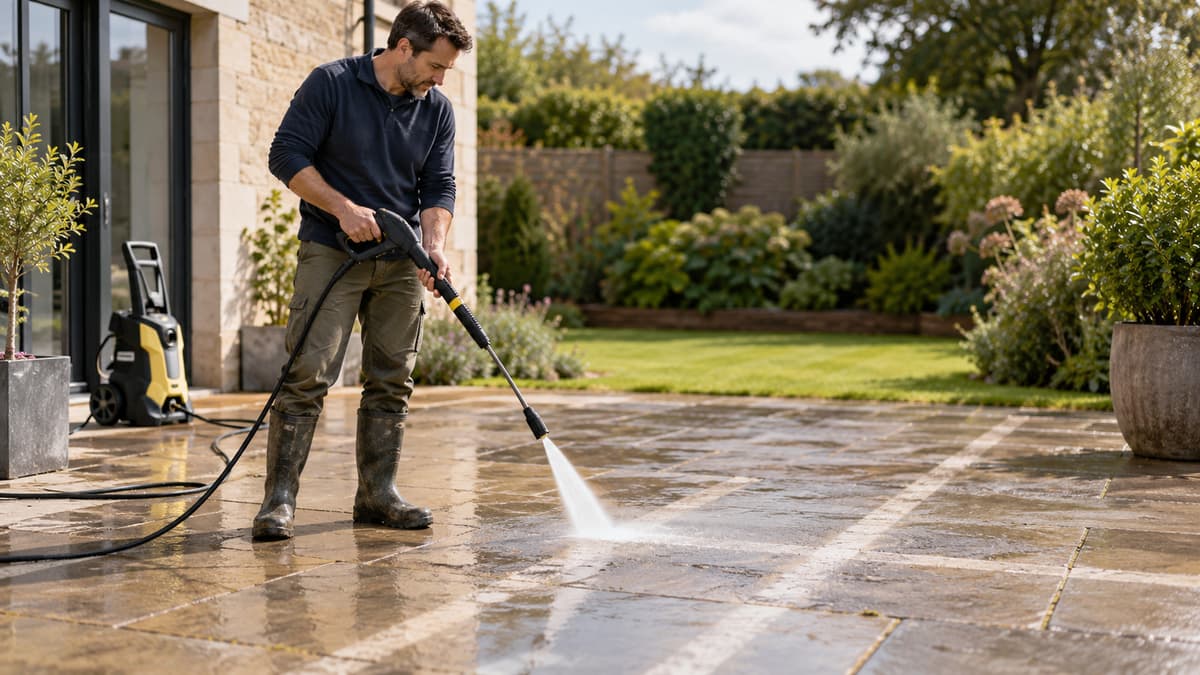
Jet wash stripes on patio: why a still lance etches lines
A lance held still etches pale lines into the flags. Distance and a moving fan matter more than another annual blast.

Patio surface cleaner: the head, the fit and the price
A round patio head is a washer attachment, and the coupling may not match the machine you own.
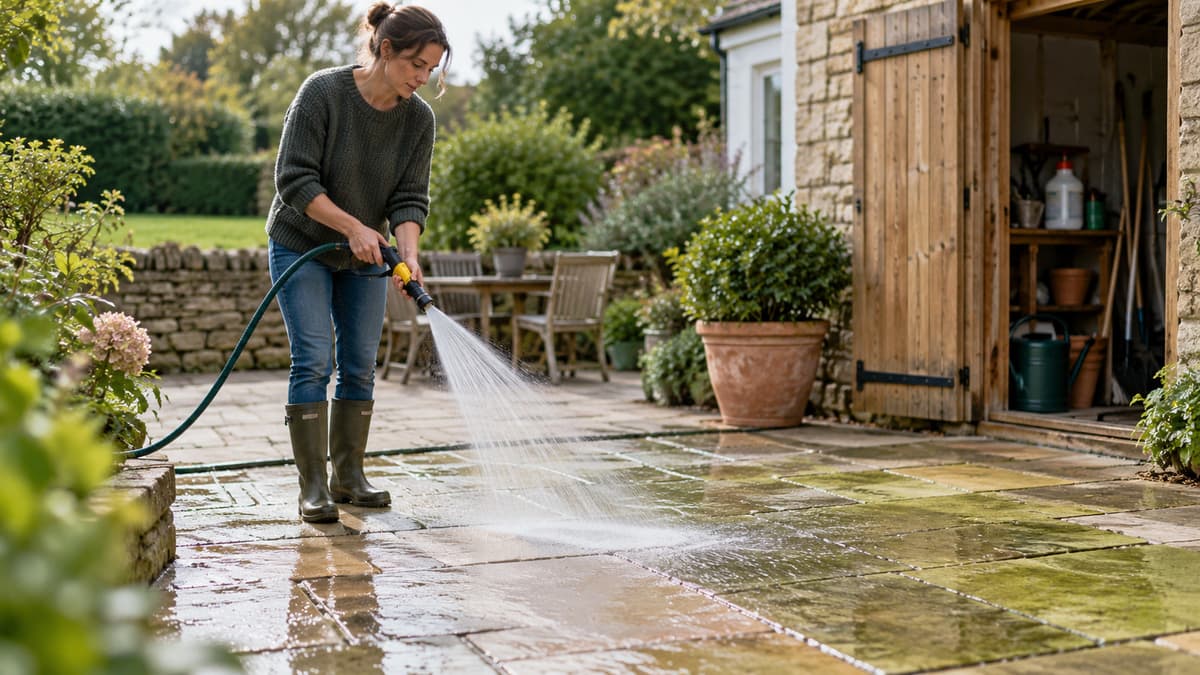
How to clean a sandstone patio: no acid, no close jet
Acid and a close jet both mark sandstone. Sweep, name the mark, then wash from a distance before a bottle.