Independent comparisons. We may earn from shop links. More info

Stove fan for a cool top: use the flue

Updated: 22.10.2026

The plate stays warm rather than hot, or it is soapstone, enamelled at an angle, or covered with a kettle, and a fan on that surface never starts. A stove fan for a cool top only makes sense if the flue above is hotter than the plate and a magnet will hold. This page stays on that job. The ranked pipe fans are the [magnetic stove fan comparison](/hub/fireplaces-and-stoves/magnetic-stove-fan). How the clamp goes on is [how to fit a magnetic stove fan](/hub/fireplaces-and-stoves/magnetic-stove-fan/sub/magnetic-stove-fan-how-to-fit). Listings were captured on 19 October 2026. This is not a thermometer on your stove. A qualifying purchase can earn a commission at no extra cost to you.

The plate stays warm rather than hot, or it is soapstone, enamelled at an angle, or covered with a kettle, and a fan on that surface never starts.

Our top picks

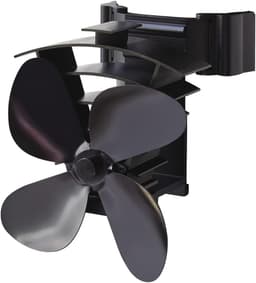
Signstek Signstek CF6-T pipe fan

Alternative

Signstek Signstek CF6-T pipe fan
5.5/10about £31.44
On this page

When the top is the wrong surface

A stovetop fan needs a flat plate hot enough to drive the module. Ecofan’s UK questions put that fan on the back or the side, not as a cure for a top that never warms. If the fan sits still, the surface is often the fault. Soapstone can feel warm and still be a poor seat. A boiler stove can keep the top cooler while the flue does the work. An angled enamel top gives the feet nothing level, and sliding a magnet across it marks the enamel. A kettle on the plate is a space problem, and it still points you off the top. The wider choice is the flue fan versus stovetop fan page.

What has to be true of the pipe

The flue can be hot while the plate is not. The pipe still has to be single-wall steel a magnet will grip, and hot enough for the module you bought. Test cold. If the magnet falls off, soapstone, a boiler and a kettle do not create a product in this set. The Remora bullets name a cool top, an irregular surface, soapstone and an angled top, and a start as low as 50°C. Valiant’s FAQ, if the fan will not spin, asks whether the pipe reaches about 200°C. Those are different claims: a stated start, and a check that the pipe is hot. Drcokars names the same sort of top, with 80–350°C and 12–15.5 cm. TITECK names wood-burning stoves and log burners, not soapstone. A 125 mm vitreous pipe that holds a magnet is a fair candidate. A stainless section above a soapstone stove is not.

What you should expect in the room

UK Remora reviews split. People with no flat top, with enamel, or with a boiler stove say the clamp runs once the pipe is warm, and some say warm air reaches further into the room. Others say the draught at the hand is faint beside a fan that used to sit on a hot plate. This is a small module moving room air, not a ducted heater. One UK review describes a boiler stove whose flue did get hot enough. That is one stove. If your pipe stays lukewarm, the fan has the same problem as a plate fan. No cubic-feet figure is printed, so there is no honest room-sized promise.

When a fan is the wrong tool

A cool top with a hot magnetic flue is a fan problem. Smoke in the room, or a pipe that stays cold because the chimney is blocked, is not. The fan does not pull smoke, and it does not replace a carbon monoxide alarm. If the whole appliance stays cold, call the installer or a sweep. Do not over-fire to force a spin. If the magnet test passes and the pipe does get hot, the Remora is the listing that states this job, with the faint-air complaint still attached. Drcokars states the same sort of top inside 12–15.5 cm, with UK texts that praise the magnet and describe slip. Next is a tape on the pipe and the height in the leaflet.

Common questions

My soapstone top stays warm, not hot. Will a pipe fan work?
It can, if the flue above that stone is magnetic single-wall and actually gets hot. The Remora listing names soapstone as a reason to leave the plate. The stone being pleasant to touch does not tell you the pipe temperature. Do the fridge-magnet test cold, then judge the pipe on a normal fire, not the top.
The stove has a boiler and the top never gets very hot. Is the flue hotter?
It might be. A boiler can keep the top cooler while the connecting flue still heats up, and one UK Remora review describes that pattern. It is one installation. If your pipe also stays cool, the fan will not start, because the module needs a hot face. Check the pipe, not the marketing line on the boiler badge.
The top is angled enamel. Can anything sit on it?
A stovetop fan needs a flat seat, so an angled enamel top is a poor place for feet. A pipe fan avoids that seat. Do not slide any magnetic base across the enamel to try. Place a flue clamp on the pipe, cold, if the magnet holds, and leave the enamel alone.
I want the top free for a kettle. Is that a reason?
Yes, as a space reason, provided the pipe passes the same tests as a cool top. Keeping the plate clear does not make a stainless flue magnetic, and it does not make a lukewarm pipe hot. If the top is flat and hot and you only want the kettle space, you can also stand a plate fan at the back and keep the front clear. That choice is the versus page, not a second pipe fan by default.
Is a cool top the same as a stove that is spilling smoke?
No. A cool or awkward top can be normal on soapstone, a boiler, or a sloped enamel plate, with a flue that still draws. Smoke in the room, or a pipe that never warms because the chimney is at fault, is a combustion and flue problem. A fan on the outside of the pipe does not cure spillage, and it should not be fitted while that is happening.

Related pages

Sources

Public UK sources used for this comparison. amazon.co.uk prices, stars and review counts were taken from the listings on 19 October 2026.

  1. Valiant Remora product page (retrieved 19 October 2026)
  2. FIR350 user guide (retrieved 19 October 2026)
  3. Remora FAQ (retrieved 19 October 2026)
  4. Caframo Ecofan technical note (retrieved 19 October 2026)
  5. Approved Document J 2022 (retrieved 19 October 2026)
  6. Approved Document J carbon monoxide circular (retrieved 19 October 2026)
  7. GOV.UK smoke and carbon monoxide alarm booklet (retrieved 19 October 2026)
  8. BFCMA general guidance (retrieved 19 October 2026)