Independent comparisons. We may earn from shop links. More info

Magnetic stove fan: buy only if the pipe holds

Updated: 22.10.2026

You already have a log burner or a multi-fuel stove, and a search for a magnetic stove fan on amazon.co.uk mixes pipe clamps with fans that sit on the plate. Some of those clamps will never grip the pipe in your room. This page is whether to order one, leave the job to a stovetop fan, or buy nothing. The five models we kept are ranked on the [magnetic stove fan comparison](/hub/fireplaces-and-stoves/magnetic-stove-fan). Listings were captured on 19 October 2026. This is not a lab test of airflow. A qualifying amazon.co.uk purchase can earn a commission at no extra cost to you.

You already have a log burner or a multi-fuel stove, and a search for a magnetic stove fan on amazon.co.uk mixes pipe clamps with fans that sit on the plate. Some of those clamps will never grip the pipe in your room.

Our top picks

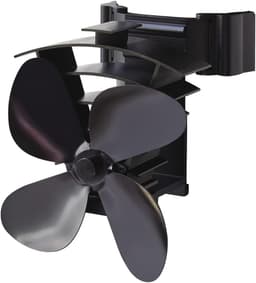
Signstek Signstek CF6-T pipe fan

Alternative

Signstek Signstek CF6-T pipe fan
5.5/10about £31.44
On this page

What you are actually buying

A magnetic stove fan clamps to the outside of a metal flue and pushes room air. It does not pull smoke up the chimney, and it does not need a battery or a 13 amp plug. A thermoelectric module uses the gap between a hot pipe and cooler room air. Feet on a flat base mean the plate type. A clamp, a ring or a strap means this aisle. The mount choice is on the flue pipe fan versus stovetop fan page. The Remora bullets attach the fan to the flue. Valiant’s shop limits that clamp to magnetic pipe of about 4–7 inches, with about 250 mm you can see. The cold sequence is on how to fit a magnetic stove fan.

The pipe test and the size bands

UK outlets are commonly 125 mm or 150 mm, so measure rather than guessing from a photo. Drcokars HL-600A prints 12–15.5 cm diameter, 37.7–48.7 cm around, and a height of 20–50 cm from the fireplace top. A 125 mm pipe is about 12.5 cm across, near the bottom of that band. A 150 mm pipe is 15 cm, near the top. TITECK prints 15.45–24.72 inches around. That is not Valiant’s 4–7 inch diameter. A 125 mm pipe is about 15.5 inches around, and a 150 mm pipe is about 18.6 inches around. Signstek CF6-T prints no diameter, so a magnet that holds is still not a size match. Test while the stove is out. If the magnet slides off, none of the five has another way to hold. Stainless and twin-wall are the usual misses.

What the saved listings can and cannot prove

Every kept listing shows 4.4 stars, and the texts do not describe the same fan. The Remora file has 446 reviews. The first 50 saved texts are from the United Kingdom and talk about a clamp, and reviewers often call the draught faint beside a plate fan. Drcokars has 1,735 reviews, and the magnet is mentioned in 20 of the first 50. Signstek’s 1,357 reviews are a poor guide to the six-blade pipe model. In the first 50 UK texts, almost none mention a pipe, though the thermometer and the fixing ring are real bullet lines. Both TITECK rows are 4.4 from 320, with one UK text that says the fan does not run and most of the sample from Germany. None of these files supports a fuel-saving percentage.

When to stop

Stop if the cold magnet will not hold, if the only reachable pipe is twin-wall or decorative stainless, or if the stove spills smoke. Approved Document J treats the connecting flue as something that must stay gas-tight. A clamp is not a reason to drill the pipe. A short strap is a return, or a clip bought as a clip. If the top is flat, hot and clear at the back, a stovetop fan is the simpler buy. If the pipe passes the magnet test, use the main comparison and open the row whose band matches the tape.

Common questions

Will a magnetic stove fan stick to my pipe?
Only if that pipe is ferromagnetic and a magnet grips it while the stove is cold. Try a fridge magnet on the section you will use. If it falls off, the Remora, the Drcokars mount, the Signstek ring, and both TITECK straps have nothing to hold. Stainless and twin-wall are the usual misses, and no listing in this set prints a workaround for them.
Is a 125 mm or 150 mm flue inside the seller’s band?
Often, once you use the unit the seller printed. Drcokars states 12–15.5 cm diameter, which covers a typical 125 mm outlet and a 150 mm outlet at the top of the band. TITECK states 15.45–24.72 inches of circumference, which also covers those two pipes if you measure around the outside. Valiant’s shop page talks about 4–7 inch magnetic pipe. Signstek states no diameter. Measure the pipe, then read the band.
Do I still need a carbon monoxide alarm?
Yes. The fan moves room air. It does not detect carbon monoxide, and it does not stand in for an alarm. For a fixed solid-fuel appliance in England, the alarm standard named for that job is BS EN 50291. Fit and test the alarm as its own instructions say, whether or not a fan is on the pipe.
Is the cheaper TITECK the same evidence as the Remora?
No. The Remora file has 446 reviews, the first 50 saved texts are from the United Kingdom, and they describe a flue clamp, at £39.99. The TITECK 8-blade is £31.34 and the dual-head is £37.99, and both show the same 320-review pattern with a single UK text that says the fan does not run. A lower price is not a larger UK sample.
Should I buy one if the stove top is flat and hot?
Usually you should buy a stovetop fan instead. A flat, hot plate with space at the back is the job that type was built for, and pipe-fan reviewers often describe a gentler draught. Choose the pipe type when the top is cool, sloped, crowded, or missing, and the flue still passes the magnet test. If you have not chosen a mount, use the versus page before either fan goes in the basket.

Related pages

Sources

Public UK sources used for this comparison. amazon.co.uk prices, stars and review counts were taken from the listings on 19 October 2026.

  1. Valiant Remora product page (retrieved 19 October 2026)
  2. FIR350 user guide (retrieved 19 October 2026)
  3. Remora FAQ (retrieved 19 October 2026)
  4. Caframo Ecofan technical note (retrieved 19 October 2026)
  5. Approved Document J 2022 (retrieved 19 October 2026)
  6. Approved Document J carbon monoxide circular (retrieved 19 October 2026)
  7. GOV.UK smoke and carbon monoxide alarm booklet (retrieved 19 October 2026)
  8. BFCMA general guidance (retrieved 19 October 2026)