Independent comparisons. We may earn from shop links. More info

How to fit a smoke alarm

Updated: October 2026

You have a battery smoke alarm, a ceiling and about half an hour. How to fit a smoke alarm is about place and fixings, so it stays up, in the right room, and gets tested. The sensor choice sits on the [smoke alarm buying guide](/hub/fire-protection/smoke-alarm/sub/smoke-alarm-buying-guide), and the twelve listings with prices are on the [smoke alarm comparison](/hub/fire-protection/smoke-alarm). The notes use GOV.UK, London Fire Brigade, Fire Kills and Scottish Fire and Rescue Service pages, plus amazon.co.uk reviews from 19 October 2026. There was no lab fitting. A qualifying purchase can earn a commission at no extra cost to you.

You have a battery smoke alarm, a ceiling and about half an hour. How to fit a smoke alarm is about place and fixings, so it stays up, in the right room, and gets tested.

Our top picks

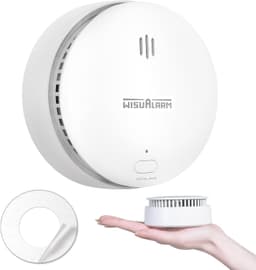
WISUALARM WISUALARM DHI-HY-SA20A

Best overall

WISUALARM WISUALARM DHI-HY-SA20A
7.6/10about £8.94
STATUS STATUS 9 V

Best value

STATUS STATUS 9 V
7.1/10about £6.97
FireAngel FireAngel FA6620

Rank 3

FireAngel FireAngel FA6620
9.3/10about £11.98
On this page

Where it goes

GOV.UK puts at least one alarm on every storey, in the middle of the ceiling, on the hall and the landing, and not in or near kitchens or bathrooms. London Fire Brigade says the same about steam. A heat alarm is the kitchen tool, and it is a different product. Bedrooms and living rooms are extras once the hall and landing are covered. One alarm on the ground floor does not cover a bedroom landing if a closed door sits between them. Ceiling is the default because smoke rises. If you cannot reach it safely, stop. A chair on a bed is how people fall.

Screws, not glue

London Fire Brigade’s line is screw, don’t glue. Adhesive can creep into the sensing chamber, and a pad that lets go is the same as no alarm. Drill, use the plugs the ceiling needs, and twist the alarm on until it sits firm. X-Sense does not reuse every old plate, so a new hole may be needed. FireAngel’s plate is described as matching the ST622; one review says it did not fit an ST-620. If a pad is the only option on a rented ceiling, press it on a clean, dry surface and check it the next day. If it is peeling, screw the alarm.
WISUALARM WISUALARM DHI-HY-SA20A

Testsieger

WISUALARM WISUALARM DHI-HY-SA20A
7.6/10about £8.94

Test, then clean

The test button checks that the battery can drive the sounder. It does not prove the sensor will see smoke. Do not hold a flaming tea towel under the alarm. GOV.UK says test at least monthly. Scottish Fire and Rescue Service says every week, and FireAngel’s page for the FA6620-R also says weekly. Use the stricter line that applies to you, and tie it to a day you already keep. Dust is the other half. GOV.UK says vacuum every six months. Greater Manchester Fire and Rescue Service says about every three months. Use the soft brush. Do not paint the cover or the standby light.

Chirps, and when to stop

A regular chirp is not a fire. Fire Kills says replace the battery at once. On a sealed alarm you replace the whole unit. Hush is a delay, not a repair, and the alarm should still react to smoke. Do not leave an empty plate. Stop and get an electrician for mains alarms, for alarms that must be linked on the supply, or where a Welsh rented home still needs that mains minimum. If you cannot reach the ceiling, or you are unsure whether the room needs a heat alarm, ask the fire service about a home fire-safety visit.

Common questions

Ceiling or wall?
Use the ceiling, in the middle of the hall or landing, which is the GOV.UK position. Smoke collects there first. A wall is a second choice only if that model’s manual allows it and you keep the distance from the ceiling that the manual states. The STATUS listing allows ceiling or wall. These listings do not give you one shared centimetre figure for a wall fit.
How far from a kitchen or a bathroom?
Far enough that steam does not reach the sensor. GOV.UK says not in or near kitchens or bathrooms. There is no single distance on these amazon.co.uk pages. East Sussex Fire and Rescue Service advises at least 30 cm from walls and lights, which is a clearance from the fitting, not a licence to mount the alarm beside a kettle. If the alarm false-alarms when you shower, it is too close.
Are the sticky pads safe?
London Fire Brigade says screw, don’t glue, because adhesive can get into the alarm and because a failed pad means no detection. A Heiman review recorded a sticker falling off a smooth ceiling after about ten hours. One WISUALARM high-ceiling sticker had held for about three months. If you must use a pad, check it the next day. If it has moved, screw the alarm. A pad that is already on the floor is not a fitted alarm.
How do I know the test worked?
You heard the sounder after a proper press. On the X-Sense that can mean holding the button for about four to five seconds. On a FireAngel quiet test the sound is deliberately reduced. A real alarm is louder. The test does not prove the sensor can see smoke. Do not burn something under it to check. Vacuum the vents, and replace the alarm if the button does nothing.
What do I do if it chirps at night?
A regular chirp is a battery or end-of-life warning, not a fire alarm. Replace a loose cell straight away. On a sealed alarm, replace the whole unit. A hush button may silence the chirp briefly, and Fire Kills says the alarm should still sound for smoke. If you only remove the battery and leave the base, the hall has no alarm until you remember.

Related pages

Sources

Public UK sources, last checked on 19 October 2026.

  1. GOV.UK smoke and carbon monoxide alarm Q&A for landlords (retrieved 19 October 2026)
  2. The Smoke and Carbon Monoxide Alarm (England) Regulations 2015, regulation 4 (retrieved 19 October 2026)
  3. Approved Document B fire safety frequently asked questions (retrieved 19 October 2026)
  4. Scottish Government fire and smoke alarms in Scottish homes (retrieved 19 October 2026)
  5. Renting Homes (Fitness for Human Habitation) (Wales) Regulations 2022, regulation 5 (retrieved 19 October 2026)
  6. The Smoke, Heat and Carbon Monoxide Alarms for Private Tenancies Regulations (Northern Ireland) 2024 (retrieved 19 October 2026)
  7. London Fire Brigade smoke alarms and heat alarms (retrieved 19 October 2026)
  8. GOV.UK fire safety in the home (retrieved 19 October 2026)