


Pot and houseplant keeper
You already water houseplants, tubs or baskets and will measure a cap on a routine. The Miracle-Gro liquid twin pack states garden and indoor use and has 3,025 reviews. The listing itself prints no NPK.
The best universal fertilisers, compared.
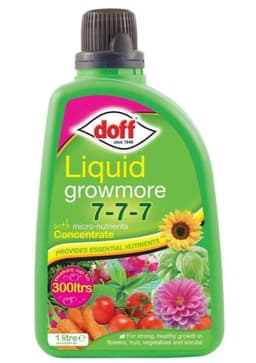
Top pick: Doff Liquid Growmore 1 L Best value: Doff Liquid Growmore 1 L – It is the lowest shelf price in the set, at £6.55, with a measure in the cap. The 4.8 rating comes from 86 reviews, and the dose fields disagree. Updated October 2026.


A universal fertiliser is a compound nitrogen, phosphorus and potassium feed for mixed garden plants. It is a different product from a lawn feed, a tomato feed, a box-tree treatment or an aquarium additive. On amazon.co.uk the useful split is form. Containers you already water suit a dilute liquid. Patio pots you will not feed every week suit coated or slow-release granules at planting. Dug beds suit ordinary granules on a repeat calendar. This page compares six listings from 15 October 2026, priced from £6.55 to £23.99. Each star rating and review count stays with its own ASIN, and a missing NPK stays missing. The Miracle-Gro All Purpose Liquid 1.6 L twin pack is the top pick, with 4.6 out of 5 from 3,025 reviews and a listing that covers the garden and indoor houseplants. Doff Liquid Growmore 1 L is the best-value option at the lowest shelf price, £6.55, with 4.8 from 86 reviews. These scores use listing and review evidence. They are editorial scores, with no laboratory test behind them. For the decision order, see the [universal fertiliser buying guide](/hub/fertiliser-soil-and-bark-mulch/universal-fertiliser/sub/universal-fertiliser-buying-guide).
A universal fertiliser is a compound nitrogen, phosphorus and potassium feed for mixed garden plants. It is a different product from a lawn feed, a tomato feed, a box-tree treatment or an aquarium additive.
22 products checked · 62 hrs invested · +21,400 readers
Swipe for more
1-2 of 6


Personal buying guide
Question 1 of 2
What are you feeding?
Doff Liquid Growmore is a 1 litre concentrate with a measure built into the cap, and it is the cheapest bottle in this comparison at £6.55. Its 4.8 out of 5 comes from 86 amazon.co.uk reviews, so the score is high but the sample is small. The listing says it suits all plants indoors, outside and in the greenhouse, and reviewers mention vegetables, hanging baskets and borders, including a visible growth spurt in a border after two feeds. Dose is where it gets untidy. The model field says 7:7:7 and the mixing-ratio field says 1:466, while one reviewer uses one cap to 4.5 litres and another half a cap in about 5 litres. One buyer warns that too much can harm plants, so follow the bottle you receive rather than a figure from a review. It is the best value here if you will feed on a routine, with the caveat that few buyers have reported back.
Pros
Cons
Best for: Borders, hanging baskets and greenhouse plants where you want the cheapest liquid feed and will follow the cap marks on the bottle.
Less suitable: Anyone who wants a single, printed dilution rate on the listing or a very large review base.
Specifications
Common questions
Can you use it indoors?
Yes. The bullets say it is suitable for all plants indoors, outside and in the greenhouse.
How is the dose stated?
The Amazon field says a mixing ratio of 1:466. A review says one cap to 4.5 litres. The bottle has an integral measure.
What happens if you add too much?
A review says to stick to the advised amount because too much can harm plants.
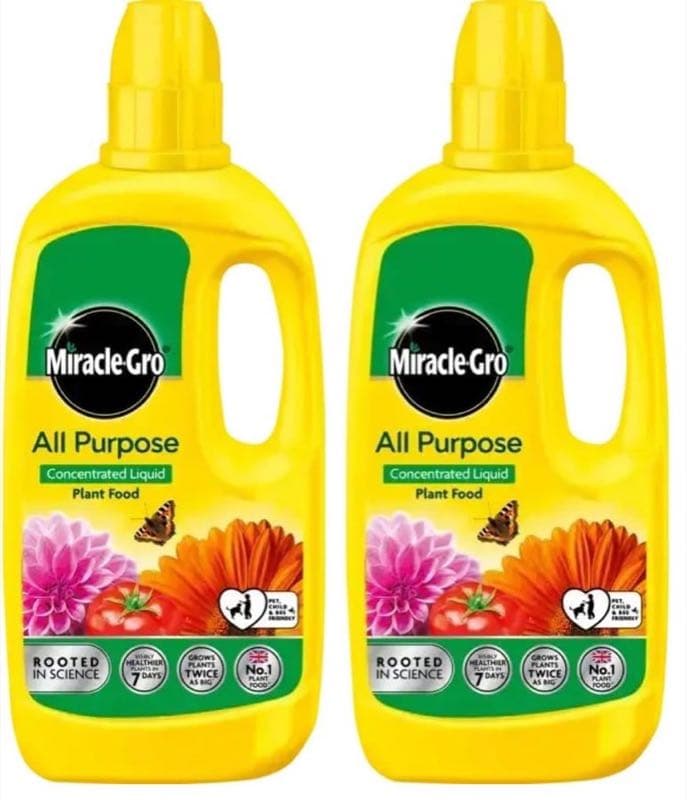
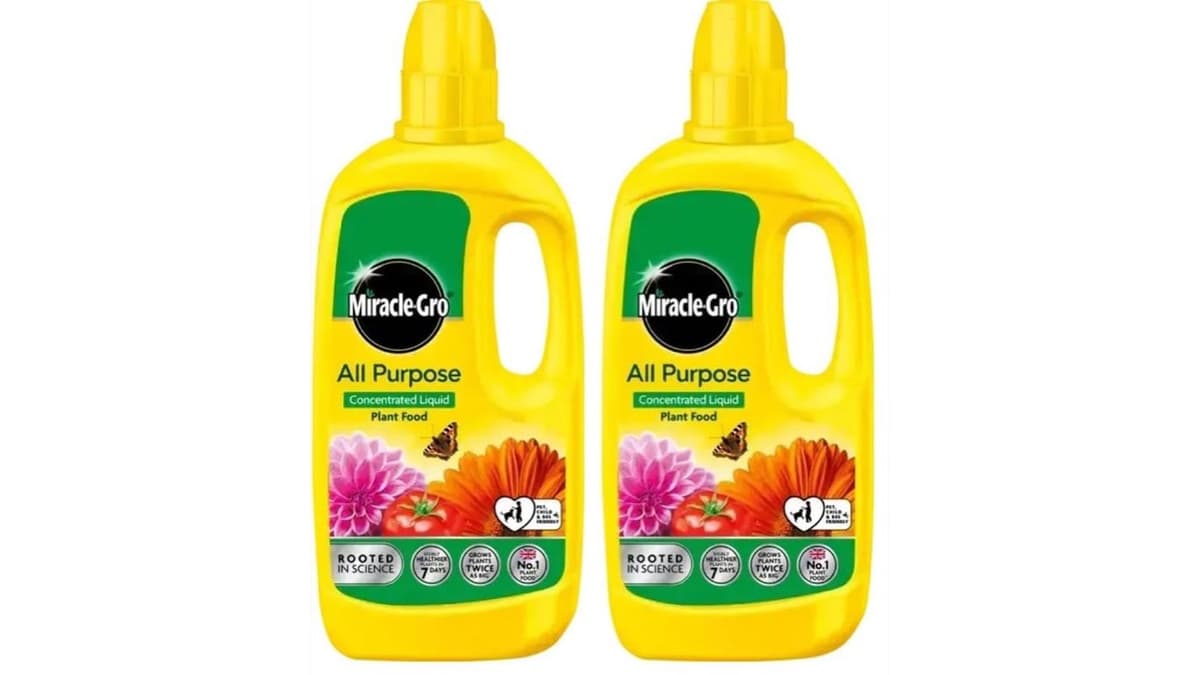
This twin pack of Miracle-Gro All Purpose Concentrated Liquid gives you 1,600 ml of plant food that you dilute in a watering can, for £7.98 on amazon.co.uk. It has the biggest review base in this comparison, 4.6 out of 5 from 3,025 reviews, and buyers describe healthier houseplants, patio tubs and baskets, with new leaves on one struggling plant after about two feeds. The listing says it can go on the garden and on indoor houseplants, which the granule listings here do not state. Buyers do complain that measuring half or a quarter of a cap per litre feels fiddly for a full can, and several say the 800 ml bottles look three-quarters full. The amazon.co.uk listing prints no NPK, and one reviewer who fed every two to three days saw no change at all. The manufacturer label for model 121175 declares 7-3-5, at half a cap per litre, which is a different recipe from Miracle-Gro soluble powder. Granules work out cheaper per feed for at least one buyer, so this is a liquid for people who already water by hand.
Pros
Cons
Best for: Houseplants, patio tubs and baskets that you water by hand and are happy to feed on a regular routine.
Less suitable: Anyone who forgets to feed pots, or who wants a printed NPK on the listing before ordering.
Specifications
Common questions
Can you use it indoors?
Yes. The listing says it can be used in the garden and on indoor houseplants.
Is it a ready-to-pour feed?
No. It is a liquid concentrate that you mix with water. The pack is two 800 ml bottles, 1,600 ml in total.
Do buyers mention the bottle size?
Yes. More than one review says 800 ml is sold in a bottle that looks like 1 litre.
Miracle-Gro Continuous Release is a coated granule that you mix into compost or sprinkle on pots, and the listing says one application at the start of spring feeds plants for the whole season. The twin 900 g pack costs £11.94 and holds 4.6 out of 5 from 2,641 reviews. Buyers like that there is no smell and no weekly mixing, and they report hanging baskets, tubs, raised beds and tomatoes and green beans in pots doing well. The listing prints no NPK and no rate. The most specific complaint is that the pellets look like resin or plastic and do not break down in soil, and one buyer returned the tub for that reason. A repeat buyer with a larger garden also found the tub did not last the season. Its secondary Amazon rank is hydroponic nutrients, which does not match the bullets, so treat the pack label as the guide to use.
Pros
Cons
Best for: Baskets, tubs and raised beds where you would rather mix granules in once than measure liquid every week.
Less suitable: Large gardens, or anyone who dislikes seeing coating left in the compost.
Specifications
Common questions
How often do you apply it?
The listing says one application at the start of spring feeds plants for the whole season.
Do you mix it with water?
The listing does not give a dilution. Reviews describe mixing the granules into compost or sprinkling them into pots, with no weekly mixing.
Is the Amazon form field liquid?
No. The form field says powder. The title says continuous release, and the bullets describe a temperature-controlled coating.
Westland Boost Slow Release is 2 kg of granular plant food for £11.64, with an instant feed plus a six-month slow-release claim. The 4.5 out of 5 comes from 181 reviews, and buyers use it on begonias and basket displays, roses, tulips, vegetable raised beds and some houseplants. One buyer calls it a useful alternative to liquid feed in containers. The bullets claim high potassium for flowering and fruit but print no NPK, and the duration bullet reads 6-moth on the listing. The dominant complaint is packaging: many reviews say the brittle plastic tub arrives cracked, with the lid loose or the granules in the outer bag. One buyer reports mould and went back to another brand. Many reviewers also say it is too early to judge, so the six-month claim is not yet confirmed by users.
Pros
Cons
Best for: Baskets, troughs and flower beds where you want a granule instead of a weekly liquid.
Less suitable: Anyone who wants a confirmed NPK, or who is sensitive to a damaged tub arriving.
Specifications
Common questions
Does the listing say it is organic?
No. The page asks the question and the bullets do not answer it.
How long is the slow-release claim?
The bullets say a slow-release feed for a 6-moth nutrient supply. That is the spelling on the listing.
What do reviews say about the tub?
Several reviews say the plastic tub arrived split, with the lid loose or the granules in the paper bag.
Topline Growmore is an 8 kg tub of ordinary granules for flowers, vegetables, fruit trees and shrubs, at £23.99 on amazon.co.uk. That is about £3 per kilogram, the lowest in this comparison. The listing gives a calendar rather than a rate: apply every 4–6 weeks from February to the end of October, as a base dressing or top dressing, and water before and after in dry weather. Buyers report lusher raised beds and roses after two spring feeds, and say it is easy to scatter and rake in. Two problems recur. The Amazon analysis field says 20:20:20, but a UK reviewer says the pack reads 7-7-7, so the analysis is not settled, and the tub is reported to split and spill granules. With 4.5 out of 5 from 136 reviews, it suits a garden big enough to use 8 kg, not a few pots.
Pros
Cons
Best for: Beds, borders and a vegetable plot where you can use a large tub over a season.
Less suitable: Small patios and balconies, or anyone who needs the NPK settled before buying.
Specifications
Common questions
Which plants does the listing name?
Most types of flowers, vegetables, fruit trees and shrubs.
How often do you apply it?
Every 4–6 weeks from February to the end of October, as a top dressing or a base dressing. In dry weather, water before and after.
Is the analysis 20-20-20?
The Amazon field says 20:20:20. A UK review says the tub is NPK 7-7-7, not 20-20-20. The two statements are not resolved on the listing.
Goulding General Purpose Granules are a 720 g tub for £9.39 that claims to feed plants for up to six months. At about £13 per kilogram on the listing, it is the most expensive feed here by weight. Buyers find the granules easy to apply, and several report that one application covers the growing season. Wisteria, roses, dianthus and agapanthus are named as responding, and some buyers have bought it again over a couple of years. The listing prints no NPK, no rate and gives 720 g as the unit count against 750 g as the item weight. One buyer says the general-purpose tub matched the rose, tree and shrub tub on the ingredient list, and another saw no benefit on strawberries. At least one pack arrived with no instructions, so check the tub when it arrives.
Pros
Cons
Best for: A few flowering shrubs and roses where a small tub is enough and you will read the pack for the rate.
Less suitable: Vegetables, larger gardens, or anyone who needs a printed analysis.
Specifications
Common questions
Does the listing say it is pet friendly?
No. The page asks the question and does not answer it.
How long does it claim to last?
The bullets say it lasts up to 6 months.
What pack size is stated?
The bullet and the unit count say 720 g. The item weight says 750 g.
We compared six amazon.co.uk listings from 15 October 2026, their UK rating lines, review signals and named public sources. Scores reflect review-count confidence, whether the listing gives a usable analysis and dose or calendar, shelf price per litre or kilogram, fit for the stated use, and listing defects. The figures are editorial scores from those sources.
Review confidence
30%Amazon stars count for more when thousands of reviews sit behind them. The same star rating on a small sample earns fewer points.
Specification
25%A printed NPK, a clear feed style and a usable dose or calendar are what make a listing possible to buy from. A missing analysis stays missing.
Value
20%Value uses the shelf price per litre or per kilogram printed for that pack. It is not a cost per pot.
Fit and convenience
15%We record indoor and vegetable wording only when the listing states it, and we set pack size against the garden the bullets describe.
Listing consistency
10%Split tubs, a disputed analysis, conflicting weights and a missing instruction sheet reduce the score. They are defect signals, not a quality award.
Start with where the plants are and how often you will feed them. A watering-can routine suits a liquid concentrate. One spring application in baskets and tubs suits a coated granule. Beds suit ordinary granules when you will repeat a calendar and can use the pack size. Read the analysis the listing actually prints, and keep a disputed field disputed. A high star rating on 86 reviews is a thinner sample than the same stars on a few thousand reviews.
A universal fertiliser is a compound feed of nitrogen, phosphorus and potassium for mixed garden plants. A lawn fertiliser, a tomato feed, a box-tree treatment and an aquarium additive are different products. The Royal Horticultural Society describes a general compound for ordinary garden use, and it points rhododendrons, camellias, heathers and blueberries to an ericaceous feed. The six amazon.co.uk listings here fall into three patterns.
A 7:7:7 line is an oxide declaration. The RHS shows it is about 7% nitrogen, 3.1% phosphorus and 5.8% potassium, so it leans towards nitrogen. The bag is not split into three equal parts.
Miracle-Gro soluble powder is a different recipe from the 7-3-5 concentrate, model 121175. Topline’s Amazon field says 20:20:20 and a UK review says the tub is 7-7-7. Leave another brand’s grams per square metre on that other brand.
A review of Doff says too much can harm plants, so follow the marks on the bottle you receive. Rhododendrons, camellias, heathers and blueberries need an ericaceous feed.
The first decision is the job. Containers you already water suit a liquid you dilute in the can. Patio pots you will not feed every week suit coated granules or a slow-release tub at planting. Dug beds suit ordinary granules as a base dressing or a top dressing. The RHS account of feeding is that open ground with decent organic matter often needs little routine feed, so a large tub is not automatically the right buy. Pack size then has to match the garden in front of you.
Read the nutrient declaration in N, then P2O5, then K2O. A 7:7:7 oxide line is about 7% nitrogen, 3.1% phosphorus and 5.8% potassium on the RHS figures, so it leans towards nitrogen. The manufacturer label for Miracle-Gro model 121175 declares 7-3-5 and half a cap per litre. The amazon.co.uk listing for that twin pack prints no NPK, so the label and the listing are different texts. The soluble-powder analysis the RHS cites, about 24-3.5-13.3, belongs to that powder.
Three typical situations, each with a recommendation from this comparison.
You already water houseplants, tubs or baskets and will measure a cap on a routine. The Miracle-Gro liquid twin pack states garden and indoor use and has 3,025 reviews. The listing itself prints no NPK.
You want one application at planting rather than a weekly mix. Miracle-Gro Continuous Release claims one spring feed for the season, with 4.6 from 2,641 reviews. The listing prints no NPK and no rate.
You can use a large tub across beds and will follow a calendar. Topline names flowers, vegetables, fruit trees and shrubs and costs about £3 per kilogram. The analysis is disputed, and reviews report split tubs.
Form and a readable analysis matter more than a universal title. The Miracle-Gro All Purpose Liquid 1.6 L is the top pick because it has 4.6 from 3,025 reviews and a listing that covers the garden and indoor houseplants, at £7.98. Doff Liquid Growmore 1 L is the best-value option at £6.55, with 4.8 from 86 reviews and a measure in the cap. The Topline 8 kg tub is cheaper per kilogram, but the analysis is disputed and reviews report split tubs. The scores come from listings and reviews.
Doff Liquid Growmore 1 L
It is the lowest shelf price in the set, at £6.55, with a measure in the cap. The 4.8 rating comes from 86 reviews, and the dose fields disagree.
Editorial

Products Compared publishes British-English buying guides based on amazon.co.uk listings and public UK sources. We do not run a lab and we do not invent test scores.
Guides on what to look for, how to use a product, and common mistakes.
Public UK and manufacturer sources used for this comparison; last accessed 15 October 2026.
Expert source (DIY & tools): Lee Burkhill (Garden Ninja) (external profile) – public expert commentary used as a research source, not as a contributor to our pages.
This article contains affiliate links. If you buy a product through one of these links, we may earn a small commission at no extra cost to you. Our editorial assessment remains independent and is based on amazon.co.uk listing data, customer-review evidence and public sources. We did not conduct a laboratory test.