Independent comparisons. We may earn from shop links. Our editors compare products independently. Some links go to shops, and we may earn a commission. More info
Top pick: Topline tomato feed bundle with bug spray Best value: Doff Tomato Feed 2.5 L – At £12.18 it states up to 750 litres of made-up feed, about 1.6p per litre at that maximum, with a conflicting 466:1 mixing field. Updated October 2026.
A tomato fertiliser in this comparison is a liquid with more potassium than a leafy-plant food, so the plant can set fruit rather than only more leaf. You dilute a concentrate, or you pour a ready-mixed bottle at the base. These twelve amazon.co.uk listings are all liquids from Doff, Levington Tomorite, Westland Big Tom, PowerGrow, Maxicrop, and a Topline bundle with an 800 ml bug spray.
Judge a bottle by a printed NPK, a dose, and the made-up volume, not by the star count. The RHS says feed containers every 10 to 14 days with a high-potassium liquid once the first fruits swell, and that enriched ground may not need a bottle. Shelf prices in the extracts run from £4.90 to £20.99 and they move. Doff Tomato Feed 1 L is the top pick: the bullets state NPK 4-5-9 and 300 litres from 1 litre at £5.30. Doff Tomato Feed 2.5 L is the best-value pack on up to 750 litres at £12.18, but its mixing field does not match. These scores are not a laboratory test. Use the [tomato fertiliser buying guide](/hub/fertiliser-soil-and-bark-mulch/tomato-fertiliser/sub/tomato-fertiliser-buying-guide) for the checks before you pay.
A tomato fertiliser in this comparison is a liquid with more potassium than a leafy-plant food, so the plant can set fruit rather than only more leaf.
A tomato fertiliser in this comparison is a liquid with more potassium than a leafy-plant food, so the plant can set fruit rather than only more leaf. You dilute a concentrate, or you pour a ready-mixed bottle at the base. These twelve amazon.co.uk listings are all liquids from Doff, Levington Tomorite, Westland Big Tom, PowerGrow, Maxicrop, and a Topline bundle with an 800 ml bug spray.
Judge a bottle by a printed NPK, a dose, and the made-up volume, not by the star count. The RHS says feed containers every 10 to 14 days with a high-potassium liquid once the first fruits swell, and that enriched ground may not need a bottle. Shelf prices in the extracts run from £4.90 to £20.99 and they move. Doff Tomato Feed 1 L is the top pick: the bullets state NPK 4-5-9 and 300 litres from 1 litre at £5.30. Doff Tomato Feed 2.5 L is the best-value pack on up to 750 litres at £12.18, but its mixing field does not match. These scores are not a laboratory test. Use the [tomato fertiliser buying guide](/hub/fertiliser-soil-and-bark-mulch/tomato-fertiliser/sub/tomato-fertiliser-buying-guide) for the checks before you pay.
A tomato fertiliser in this comparison is a liquid with more potassium than a leafy-plant food, so the plant can set fruit rather than only more leaf. You dilute a concentrate, or you pour a ready-mixed bottle at the base. These twelve amazon.co.uk listings are all liquids from Doff, Levington Tomorite, Westland Big Tom, PowerGrow, Maxicrop, and a Topline bundle with an 800 ml bug spray. Judge a bottle by a printed NPK, a dose, and the made-up volume, not by the star count.
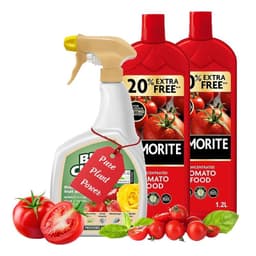
This Topline parcel combines two 1.2 litre bottles of seaweed tomato feed with an 800 ml ready-to-use bug spray, so it is not a like-for-like alternative to a feed-only pack. Its 4.7-star line from 107 reviews is the highest displayed average in the set, but that does not establish which part of the bundle reviewers valued. The listing extract prints neither an NPK nor a dilution rate for the feed. It also gives no MAPP number for the spray, although it states a 24-hour interval before picking fruit and vegetables and says produce should be washed. At £20.99 you pay the highest shelf price here and should buy it only if you need both products. The bundle is not the default top pick for someone shopping solely for fertiliser.
Pros
Two 1.2 litre feed bottles
Includes an 800 ml ready-to-use spray
4.7-star line from 107 reviews
Cons
No feed NPK or dilution rate in the extract
No MAPP number printed
Highest shelf price in the comparison
Best for: A buyer who genuinely needs both tomato feed and the separately labelled spray.
Less suitable: Anyone seeking feed alone or a pesticide with fully verifiable authorisation details online.
This 4 litre PowerGrow bottle gives you a large supply of liquid tomato feed for £12.12, which works out at £3.03 per litre before dilution. Its 4.6-star line from 725 amazon.co.uk reviews is reassuring, but the listing extract does not print either an NPK analysis or a numeric mixing rate. That omission makes it harder to compare the actual feed strength and cost per watering can with Doff or Tomorite. Manufacturer information for other markets should not be substituted for the instructions on the bottle you receive. The larger pack suits a long season only if you are happy to verify the label before measuring. It is a weaker choice if you want a fully documented recipe before ordering.
Pros
Large 4 litre bottle
Low shelf cost per litre of concentrate
4.6-star line from 725 reviews
Cons
No NPK in the listing extract
No numeric dilution rate in the listing extract
Best for: A greenhouse or several grow bags where a large bottle is useful and you can check the delivered label before mixing.
Less suitable: Anyone who needs a verified NPK or made-up cost before ordering.
The 1 litre Powergrow G60081 is a compact £6.47 liquid feed with a 4.6-star line from 549 amazon.co.uk reviews. That review volume is substantial, but the extract gives you very little with which to judge the formula. It prints no NPK, no numeric dilution rate and no made-up volume. The title says Powergrow while the brand field says Mosqueda, although Hygeia Chemicals Limited is named as manufacturer. Those inconsistencies do not prove the bottle is unsuitable, but they increase the need to inspect the delivered label. Choose it for the familiar review signal, not for specification transparency.
Pros
Manageable 1 litre bottle
4.6-star line from 549 reviews
Moderate £6.47 shelf price
Cons
No NPK or dilution rate in the extract
Title and brand fields disagree
Best for: A small number of plants where you are willing to verify the formula and dose on delivery.
Less suitable: Specification-led comparisons or cost-per-made-up-litre calculations.
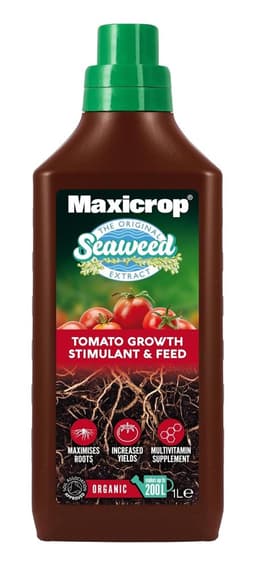
Maxicrop is the clearest option in this set if a named organic claim matters: the Amazon bullets say it is approved and certified for organic growing by OF&G. The same listing also contains a Soil Association line, so you should check the mark and control-body wording on the bottle rather than treating the two names as interchangeable. Its 1 litre concentrate is listed to make up to 200 litres, putting the £11.99 shelf price at about 6p per made-up litre if that coverage is achieved. Seaweed is named and the feed is also listed for peppers, chillies and aubergines. A 4:2:6 entry appears in the mixing-ratio field, but it is an analysis-style number rather than a usable cap dose. This is the organic-focused pick, with an important certification caveat.
Pros
OF&G claim in the Amazon bullets
Up to 200 litres of made-up feed
Seaweed and several fruiting crops named
Cons
Listing names two different organic bodies
No clear numeric cap dose in the extract
Higher shelf price than basic concentrates
Best for: Growers who want a named organic scheme and will verify the control-body mark on the pack.
Less suitable: Anyone who assumes seaweed alone proves organic status or needs an unambiguous online dose.
This Tomorite twin pack appears to supply 2 × 1.3 litres, supported by the 2,600 ml unit count, and it adds seaweed to the stated NPK 4-3-8 with magnesium. That volume could suit a long greenhouse season, and the displayed rating is 4.6 stars from 223 reviews. The listing is nevertheless internally inconsistent because another liquid-volume field says 1.3 litres. Its 1:10 mixing field also conflicts with Levington's published 20 ml in 4.5 litres, so it should not be used as the dose without checking the pack. At £15.65, it is not clearly better value than buying the listed 1 litre size according to your actual needs. The product may be useful, but the online data needs more verification than a straightforward twin-pack listing should.
Pros
Title and unit count indicate 2.6 litres total
NPK 4-3-8 with magnesium stated
Seaweed named
Cons
Volume fields disagree
Mixing field conflicts with manufacturer guidance
Premium shelf price
Best for: A long season when you want a larger Tomorite supply and will verify both pack size and dose on delivery.
Less suitable: Anyone who needs unambiguous online volume and dilution information.
The 1 litre Levington Tomorite is the sensible Tomorite size in this comparison, costing £7.45 while the 500 ml listing costs £7.69. Its model field states NPK 4-3-8, and Levington's product guidance gives a 20 ml dose in 4.5 litres, although that dose is not printed in this Amazon extract. The 4.6-star line from 145 reviews is positive without being as broad as the Doff or PowerGrow review bases. A 1 litre concentrate is practical for a greenhouse or several containers and avoids the twin pack's conflicting volume fields. You must still follow the label on the bottle rather than relying on a remembered Tomorite recipe. It is a sound familiar-brand option, but Doff provides stronger value information in the listing itself.
Pros
NPK 4-3-8 stated
Better listed value than the 500 ml pack
Practical 1 litre concentrate
Cons
No numeric dose in the Amazon extract
Smaller review base than leading alternatives
Best for: Several tomato plants when you want the familiar Tomorite formula in the better-value listed size.
Less suitable: Anyone who needs complete mixing instructions visible on Amazon before ordering.
This 500 ml Tomorite bottle gives you the familiar NPK 4-3-8 analysis in a compact pack. The formula is more transparent than listings with no NPK, and the 4.6-star line comes from 124 reviews. However, the Amazon extract does not include the numeric dose, so the label remains essential when you mix it. Several reviews mention a cap that is difficult to open, including a report of liquid being lost during opening. At £7.69, it also costs 24p more than the 1 litre Tomorite listing in this comparison, despite containing half as much liquid. It only makes sense when the smaller physical bottle is specifically useful.
Pros
NPK 4-3-8 stated
Compact bottle
4.6-star average
Cons
Costs more than the listed 1 litre pack
No dilution rate in the extract
Reviews mention a difficult cap
Best for: Very limited storage or occasional use where a small bottle is worth paying extra for.
Less suitable: Value-led shoppers or anyone feeding several plants through a full season.
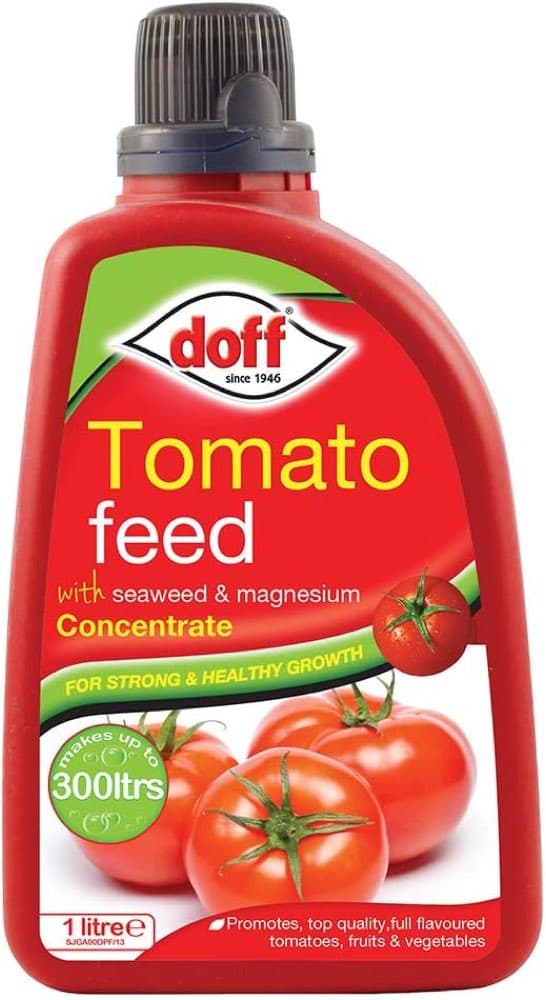
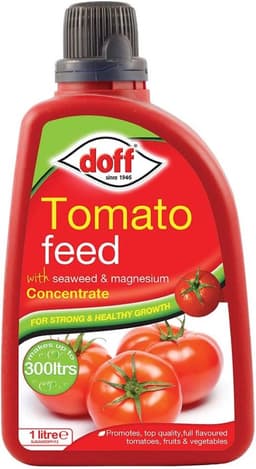
Doff's 1 litre concentrate gives the strongest balance of price, disclosed formula and usable coverage in this comparison. At £5.30, the listing says it makes 300 litres, or roughly 1.8p per made-up litre, and its bullets state NPK 4-5-9 with seaweed and magnesium. Doff's current website shows a different NPK, so the delivered label should take priority over either page. The 4.5-star line from 1,156 reviews is substantial, but the same count and review text appear across three Doff sizes and should be treated as one parent review block rather than three independent tests. Even with that caveat, this is the top pick for a greenhouse or several grow bags because the Amazon extract gives you more decision-useful information than most rivals. It is less attractive only if you specifically require an organic control-body claim.
Pros
Low £5.30 shelf price
Listing states NPK 4-5-9
Makes 300 litres according to the listing
Seaweed and magnesium named
Cons
Website and Amazon NPK differ
Review block is shared across multiple sizes
Best for: A greenhouse, several grow bags or frequent feeding where a low-cost concentrate is wanted.
Less suitable: Growers who require a named organic certification scheme.
This 2.5 litre Doff concentrate is built for volume: the listing promises up to 750 litres of made-up feed for £12.18, about 1.6p per litre at the stated maximum. That makes it the best-value pack on the displayed coverage figures for anyone who will use a large quantity. The difficulty is that its separate 466:1 mixing field does not reconcile cleanly with 750 litres, so you should follow the bottle rather than calculate a dose from the Amazon fields. No NPK is printed in this extract, and the 1,156-review line is shared with other Doff sizes. The large pack reduces repeat purchases but is unnecessary for a handful of patio plants. Its value case rests on coverage, not on a fully transparent formula.
Pros
Up to 750 litres stated coverage
Very low calculated cost per made-up litre
Large 2.5 litre concentrate
Cons
Mixing field conflicts with coverage
No NPK in this extract
Shared review block across Doff sizes
Best for: A busy greenhouse or many grow bags where the full 2.5 litres will be used.
Less suitable: A few pots or anyone who needs consistent online dilution figures before buying.
The 500 ml Doff bottle offers the lowest cash outlay in the comparison at £4.90 and may suit a very small collection of plants. Its mixing field says 1:300, but the extract does not state a made-up volume, so that figure still needs checking against the delivered label. The listed weight of 99.8 g cannot credibly describe 500 ml of a water-based liquid and should be ignored as a catalogue error. Its 4.5-star line from 1,156 reviews is shared with larger Doff sizes rather than proving this pack was reviewed separately. At £9.80 per litre of concentrate, it is much poorer bottle-value than the £5.30 1 litre pack. Buy it only when storage space or the smallest initial spend matters more than long-season economy.
Pros
Lowest shelf price in the set
Compact 500 ml bottle
Mixing field states 1:300
Cons
No made-up volume stated
Implausible listed weight
Poor value beside the 1 litre Doff bottle
Best for: One or two plants, limited storage or the smallest possible initial spend.
Less suitable: A greenhouse or anyone optimising cost over a full growing season.
Westland Big Tom packs a useful amount of specification into a £6 bottle: the model field states NPK 6-3-9.5 plus trace elements, and the listing names seaweed, magnesium and iron. That higher potassium figure makes the product easier to assess than feeds whose extracts omit an analysis. The 1 litre size is manageable for pots or a modest greenhouse without committing to a 4 litre pack. Its 4.4-star line is based on 57 reviews, the smallest review base among the straightforward concentrates here. The extract also omits a numeric dilution rate, so you cannot calculate its made-up cost from the Amazon page alone. It is a well-described formula, but you still need the bottle label before mixing.
Pros
NPK 6-3-9.5 stated
Seaweed, magnesium, iron and trace elements named
Competitive £6 shelf price
Cons
No numeric dilution in the extract
Only 57 reviews
Best for: Growers who want a clearly stated high-potassium analysis in a 1 litre bottle.
Less suitable: Anyone who wants to calculate cost per watering can before purchase.
Doff Pour and Feed removes the measuring step because the 3 litre bottle is already mixed and goes directly around the base of the plant. The amazon.co.uk extract says to use 2.5 caps every 4 to 7 days, while Doff's own page describes a 100 ml dose, so the bottle in your hand must settle the instruction. At £6.53 it looks inexpensive beside concentrates, but the whole pack provides only 3 litres of usable mix. Reviewers repeatedly note that it runs out quickly, which matters if you have a greenhouse rather than two or three patio plants. Seaweed and magnesium are named, although no NPK appears in the extract. It is a convenient choice for light use, not the economical option for a long season.
Pros
Ready to use with no dilution
Clear base-feeding format
Seaweed and magnesium named
Cons
Only 3 litres of usable mix
Amazon and manufacturer dose wording differs
No NPK in the listing extract
Best for: A few pots when you value convenience more than the lowest cost per feed.
Less suitable: A full greenhouse, grow-bag collection or anyone expecting a concentrate.
No. The listing says it is premixed. The dose is 2.5 caps at the base every 4 to 7 days.
Where does the listing say it is made?
The country field says China. A bullet says the feeds are proudly made in the UK.
How we compared
We compared twelve amazon.co.uk listings, their UK rating lines, stated NPK and dose fields, and the manufacturer pages named in the digest. Editorial scores reflect review-count confidence, specification, value, convenience and listing consistency. Shared Doff review text is treated as one parent block. The scores are not laboratory test results.
1
Amazon rating and review confidence
30%
We use the amazon.co.uk star line and review count, and we count a shared parent review block once rather than as separate product tests.
2
Specification
25%
A stated NPK, a clear feed format and an intelligible dose are the decision-useful details. Missing or conflicting figures reduce the score.
3
Value
20%
Value uses the stated made-up volume where the listing provides it, and the shelf price otherwise.
4
Suitability and convenience
15%
Pack size and a ready-to-use format are scored for the use the listing actually describes.
5
Listing consistency and safety
10%
Conflicting dilution or volume fields, implausible catalogue data and unclear pesticide details reduce the score.
Independent review
Last updated: October 2026
8 sources checked
Tomato fertiliser buying guide
Start with the plants in front of you, then the format. A concentrate suits a greenhouse. The ready-mixed 3 litre bottle suits a few pots and runs out quickly. Read any printed NPK and dose, then the made-up volume, and do not treat the shared Doff review count as three tests. An organic mark is a separate question from seaweed wording, and a bug spray in the parcel is a pesticide, not extra feed.
What is a tomato fertiliser?
A tomato fertiliser in this set is a liquid you dilute, or a bottle that is already mixed, with more potassium than a feed aimed at leafy growth. These twelve amazon.co.uk extracts are Doff, Levington Tomorite, Westland Big Tom, PowerGrow, Maxicrop, and a Topline parcel with an 800 ml bug spray. There are no granules.
Best for
Greenhouse and grow-bag growers who will dilute a concentrate
Buyers who need a named organic mark and will check the pack
Not ideal for
Allotment soil that is already enriched and does not need a weekly bottle
Anyone looking for granules or a bag of tomato compost
Mistakes to avoid
1
Treating the ready-to-use bottle as a concentrate
Doff Pour and Feed is already diluted. The 3 litre pack is the whole supply, and reviewers say it runs out. Do not measure it as if it were a concentrate that makes hundreds of litres.
2
Counting the shared Doff reviews three times
The 1 litre, 2.5 litre and 500 ml Doff files show the same 4.5 from 1,156 and the same review text. Treat that as one parent block, not three separate tests of each size.
3
Using the twin pack 1:10 field as the Tomorite dose
Levington's page says 20 ml in 4.5 litres. The 1:10 figure is what this twin-pack listing stores. It is not the same rate. Read the bottle, and do not double a dose to make a pack last.
What to weigh up
Format, NPK and dose
High
Format decides whether the bottle will last. A concentrate is the practical choice for a greenhouse or several grow bags, because you mix a small measure into a watering can. Doff Pour and Feed is the only ready-to-use bottle here: 3 litres at £6.53, poured at the base, and reviewers say it runs out quickly. Do not read that 3 litre pack size as 3 litres of concentrate.
The analysis is the next line to find. Big Tom prints NPK 6-3-9.5 on the model field.
Made-up cost and listing clarity
High
Value in this set is the shelf price divided by the made-up volume the listing actually states. On those figures, Doff 1 litre is about 1.8p per diluted litre and Doff 2.5 litre is about 1.6p, while Maxicrop is about 6p and the ready-to-use bottle gives you only the 3 litres in the pack. Printed make-up volumes here land around 2p to 7p per diluted litre. That is a rule of thumb from these extracts, not a price survey, and the prices move.
Which option suits you?
Three typical situations, each with a recommendation from this comparison.
🏡
Greenhouse or grow-bag grower
You feed containers through the season and need a concentrate with a stated analysis. Doff Tomato Feed 1 L lists NPK 4-5-9 and 300 litres from 1 litre at £5.30. The 1,156-review line is shared with the other Doff sizes, and the website NPK differs, so use the bottle.
You have a few pots and would rather pour than measure. Doff Pour and Feed is already mixed, at £6.53 for 3 litres, with 2.5 caps at the base every 4 to 7 days. Reviewers say it runs out quickly, and the extract prints no NPK.
You want a named organic scheme, not seaweed wording on its own. Maxicrop's bullets say OF&G, and the listing says up to 200 litres from 1 litre at £11.99. A Soil Association line also appears, so read the mark on the pack.
Which tomato fertiliser is the top pick in this comparison?
The top pick is Doff Tomato Feed 1 L. At £5.30 the amazon.co.uk bullets state NPK 4-5-9, with seaweed and magnesium, and say 1 litre makes 300 litres, about 1.8p per diluted litre if that coverage holds. The 4.5-star line from 1,156 reviews is shared with the other Doff sizes here, so it is one parent review block. Doff's website currently shows a different NPK. Use the bottle. This comparison of listings is not a laboratory test.
How much does tomato fertiliser cost?
Shelf prices in these amazon.co.uk extracts run from £4.90 for Doff 500 ml to £20.99 for the Topline bundle. Entry bottles include Doff 1 litre at £5.30, Westland Big Tom at £6.00 and Doff Pour and Feed at £6.53. Mid-range listings include Tomorite 1 litre at £7.45, Maxicrop at £11.99 and Doff 2.5 litre at £12.18. Prices move. Compare diluted litres with bottle litres before you treat a low shelf price as the cheaper feed.
Should I buy a concentrate or a ready-to-use tomato fertiliser?
Choose a concentrate for a greenhouse full of plants. Doff Pour and Feed, 3 litres at £6.53, is already mixed, and reviewers say it does not last. The Amazon extract says 2.5 caps at the base every 4 to 7 days. Doff's own page describes a 100 ml dose, so follow the bottle you receive. Do not treat that pack as a concentrate.
What NPK should a tomato fertiliser show?
These liquids are meant to supply more potassium than a leafy-plant food. Big Tom's model field is NPK 6-3-9.5. Tomorite listings and the Levington page say NPK 4-3-8. Doff's 1 litre Amazon bullets say NPK 4-5-9, while Doff's website currently says NPK 4-2-10. The 2.5 litre Doff extract does not print an NPK, so do not copy the 1 litre figure across. PowerGrow prints no NPK. Use the analysis on the bottle in your hand.
Will tomato fertiliser fix blossom end rot?
No. The RHS describes blossom end rot as calcium missing in the fruit after uneven watering, not as an empty compost bag and not as a reason to change bottle. Do not rely on a foliar calcium spray, and do not expect a new feed to save fruit that is already marked. Water evenly and feed moist compost. The bag the plants grow in is a different purchase, covered in the tomato soil comparison.
Is Maxicrop certified organic?
The amazon.co.uk bullets say Maxicrop is approved for organic growing by OF&G. The same listing also contains a Soil Association line. Do not treat the two names as the same certificate, and do not call the product Soil Association certified from a retailer page. Seaweed named on other bottles is not an organic mark. Read the control-body wording on the pack before you rely on it.
Is the Topline bundle only fertiliser?
No. Topline at £20.99 is two 1.2 litre bottles of seaweed tomato feed plus an 800 ml ready-to-use bug spray. The listing says fruit and vegetables can be picked 24 hours after spraying and should be washed. No MAPP number is printed, and this comparison does not treat the spray as checked on the HSE database. Follow the pesticide label. Buy the bundle only if you need both products, and keep the bottles away from children.
How often should I feed tomatoes in containers?
The RHS says feed containers every 10 to 14 days with a high-potassium liquid once the first fruits swell. Levington's guidance starts at the first truss under glass and the second truss outdoors. Soil that already has manure may not need a weekly bottle. Do not feed before a truss has set, and do not double the dose. If a child or a pet has swallowed feed or spray, call a vet or NHS 111 with the label.
Our verdict
A useful tomato fertiliser in this set is a liquid with a stated NPK or a dose you can follow, and a made-up volume you can set against the shelf price. Doff Tomato Feed 1 L is the top pick: the listing states NPK 4-5-9, 300 litres from 1 litre, and £5.30, with the shared 1,156-review line treated as one parent block. Doff Tomato Feed 2.5 L is the best-value pack on up to 750 litres at £12.18, although the 466:1 mixing field does not match and this extract prints no NPK. Enriched soil may not need a bottle, and blossom end rot is a watering problem, not an empty feed.
UK product comparisonsAmazon listing analysisPublic-source research
Products Compared publishes British-English buying guides based on amazon.co.uk listings and public UK sources. We do not run a lab and we do not invent test scores.
Updated: October 2026
8 sources checked
Guides to tomato fertilisers
Guides on what to look for, how to use a product, and common mistakes.
This article contains affiliate links. If you buy a product through one of these links, we may earn a small commission at no extra cost to you. Our editorial assessment remains independent and is based on amazon.co.uk listing data, customer-review evidence and public UK sources. We did not conduct a laboratory test.