Independent comparisons. We may earn from shop links. More info

All Purpose Fertiliser Buying Guide: What to Check Before You Buy

Updated: October 2026

This all purpose fertiliser buying guide puts the decisions in order: whether you need a feed at all, what the numbers on the label mean, which form suits your pots or beds, and how far to trust a price per litre. It uses the six amazon.co.uk listings we compared on 15 October 2026, and it does not crown a winner. For the six-row table of prices and stars, go to the [universal fertiliser comparison](/hub/fertiliser-soil-and-bark-mulch/universal-fertiliser). We did not run a lab test. A qualifying purchase can earn a commission at no extra cost to you.

This all purpose fertiliser buying guide puts the decisions in order: whether you need a feed at all, what the numbers on the label mean, which form suits your pots or beds, and how far to trust a price per litre.

Our top picks

On this page

Start with the job, not the bottle

Before you compare anything, ask whether your plants need feeding. The RHS says plants in open ground, in soil with reasonable organic matter, often need little routine feed, so a general feed is a top-up rather than a weekly habit. Containers are different, because the compost holds only a limited store of nutrients and your watering washes some of it out. That gives you three starting points. A basket or tub you water by hand suits a liquid. A patio pot you will not feed weekly suits a coated or slow-release granule mixed in at planting. A dug bed or border suits ordinary granules scattered on the surface. If your soil is already in good heart and your plants look healthy, the honest answer may be to buy nothing yet.

Read the numbers, including 7:7:7

The label matters more than the title. Fertiliser labels give three numbers in a fixed order: nitrogen (N), phosphate (P2O5) and potash (K2O). The RHS explains that these are oxide figures, so a 7:7:7 Growmore-type feed is about 7% nitrogen, 3.1% phosphorus and 5.8% potassium once you convert to the elements. It leans towards nitrogen. Two Miracle-Gro products show why you must not swap recipes by brand name. The all-purpose concentrated liquid in this set, model 121175, is declared on the brand's label as 7-3-5. The soluble powder the RHS cites near 24–3.5–13.3 is a different product altogether. GOV.UK guidance on marketing fertilisers tells you to look for a declaration, so if a listing prints none, the pack in your hand is where you get the figure. The Goulding and Westland Boost listings print no NPK, and neither do the Miracle-Gro listings. Only the Doff bottle shows a clean model field of 7:7:7, and the Topline field is disputed.
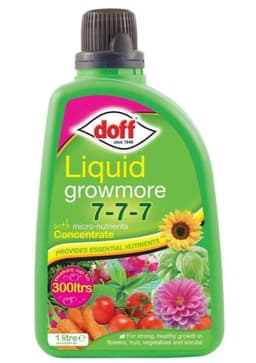
Doff Doff Liquid Growmore 1 L

Testsieger

Doff Doff Liquid Growmore 1 L
7.6/10about £6.55

Liquid, coated granule or ordinary granule

The six listings fall into three patterns. A liquid concentrate, such as the Miracle-Gro twin pack at £7.98 or the Doff bottle at £6.55, acts quickly and stops quickly, so you measure it into a can every week or two. A coated granule, such as Miracle-Gro Continuous Release at £11.94 for 1.8 kg, meters out nutrients over a season, and the listing claims one spring application. Ordinary granules, such as the Topline 8 kg tub, are a bed tool that you scatter every four to six weeks from February to the end of October. Slow release is where buyers get caught. Goulding and Westland Boost both claim about six months, yet nothing on the listings shows they use the same coating as Miracle-Gro. Treat the claim as a claim until the pack says more. If the choice between a watering can and a mix-in tub is the real question, our liquid vs granular fertiliser page goes through it case by case.

Price per litre is not a reason on its own

Shelf arithmetic is useful but easy to misread. The Topline tub works out at about £3 per kilogram, the lowest in the set, but 8 kg is a lot of feed for a few pots, and the amazon.co.uk analysis field says 20:20:20 while a UK reviewer says the pack reads 7-7-7. Until that is settled, do not assume the stronger figure. Price per kilogram also tells you nothing about cost per pot. Choose the form that matches your habit first, then use price to separate two products that do the same job. Our best universal fertiliser page names a top pick with conditions, and the how to use all-purpose fertiliser page covers dose and timing.

Common questions

Do you need an all-purpose feed if you already add compost?
Often you need less of one. The RHS says open ground with reasonable organic matter may need little routine feeding. Containers are different, because the nutrients in the compost run out sooner, and peat-free compost often needs feeding earlier. Check the plant and its growth before you buy.
What should you read on the label before the title?
Read the declared nitrogen, phosphate and potash figures, always in that order, then the pack size and the form. Titles such as universal or balanced are marketing words, whereas the declaration tells you what the product actually supplies. If a listing prints no figures, check the pack when it arrives.
Why is 7:7:7 not an equal diet?
The figures are oxides. The RHS gives the elemental equivalent of 7:7:7 as roughly 7% nitrogen, 3.1% phosphorus and 5.8% potassium, so nitrogen is the largest share. That is why a 7:7:7 feed suits growth and leaves better than a high-potash feed meant for fruit and flowers.
When is a liquid the wrong form?
A liquid is the wrong form when you will not remember to measure it on a regular schedule. It acts fast but runs out quickly, so a basket you forget will starve. A coated or slow-release granule mixed in at planting suits that habit better.
When is an 8 kg tub too much?
When you are feeding a few pots. The Topline tub has a low price per kilogram, but a patio uses a small amount, and reviewers report split tubs and spilled granules. It suits beds, borders or a vegetable plot where you will actually use it over a season.
What should you do if the listing and a review disagree on the analysis?
Trust the pack, not either source. The Topline listing field says 20:20:20, but a UK reviewer says the pack reads 7-7-7. Until the declaration is confirmed, do not assume the higher figure, and keep to the rate printed on the tub you receive.

Related pages

Sources

Public UK and manufacturer sources used for this comparison; last accessed 15 October 2026.

  1. RHS: Fertilisers (retrieved 15 October 2026)
  2. RHS: Nutrition and feeding plants (retrieved 15 October 2026)
  3. RHS: Fertiliser labels explained (retrieved 15 October 2026)
  4. GOV.UK: Manufacturing and marketing fertilisers (retrieved 15 October 2026)
  5. The Fertilisers Regulations 1991 (retrieved 15 October 2026)
  6. Miracle-Gro All Purpose Concentrate label 121175 (retrieved 15 October 2026)
  7. Which?: Controlled-release fertilisers (retrieved 15 October 2026)
  8. NHS: Poisoning (retrieved 15 October 2026)