Independent comparisons. We may earn from shop links. More info

All Purpose Fertiliser for Vegetables: When a General Feed Is Enough

Updated: October 2026

The question is whether an all purpose fertiliser for vegetables will carry the season, or whether you need to switch bottles once the crops start to fruit. A general feed does a sound job for leafy crops and early growth, but fruiting crops usually need a different balance later. This page follows that crop stage, using six amazon.co.uk listings and public RHS and Which? advice, and it leaves dilution to the [how to use all-purpose fertiliser](/hub/fertiliser-soil-and-bark-mulch/universal-fertiliser/sub/universal-fertiliser-how-to-use) page. Prices and stars sit on the [universal fertiliser comparison](/hub/fertiliser-soil-and-bark-mulch/universal-fertiliser). We did not run a lab test. A qualifying purchase can earn a commission at no extra cost to you.

The question is whether an all purpose fertiliser for vegetables will carry the season, or whether you need to switch bottles once the crops start to fruit.

Our top picks

On this page

Beds and pots are not the same job

In open ground, a vegetable bed is usually fed with granules before planting and topped up on a calendar. The Topline Growmore listing names flowers, vegetables, fruit trees and shrubs, and says to apply every 4 to 6 weeks from February to the end of October as a base dressing or top dressing. It gives no grams per square metre, so you need the pack for a rate. Do not carry Westland's gram rate across to Topline. Pots and grow bags work differently, because the compost holds less and watering flushes nutrients out. For container vegetables the RHS advises steady watering and a general-purpose liquid about every two weeks. That is a container interval, not a rule for every bed. A bed that has had compost dug in may need much less, and the interval says nothing about the strength of your particular bottle.

Leafy crops can stay on a general feed

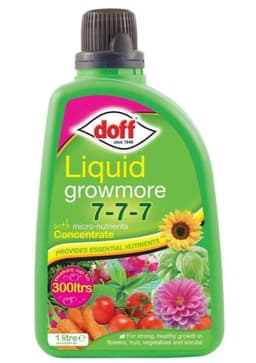
Lettuce, spinach, chard and other leafy crops want plenty of nitrogen, and a Growmore-style feed leans that way. The RHS explains that a 7:7:7 label works out at roughly 7% nitrogen, 3.1% phosphorus and 5.8% potassium, so it is not an equal split of the three elements, and the nitrogen share is the largest. For a crop you pick for its leaves, that suits you. For a crop you want to set fruit, it is less useful later. Several listings in this set are used this way by buyers. Doff Liquid Growmore is described by its buyers as used for years on vegetables and hanging baskets, although the bullets only say all plants. These are buyer reports rather than trials, so treat them as signs that the feeds work in a small garden, not as a rate.
Doff Doff Liquid Growmore 1 L

Testsieger

Doff Doff Liquid Growmore 1 L
7.6/10about £6.55

Fruiting crops need a different balance later

Tomatoes, peppers and courgettes are the point at which you change bottle. Which? says tomato feeds are higher in potassium, which supports flowering and fruit, and that they should not be used on seedlings. The RHS likewise treats fruiting crops as a separate feeding job, about every two weeks with a liquid. A general feed can start the plants off, and a general liquid at a low dose suits young plants: Miracle-Gro's label gives a quarter cap per litre for small or young plants. It is not a replacement for a higher-potassium feed once the fruit is swelling. The Westland Boost listing claims high potassium for flowering and fruit, but it prints no NPK, so you cannot verify it. The Topline tub names vegetables and has a disputed analysis field. We have not tested any of these as tomato foods, and our site does not rank them as one.

Stop on the calendar, not when the bottle is empty

The RHS says not to fertilise after September, because late feeding encourages soft growth. For a vegetable plot that usually means feeding fruiting crops through summer, easing off as the season ends and not topping up out of habit. Overfeeding also carries a risk: one Doff buyer warns that too much can harm plants. Stay with the measure on the bottle rather than guessing a stronger mix. Once you know which stage your crop is at, the next question is form. Our liquid vs granular fertiliser page compares watering-can feeds with mix-in and scatter granules, and the best universal fertiliser page covers who each of the six suits.

Common questions

Can you use an all-purpose feed on vegetables at all?
Yes, for leafy crops and early growth. Miracle-Gro's label covers fruits and vegetables at its all-purpose dilution, and the Topline listing names vegetables. For fruiting crops such as tomatoes, a higher-potassium feed is usually the better tool once the fruit has set.
How often should you feed vegetables in pots?
The RHS advises a general-purpose liquid about every two weeks for container vegetables, with steady watering. That is a guide for pots, not for beds. Always follow the dilution on your own bottle, because strengths differ between brands.
When do tomatoes need a different bottle?
When flowers and fruit appear. Which? says tomato feeds are higher in potassium, and the RHS treats fruiting crops as a separate feeding job. Until then, a general feed at a low dose can cover young plants.
Are leafy salads on the same feed as courgettes?
Not for long. Leafy salads suit a nitrogen-leaning general feed, while courgettes are a fruiting crop and move to a higher-potassium feed later. Start both on a general feed if you wish, then switch the courgettes.
Does the Topline tub state a gram rate for beds?
No. The listing names vegetables and gives a 4 to 6 week calendar from February to the end of October, but prints no grams per square metre. Follow the rate on the tub you receive, and do not use Westland's 135 g figure.
Can seedlings take a strong general liquid?
No. Which? says tomato feed should not be used on seedlings, and Miracle-Gro's label gives only a quarter cap per litre for small or young plants. Use the weakest dose on the pack, on moist compost.
When do you stop feeding the plot?
The RHS says not to fertilise after September, because soft growth does not harden before winter. Plan your last feed for late summer, and do not keep feeding just because there is feed left in the bottle.

Related pages

Sources

Public UK and manufacturer sources used for this comparison; last accessed 15 October 2026.

  1. RHS: Fertilisers (retrieved 15 October 2026)
  2. RHS: Nutrition and feeding plants (retrieved 15 October 2026)
  3. RHS: Fertiliser labels explained (retrieved 15 October 2026)
  4. GOV.UK: Manufacturing and marketing fertilisers (retrieved 15 October 2026)
  5. The Fertilisers Regulations 1991 (retrieved 15 October 2026)
  6. Miracle-Gro All Purpose Concentrate label 121175 (retrieved 15 October 2026)
  7. Which?: Controlled-release fertilisers (retrieved 15 October 2026)
  8. NHS: Poisoning (retrieved 15 October 2026)